Keep These Glove Selection Issues in Mind
If there is any doubt about the quality or completeness of the protection being offered, remove the glove immediately and use another glove for the application.
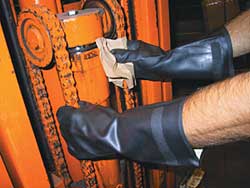 SAFETY is a key concern for many companies, and so many businesses make substantial investments in various forms of protective apparel and equipment for the eyes, head, hands, arms, and feet. This article will focus on the factors to consider when selecting hand protection for a particular task. It is important to note no glove material is suitable for each application, and no method will provide protection for an extended period of time.
Sizing of the Glove
A glove that is either too large or too small will lead to discomfort, a poor grip, and less protection. Workers are not likely to continue wearing a glove they find uncomfortable. A glove that is too tight can restrict circulation and reduce flexibility; a glove that is too large will not provide the worker with a strong grip and may cause him/her to become caught in machinery.
Material
As discussed above, there is no glove material best suited for every application. Each material has specific properties that make it ideal for certain applications and ineffective for others.
Before selecting a glove to use for a specific task, check the manufacturer's chemical guide in order to see which material is recommended for the particular substance or compound being handled. If there is not enough information provided in that table, contact the manufacturer directly. It is best to receive a sample of the glove in advance in order to ensure it will, in fact, stand up to the chemical(s) being used.
Upon receiving the sample, try dipping it in the liquid. Do not put your hand in the glove when testing, in case the glove is not suitable for that application and does not offer adequate protection.
Latex Sensitivity/Allergy
Some people are allergic or have sensitivities to latex. For them, even a minute quantity of latex protein from a glove, balloon, rubber band, or other common item containing latex may be sufficient to yield an allergic reaction, ranging from a mild rash or redness to potentially fatal anaphylactic shock.
Exposures can take place while wearing the glove, but also upon the doffing of a glove by another individual. Latex proteins can become caught on the powder that is released into the air when the glove is removed from the dispenser or hand, landing on or being inhaled by an individual with the allergy or sensitivity. Many medical facilities have banned the use of latex gloves, particularly the powdered variety, partly because of this situation.
In order to reduce the risk of a reaction in facilities where latex is not banned, individuals with latex allergies may find it useful to carry around non-latex gloves --either nitrile or vinyl--for their doctors, dentists, or other professionals to use during their examinations.
The U.S. Food and Drug Administration has conducted investigations and believes latex proteins can be transferred to customers through food handled with latex gloves during preparation. Some states, including Oregon and Rhode Island, have begun to restrict or prohibit the use of latex gloves in food service establishments.
Glove Thickness
Thicker gloves often offer superior protection and resistance to their thinner counterparts. The thicker the glove is, however, the more difficult it is for the wearer to handle and work with small pieces. Flexibility and touch sensitivity are reduced, making it more difficult to maintain a strong grip on small items and to move fingers in order to complete the task.
Lightly Powdered/Powder Free
Disposable gloves are available in both lightly powdered and powder free styles. The powder assists in facilitating the donning of the glove. In powder free gloves, a chlorination process designed to make the glove smoother will have a similar effect. People with sensitive skin or who use powdered gloves often and/or for hours at a time may experience dry skin or some redness.
Color
Color plays a key role for some applications. Sometimes pieces of a glove fall into food or other material being processed or prepared. While clear gloves can be used for many of these applications, a brightly colored glove is more visible to the eye and can be removed more easily from the substance.
Cuff Style
Different cuff styles are available to meet the specific requirements of a variety of applications. Slip-on cuffs are suitable when easy donning and doffing of the glove is required, and the individual is not placing her hand in chemicals or liquids that could potentially be harmful if they come into contact with the skin.
Knitwrist cuffs provide a firmer hold on the hand. They are not suitable for use with chemicals but can be used with non-abrasive materials.
Safety and gauntlet cuffs offer the wrist superior protection from cuts and nicks. These cuffs can be reinforced with rubber.
The standard length of a safety cuff is 2 to 2 1/2 inches; gauntlet cuffs are typically 4 to 4 1/2 inches long. The additional length of a gauntlet cuff allows the glove to offer protection to a larger portion of the arm.
In some instances, the length of the glove and/or the cuff style will still be insufficient to offer the level of protection required. Sleeves manufactured from vinyl or polyurethane, for example, can be used in those applications.
Application
The nature and duration of the application will affect which glove will be most appropriate for the job. Questions to consider include the following: Will the task be performed in a very hot or cold environment? Does the task involve touching very hot or cold items? What is the key focus--protecting products from dirt and smudges; food from dirt, germs, and bacteria; or hands from sharp, toxic, or otherwise dangerous substances? Will chemicals be used? If so, which one(s)? Will the glove be used for a medical examination or for general industrial work?
Reusability
After some applications, including medical examinations and bloodwork, gloves must be disposed of very carefully, immediately after removal, in order to prevent the spread of pathogens or toxic liquids. Gloves used in other situations, such as those made from cotton and leather, can be reused until they wear out. Many of them can be washed between uses.
While selecting the most suitable glove is critical, it is also very important to pay careful attention before donning or during use to tears, holes, or thinning of material that may be in the glove. If there is any doubt about the quality or completeness of the protection being offered by the glove, remove it immediately and use another glove for the application.
Cost
Gloves can vary widely in cost depending on many factors, including quality and glove thickness. For applications where only minimal protection is required, a relatively inexpensive, lower-quality glove may be sufficient. When a task involves the use of harsh chemicals, toxic liquids, or blood, a higher level of protection would be required. In these cases, the selected gloves must offer a superior level of protection.
It is crucial not to try to cut costs when it comes to protection. Using gloves that do not offer sufficient protection (given the application) can yield severe or even fatal results.
Conclusion
Considering these 10 factors will help a company determine which glove will allow workers to perform their tasks as safely as possible. If there are still questions remaining, don't hesitate to contact manufacturers and ask as many questions as necessary until the answer received is satisfactory. Gloves are used primarily for the safety of the individual; ensure this fact is always in mind when selecting hand protection.
This article originally appeared in the January 2004 issue of Occupational Health & Safety.