The Hidden Hazards Lurking in Oil and Gas Work
Asbestos and NORM exposures remain a persistent risk in maintenance and aging infrastructure. Proper hazard identification and advanced PPE strategies are critical to protecting workers in complex, multi-hazard environments.
- By Kevin Endres, Ph.D., Mark Tartaglia, Steve Mata
- May 27, 2026
Introduction
The oil and gas industry is known for high-energy hazards like flash fires, chemical splash, and extreme temperatures, which shape most PPE programs. Yet equally serious risks often arise quietly during routine maintenance, retrofits, or work on aging infrastructure. Among these hidden dangers, asbestos and Naturally Occurring Radioactive Material (NORM) continue to surface in modern operations, posing significant health risks when not properly controlled.
Unlike fire or chemicals, these hazards are microscopic. Workers cannot see the fibers or particulates that pose danger, making hazard identification and PPE selection foundational to worker protection. Understanding how asbestos and NORM behave, and how apparel must respond to them, is essential for creating safe, compliant, and effective PPE programs.
The “Unexpected” Side of Oil & Gas Hazards
While flash fires dominate attention, legacy materials and soil contaminants often present risks during groundbreaking and maintenance activities. Workers may encounter:
- Asbestos during excavation, insulation removal, cutting gaskets, equipment retrofits, or disturbing older fireproofing materials.
- NORM when cleaning pipe scale, tank sludge, produced water systems, or decommissioning contaminated equipment.
These hazards demand specialized knowledge because their exposure pathways differ from typical process risks. Asbestos becomes dangerous when fibers become airborne, while NORM exposure is driven primarily by contaminated soil, dust, and surface contact. Without proper particle protection, these microscopic contaminants can cling to work clothes and be unknowingly transported home, creating a serious take-home toxin risk for family members. Both hazards emphasize the need for dedicated particulate protection, which flame-resistant (FR) garments alone cannot provide.
Unexpected Hazards Explained and Required Protective Apparel Considerations
Asbestos
Asbestos was widely used in refineries, petrochemical plants, and midstream facilities for its heat resistance and durability and still remains in older insulation, gaskets, packing, and fireproofing. OSHA regulates asbestos in general industry under 29 CFR 1910.1001, which defines asbestos, establishes regulated areas, and outlines exposure controls. When insulation or gaskets are disturbed, microscopic fibers become airborne; OSHA defines an asbestos fiber as a particle 5 micrometers or longer with a 3:1 length-to-diameter ratio, underscoring how easily such fine particles can penetrate inadequate garments.(1)
Protective garments for asbestos must provide:
- High-performance particle barriers, capable of blocking asbestos fibers
- Seam designs that prevent particulate intrusion, since seams often leak more than fabric
- Durable fabric with excellent abrasion resistance, tear resistance, and strength to prevent particle penetration during work usage.
NORM (Naturally Occurring Radioactive Materials)
NORM is also common in oil and gas operations, as radium-bearing formation water can deposit radioactive scale inside pipes, valves, tanks, and separators. When these systems are opened for cleaning or maintenance or when ground is disturbed, radioactive particulates may become airborne or contaminate workers’ clothing and skin. OSHA classifies NORM as a source of ionizing radiation under 29 CFR 1910.1096, requiring employers to protect against exposure, which requires garments trusted to protect against dermal contact with radioactive dust (2).
Protective garments for NORM must offer:
- Strong particulate filtration against fine radioactive dust
- Compatibility with disposable contamination control practices
- Clear understanding of limitations; apparel provides particulate protection, not radiation shielding
These apparel decisions must align with contingency plans for contaminated waste handling and decontamination practices.
Don’t Compromise Protection: Hazard Identification and Risk Assessment Matter
PPE is the last line of defense, and that defense must reflect all hazards present, not just the most familiar ones. Oil and gas maintenance tasks rarely involve a single risk; workers could simultaneously face:
- Flammable vapors
- Asbestos fibers
- NORM contaminated particulates
- Heavy metal dust
- Sharp, abrasive surfaces
OSHA requires employers to conduct hazard assessments under the General Industry Standards (OSHA 1910.132) to ensure PPE selection matches each exposure scenario (3). Multi-hazard environments can create common PPE gaps:
- Protective garments for particles without FR performance in flammable areas
- FR garments without particulate barriers during asbestos or NORM work
- Poor seam design that undermines barrier effectiveness
To address these gaps and provide adequate protection against particulate hazards where flash-fire risks are present, secondary flame-resistant (SFR) garments must be worn in addition to primary FR garments. When worn over primary FR clothing, they add particulate protection, chemical splash protection (depending on the fabric and design), and maintain FR performance of the underlying layer.
SFR garments also follow the principle of “do no harm”, meaning they must not compromise or interfere with the FR properties of the primary FR. For asbestos and NORM work occurring inside processing areas, SFR garments eliminate the dangerous choice between barrier protection and flame resistance.
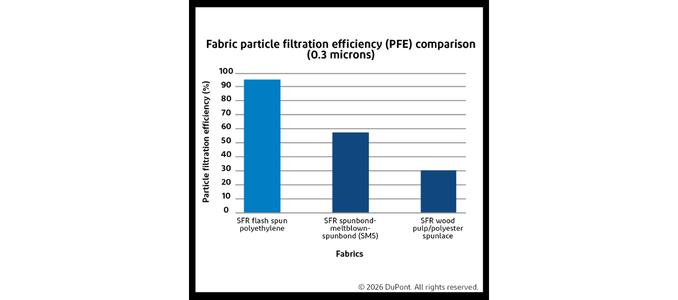
Particle Filtration Efficiency (PFE) is a critical measure of how effectively a garment blocks hazardous particulates like asbestos fibers, NORM-contaminated dust, and heavy metal particles like lead. Since protective fabrics vary widely in filtration performance, safety professionals can assess fabric particle-barrier effectiveness using PFE data. This data provides a percentage value for a specific particle size or particle size range typically in the hundreds of nanometers size range to micron size range.
Oil and gas work is also physically demanding, and protective apparel must maintain integrity against long shifts in harsh conditions, abrasive surfaces and sharp edges, heat and moisture, and mechanical stress.
Important garment features include:
- Durable, tear-resistant fabrics that maintain performance under stress
- Comfortable, ergonomic design; fabric that minimizes heat stress impact
- Reinforced seams that prevent particulate ingress
- Storm flaps and secure closures that maintain a full barrier seal
A garment that fails mid-shift does more than inconvenience the worker; it reopens exposure pathways to hazards that the apparel was specifically chosen to help prevent against.
Conclusion
Hidden hazards like asbestos and NORM continue to pose serious risks in oil and gas operations, particularly during maintenance and work on aging infrastructure where exposures are often unexpected and invisible. Effective protection depends on accurate hazard identification and the selection of garments with proven particle barrier performance, robust construction, and compatibility with flammable environments. By incorporating metrics such as particle filtration efficiency, durable garment design, and secondary flame-resistant solutions where needed, safety programs can close common PPE gaps, reduce take-home contamination risks, and better protect workers in the complex, multi-hazard conditions that define modern oil and gas operations.
This article originally appeared in the June 2026 issue of Occupational Health & Safety.