"Unprotected trenches can become deathtraps in an instant when cave-ins occur," said Richard S. Terrill, OSHA's regional administrator in Seattle.
"Employers should not assume this [combustible dust] hazard is minor or non-existent. Addressing it requires ongoing attention and effort, but proper precautions can prevent or minimize the possibility of a devastating explosion or fire," said William Coffin, OSHA's area director for Maine.
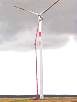
Acciona Energy, a Spanish company whose North American subsidiary has several U.S. projects under way, announced March 9 it has signed a deal to build three wind farms in the Mexican state of Oaxaca with 204 of its turbines providing 306 MW of total capacity. New equipment for servicing turbines is arriving, too.
If energy-saving construction were a poker game, the Department of Energy made a large bet March 5 by offering a conditional commitment for a $72 million loan guarantee to SAGE Electrochromics Inc. of Faribault, Minn.
"Employers whose businesses have injury and illness rates this high need to take immediate steps to protect their workers," said OSHA head Dr. David Michaels.
Rick Marinelli joined FAA in 1992 and now serves as manager of its Airport Engineering Division, responsible for programs relating to runway and taxiway geometry, airport airspace analysis, airport winter operations, design standards for airport facilities and equipment, airport pavements, airport lighting and electrical systems, and airport safety data.
“Hot work around flammable gas or vapor is one of the most common causes of worker deaths that we see at the Chemical Safety Board,” said CSB Board Member William B. Wark.
The agency's investigation substantiated the employee's complaint that his job duties were systematically removed and his paychecks were delayed and ultimately stopped after he questioned the accuracy of several statements made in the company's SEC filings.

Pressure on the industry to achieve a zero risk level is wrongheaded because it is not attainable in the real world, Dale Klein, a Nuclear Regulatory Commission member, told attendees Friday in Raleigh, N.C., at the Grand Challenge Summit 2010.

"One may think that fingersticks are selected more frequently because they cost less; however, that isn't necessarily true," says white paper author Richard Penington. "Likewise, some believe that the venous blood draw gives results that are more accurate because the blood is sent to a lab for testing. That's also not necessarily true."
Under a pair of 50/50 joint ventures with Husky Energy, BP operates the 91-year old Toledo Refinery near Toledo, Ohio, that processes crude from Canadian oil sands into gasoline and other products.
The new guidance does away with the old Survey Type 1, 2, and 3, replacing those with the more comprehensive Management Survey and Refurbishment and Demolition Survey.

This year's Patient Safety Awareness Week has the tagline "Let's Talk: Healthy Conversations for Safer Healthcare."
Among the most significant challenges facing the river is the runoff of excess nutrients from manure and commercial fertilizer, specifically nitrogen and phosphorus.

A safety culture in shambles is what Peter Rogoff said exists inside the Washington Metropolitan Area Transit Authority, but he put it more nicely when he said its Safety Department "has been dysfunctional and ineffective."
Among the products considered most likely to lead to the danger of an explosion or fire are zinc and other metallic powders, wheat flour and other food products, and certain plastics and resins. In all of these cases, if unprotected, normal processing steps can produce enough static electricity to ignite a dust cloud.
Secretary Steven Chu listed them in a Feb. 2 letter to John E. Mansfield, vice chairman of the Defense Nuclear Facilities Safety Board.
Specifically, the agency found instances of improper transfer and storage of flammable liquids; lack of specific lockout/tagout procedures and training to prevent the unintended startup of machines during maintenance; lack of hearing protection; inadequate respirator training, fit-testing, medical evaluation, inspection, and maintenance; unguarded grinders; and more.
Technologies have radically changed our lives, but our environments haven't kept up the same pace to ensure a healthy and productive workplace.
Think that companies only suffer cumulative trauma disorders (CTDs) to their workers' backs, arms, and shoulders? Arguably, most professionals think of CTDs as physical problems — usually, strains and sprains. We explain in our injury-prevention work these ergonomic issues are like metal fatigue, akin to repetitively bending a piece of steel. One or a few creases may seem insignificant, but multiple bends can weaken, then eventually break, even the strongest superalloy. In the same vein, strawthat- broke-the-camel's-back leadership problems can contribute to organizational breakdown.