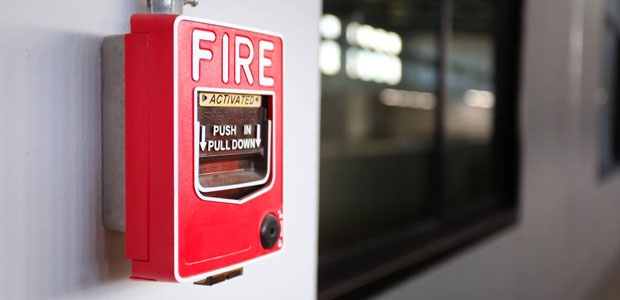
Fire detection systems are designed to discover fires early in their development when time will still be available for the safe evacuation of occupants. Early detection also plays a significant role in protecting the safety of emergency response personnel. Property loss can be reduced and downtime for the operation minimized through early detection because control efforts are started while the fire is still small.
The leader of any organization is the safety officer, the head of the organization. Managers and supervisors are safety officers for their respective units and are directly responsible for protecting the resources entrusted to them. Safety must be the core value. However, the predicament is how to effect a value system among individuals—each having his or her own that may already be set in stone. We must realize that not all of our beliefs are the same beliefs others hold. Each of us sees the world differently, and we cannot expect to believe that all will respond the same.
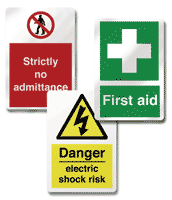
The best way to manage on-thejob hazards is to make sure every step is taken to avoid them. One way to help prevent accidents is by utilizing a safety signage program to keep employees informed and educated about possible hazards, company procedures, and general safety tips.
DHS issued new guidelines after months of discussions prompted by 362 arrests in New Bedford, Mass., last March.

It's meant to fill a knowledge gap, identified as the NFPA 720 standard was expanded this year, about how carbon monoxide moves inside buildings.
The program's goal is to ensure that any individual who has unescorted access to secure areas of port facilities and vessels has received a thorough background check and is not a security threat.
Ninety days of notice would be required, not 60, whenever 50 or more employees (including part-timers) at a single job site are laid off.
OSHA has long required employers to evaluate the workplace for electrical hazards. Most companies are familiar with possible shock hazards and know that OSHA requires all qualified workers be properly trained to work on or near electrical equipment. However, many safety managers are unaware that OSHA also requires so-called unqualified personnel to be trained to recognize and avoid electrical hazards.
Catalytic Leaders work to perceive what's really going on, rather than stumbling, eyes obscured by outdated information or by their own or others' biases. They don't persist with diminishing return strategies or ignore fixes that may be "different."
To help ensure that hazardous chemicals are used and handled safety in the workplace, OSHA created the Hazard Communication (HazCom) standard, 29 CFR 1910.1200, in 1994. The standard requires employers to create a program to properly handle hazardous chemicals in their workplaces.
Safety directors at oil refineries today are required to keep up to date with an ever-increasing list of regulations from a number of sources. State and federal regulations govern everything from the maintenance of equipment to training of operators, and new regulations are proposed continuously.
WHILE many new topics are addressed in the ANSI Z359 family of fall protection standards--which was available for purchase in late August and takes effect Oct. 15--one of the critical concepts presented is certified and non-certified anchorages for fall protection systems.
Recovering from a disaster is never easy, whether it's a hurricane, tornado, earthquake, fire, flood, or thunderstorm. These events have the potential to cause loss of equipment, power failures, non-functioning communication systems, and missing or otherwise preoccupied personnel.
THE night he fell, Gary was working as a line cook at the signature restaurant of a newly opened, 5-star resort hotel. With more than 10 years of experience in restaurants, he had never experienced an injury on the job beyond some occasional cuts and burns--those all minor and mostly when he was learning the ropes. He was glad to have a nice assignment in this prestigious restaurant; the spacious kitchen and gleaming new equipment made for a very pleasant work environment.
IN the previous two articles, we discussed the need for clear ownership and a driving focus on exposure in creating an injury-free culture. These two attributes in themselves may compel leaders to reorient their thinking around safety. There is a third attribute, however, where the injury-free culture truly begins to take shape: measurements and metrics.
THIS article deals with the subject of health and safety as cultural imperatives in organizations attempting to compete in a global environment; the article will help determine whether your organization has a safety-friendly corporate culture and provides a 10-step model for establishing such a culture.
ANIL Mathur is the CEO of Alaska Tanker Corporation. He leads according to Lao Tsu's precept, "Things that are not growing are dying." Consistent with this, Anil, an incisive thinker and articulate, no-nonsense communicator, directs safety with strong expectations of watchful and continuous improvement.
In any work environment, there can be many reasons to keep sound levels within a reasonable range. Sound levels above this range are perceived as "noise." Noise can distract the workforce, creating an unsafe workplace. Or, worse yet, it can cause hearing loss.
A recent USA Today list of the 25 Top Medical Events of the past 25 years listed "The rise of the AED" at number 9: "Hundreds and perhaps thousands of cardiac arrest victims are saved each year by folks using an AED, which delivers a shock to a dying heart. The first models were sold for home use in 1986, but it was in the early 1990s when the device became so simplified with voice prompts that even children could use one to save a life." (Big Dose of Medical Change, July 16, 2007)