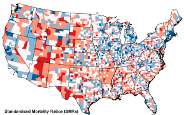
University of South Carolina geographers have produced a map of natural-hazard mortality in the United States that gives the likelihood of dying as the result of natural events such as floods, earthquakes, or extreme weather
Fully wireless communications technology won't be ready or technologically feasible by June 15, 2009, when the MINER Act requires operators of those mines to have submitted a plan to use it, so MSHA's letter explains what will work.
The alliance will place special emphasis on emergency preparedness and response activities related to restoring utility services quickly and safely following a major disaster.
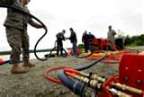
Subcommittee F20.11 on Control, part of ASTM International Committee F20 on Hazardous Substances and Oil Spill Response, recently developed F2709, Test Method for Determining Nameplate Recovery Rate of Stationary Oil Skimmer Systems.
The National Law Enforcement Officers Memorial Fund's "Drive Safely" campaign reminds motorists of steps they can take to protect law enforcement officers, other drivers and themselves.
The Centers for Disease Control and Preventions' Emergency Communication System (ECS) has redesigned its entire Emergency Preparedness and Response Web site, www.emergency.CDC.gov.

Talk of shifting FEMA back to an independent agency is short-sighted, the outgoing chief of DHS said in a bloggers' roundtable Dec. 9. He said unified response to disasters could be harmed, and DHS' structure is more cohesive than the public perceives.
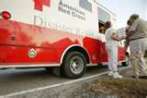
The American Red Cross is trying to raise that much by Dec. 31 to cap a $100 million goal for the Red Cross Campaign for Disaster Relief. ARC has designated today as the "National Day of Giving for the American Red Cross" to reach the goal.
The American College of Occupational and Environmental Medicine (ACOEM) is urging health care workers and their employers to follow three basic steps this flu season to help prevent influenza infections in the health care workforce.
The fugitives' alleged violations include smuggling of ozone-depleting substances, illegally disposing of hazardous waste, discharging pollutants into the air and water, laundering money and making criminally false statements.
Enforcement of disaster-resistant building codes is part of the effort being launched by FEMA and the International Code Council, which earlier this year added home fire sprinklers to its model U.S. building code.
The U.S. Fire Administration has completed a project with the International Association of Fire Fighters (IAFF) to study what important areas of safety and technology discussed in the USFA manual Fire Department Communications Manual - A Basic Guide to System Concepts and Equipment (FA-160) needed to be updated or revised, as well as what topics and technology related to fire department communications not discussed in the manual needed to be added since its development in 1996.

In explosive blast tests at the Pittsburgh Research Laboratory Lake Lyon Experimental Mine, an 8-inch-thick wet-laid solid concrete-block stopping coated on one side withstood the strongest pressure, according to this report.

About 35 robots performed at a Texas facility as developers worked on creating a standard suite of performance tests to help evaluate mechanical rescuers. The tests, shown in this Texas Engineering Extension Service photo, were sponsored by the Department of Homeland Security's Science and Technology Directorate.
This article is an attempt to briefly cover the most common differences between types of sprinkler systems. Most sprinkler systems fall within one of four categories.
Here it is December, and we’re talking about hot work. No, we aren’t talking about working when it’s hot—but, sometimes, we have to. We’re talking about working on equipment, making it hot, and having to be careful with the heat we generate and the surrounding environment.
In its more than 30 years of existence, the Emergency Response Guidebook (ERG) has been the “go-to” reference for first responders faced with the possibility of a hazardous materials incident— and it will continue to be the essential reference. In order to reflect changes in both domestic and international regulations, the ERG is republished every four years in English, French, and Spanish.
Firefighting is one of the world’s most dangerous and highly regarded jobs. As kids, many of us want to be firefighters when we grow up—but few of us actually do it. For Larry Wilson, his respect for the job was motivation enough not only to become a wildland firefighter while in college, but also to take it a step further and become a smokejumper.
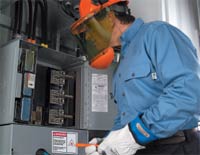
Understanding and protecting against arc flash and other electrical hazards and meeting the requirements of NFPA 70E has become more widely practiced in the past several years, and “8 cal” has become the industry standard for daily-wear FR clothing. This refers to the amount of protection from incident energy, expressed in calories per centimeter squared, that a fabric will provide in an arc flash exposure. It’s also expressed as an “ATPV” (Arc Thermal Performance Value) or arc rating.

The U.S. Department of Health and Human Services has issued a final rule for Patient Safety Organizations (PSOs).