Managing Live Traffic as a Fatal Risk in Construction Work Zones
Active work zones remain highly dangerous as safety teams deploy drone imagery, digital navigation alerts and wearable PPE strobes to protect crews.
- By Eric Yates
- May 22, 2026
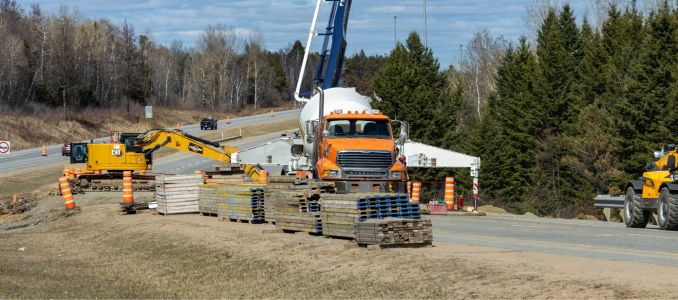
Most drivers don’t think of a work zone as someone’s workplace until they see the faces behind the cones. But for construction workers, that lane line or fence is the edge of a jobsite. On the other side are moving vehicles and pedestrians, lane shifts, merging traffic and distracted drivers, all happening while our crews are trying to do their work safely.
What makes live traffic different is simple: our crews and the public are sharing the same space. Our teams can’t count on the risks of live traffic to stay neatly “outside” the jobsite. It is right there alongside the work. That’s what turns routine tasks into high-stakes moments.
Effective safety programs in construction are built around recognizing serious hazards early, planning for high‑consequence risk and training teams to identify problems before they escalate. Live traffic is different from most jobsite hazards, because drivers are not part of our project teams and are not trained to recognize or respond to construction risk.
That’s why it’s critical to recognize live traffic as a fatal risk in construction. It is ever changing, it does not respond to a single fix and it requires layers of protection, not just one safeguard.
Why It Matters and Why Speed Changes Everything
Any battle between a person and a vehicle traveling at speed is a battle a person will not win. Crash data shows how quickly fatality risk climbs as speed increases: 20 mph is about a 1% fatality risk, 35 mph is about 19% and 50 mph at 80% or more.
This is not a rare problem. Data from The Center for Construction Research and Training (CPWR) shows that from 2012 to 2023, about 50 construction workers each year were killed while working in active work zones, with little improvement over the decade. In 2023, nearly 16% of pedestrians killed in construction work zones were workers on foot. These figures reinforce a critical reality: working on foot in live traffic remains one of the highest‑consequence exposures in construction.
Behind these numbers are workers and families who expected someone to come home and did not. For those who work inches from live traffic each day, this risk is not abstract, it is personal.
Reducing Exposure Through Layered Controls
We would not talk about live traffic as a fatal risk unless we are willing to take action in the field, invest in solutions and learn what works.
Using intrusion and near‑miss data as leading indicators. Intrusion data is only effective when it is consistently reported, discussed and acted upon. Our teammates are using intrusion and near-miss reports to refine traffic control layouts when drivers are not recognizing work zone boundaries. For example, when intrusion data shows drivers encroaching because barrels are spaced too far apart, our teams tighten the layout to reinforce the boundary and reduce unsafe vehicle movements.
Pre-task planning supported by drone imagery. Drone-supported pre-planning allows teams to rehearse traffic control configurations before lanes are shifted. By reviewing aerial views of traffic patterns and site conditions in advance, crews can identify confusion points and reduce risk before drivers are introduced into the space.
Early driver awareness through digital alerts. On some highway projects, real-time digital driver alerts are sent through navigation apps to increase motorist awareness before vehicles reach the physical limits of a work zone. In 2025, Safety Cloud® by HAAS Alert was used across three of our projects in North Carolina to deliver 334,000 digital alerts to approaching motorists across 22 miles of roadway.
Enhanced visibility for workers and equipment. Visibility is one of the most practical layers of protection we have and one that the public is already well aware of. Teams are using equipment-mounted strobes and wearable lighting systems on PPE, including solutions from Guardian Angel, to help drivers recognize workers sooner in daylight, bad weather and at night. On a highway job in North Carolina, teammates have shared that strobes help get motorists’ attention in heavy traffic and dense weather conditions.
Addressing risk beyond the jobsite. Even strong controls can fall short when drivers do not understand work zone demands. Many safety leaders are supporting broader efforts to improve work zone awareness through driver education and public outreach, recognizing that exposure reduction requires both engineering controls and informed behavior.
Live traffic is not only a highway issue. People often picture live traffic on interstate work. But it shows up on all of our jobsites, including vertical building projects where deliveries, pedestrians and daily site access create a constant traffic ecosystem and rail projects where crews work alongside active roadways, crossings and signals. Our teams plan for our clients’ traffic needs and also for the end users who will move through those spaces after we leave.
Safety Is a Two-Way Street
The risks of live traffic on construction sites is a deeply personal issue for not only me, but for many across the industry. We share the responsibility to keep work zones safe, even as part of the traveling public. Each day, our teams plan, train and use controls to mitigate risks, but we also make the decision to travel safely to and from our work zones.
Increased safety in and around work zones depends on shared awareness. We work hard to make sure teammates go home every day, but our layers of protection work best when pedestrians and motorists do their part.
When you approach a work zone, slow down, stay alert, eliminate distractions and follow posted guidance. If you can safely move over, do it. Those small choices directly impact whether someone goes home safely to their loved ones.
We say it often because it’s true: when you drive through a work zone, you are driving through someone’s workplace. Treat it with care.
Slow Down. Make Room. Save Lives.