Designed for power systems professionals, the event will offer educational resources and networking opportunities with leading industry authorities, manufacturers, and suppliers.
The seven goals listed today start with making protecting workers on the job a top priority for President Obama and the 111th Congress. Goal 3: Count all occupational injuries and illnesses.

According to the American Association of Neurological Surgeons (AANS), every year, thousands of adults and children are treated at U.S. hospital emergency rooms for head and neck injuries related to winter sports. As a result, many people are left with permanent health problems, are paralyzed, or lose their lives.
The U.S. Consumer Product Safety Commission, in cooperation with Atomic Skis GmbH, of Austri, have announced a voluntary recall of the Alpine Ski Bindings.

Taking extra precautions during temporary traffic control helps workers and motorists alike. Since Nov. 24, 2008, all workers in rights of way of federal-aid highways who are exposed to traffic must wear high-vis apparel meeting ANSI/ISEA 107-2004.

The Health and Safety Executive said 455 agricultural workers have died in the past decade, and the annual death toll has remained high.
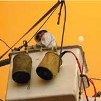
The IBEW’s 2008 Photo Contest attracted about 100 submissions, with 15 selected as finalists for members' online voting that will end Dec. 31. This finalist photo from the contest site was taken by Vacaville, Calif. Local 1245 member Kevin Markoe.
"These employees were just one misstep or tumble away from a fatal or disabling plunge," said Arthur Dube, OSHA's area director in Buffalo, N.Y.
NIOSH has engaged The National Academies' Institute of Medicine to review the draft NIOSH Current Intelligence Bulletin: "Asbestos Fibers and other Elongated Mineral Particles: State of the Science and Roadmap for Research."
A study examined factors contributing to occupational deaths in East Attica, Greece, in the five years preceding the 2004 Olympics. A 2002 increase to 19 deaths was linked with construction of large-scale public works projects, the investigators concluded.
Angie Shepherd, general engineer at NIOSH's National Personal Protective Technology Laboratory in Pittsburgh, is one of the first two recipients of the President's Leadership Award from ASTM International.
An MMWR case study and post on the NIOSH Science blog by two men in the NIOSH Education and Information Division cite potential occupational hazards associated with 1-bromopropane (1-BP), which is used in dry cleaning and as a substitute for ozone-depleting chlorofluorocarbons.
"Employees who were removing asbestos-containing materials at this site lacked basic safeguards that must be in place before performing such work," said Robert Kowalski, OSHA's area director in Bridgeport, Conn.
ISO has issued a standard to provide the minimum performance requirements for protective clothing worn in situations where users may be exposed to radiant, convective or contact heat, flames, arc flashes and molten metal splashes.
Here it is December, and we’re talking about hot work. No, we aren’t talking about working when it’s hot—but, sometimes, we have to. We’re talking about working on equipment, making it hot, and having to be careful with the heat we generate and the surrounding environment.
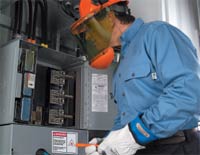
Understanding and protecting against arc flash and other electrical hazards and meeting the requirements of NFPA 70E has become more widely practiced in the past several years, and “8 cal” has become the industry standard for daily-wear FR clothing. This refers to the amount of protection from incident energy, expressed in calories per centimeter squared, that a fabric will provide in an arc flash exposure. It’s also expressed as an “ATPV” (Arc Thermal Performance Value) or arc rating.
The U.S. Consumer Product Safety Commission, in cooperation with DuPont, of Wilmington, Del., has announced a voluntary recall of DuPont's Heavy Duty Acidic Cleaner bottles. Consumers should stop using recalled products immediately unless otherwise instructed.
OSHA's next action on the rule, which several groups urged the agency to write back in 1999 and 2001, is the March 2009 completion of a peer review of health effects and risk assessment.
Two requests for comments by Jan. 15 or 16 are important to users of SCBAs and other protective respirators, and to the manufacturers. NIOSH may create a new subpart to the 42 CFR Part 84 standard for the suits.
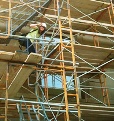
Meanwhile, fall protection in construction accrued the highest total penalty amounts of all the categories in FY 2008.