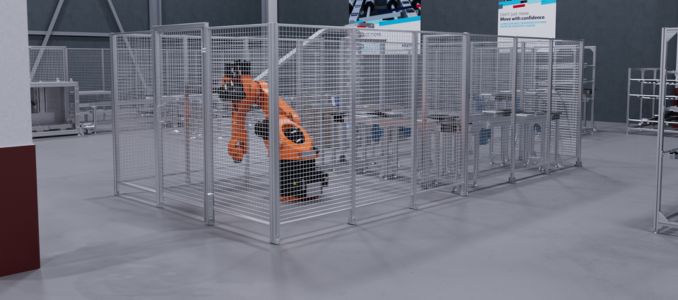
How Designing and Integrating Machine Guarding Has Evolved
Aluminum framing adapts to the automation era as factory operators use layout software to protect human workers and flexible robotic cells.
- By T.J. Kusnierek
- May 21, 2026
Many factory environments are changing in their appearance as new technology seems to be introduced daily. While it’s important to constantly evaluate the solutions marketplace, it’s equally vital for companies to continue leveraging established protocols that keep factories safe and efficient.
Aluminum framing has long been the standard for machine guarding in factories, and even though its composition has remained largely unchanged, how it’s designed and implemented by end users represents a new era of how this legacy solution continues to prove its worth and meet the evolving needs of factory owners.
Embracing Digital Design Software
For many who have been around industrial environments for a while, they can remember having to source machine guarding – and, in fact, most solutions – through a catalog or even a phone call. It could often be a time-consuming process, which required the factory owner to have a crystal-clear idea of what he or she wanted so that when the product arrived on the floor, it was integrated correctly into the given space.
It also depended on the supplier having the solution in stock so that there wasn’t a lengthy delay in its arrival on the company’s doorstep.
Thankfully, modern technology has streamlined the entire machine guarding purchasing process and is giving end users more of a hands-on experience. Design software allows factory operators to digitally see how machine guarding fits into their given space. They can adjust the sizing and guarding components to their exact specifications, which cuts down on unnecessary products that they don’t need.
Given that floorspace is at a premium in many environments, operators must maximize every inch available, while also providing sufficient protection between machines that may be close together and for any human workers that may be nearby. Design software can accommodate for all of those factors and will undoubtedly continue to be invaluable to operators who are looking to customize their machine guarding, including through the protection of more advanced machinery.
Automation Consideration
Among those newer technologies that factory operators are integrating are solutions that help automate workflows. For some, that includes robots, both in a fixed/industrial environment and in more collaborative applications through cobots. There are varying levels of machine guarding to consider when integrating robotics to the factory floor, and it’s a process each company navigates independently based on its operations.
Safety assessments are a critical component of this, as they provide detailed information about what’s required to keep everyone safe. Fortunately, machine guarding is diverse in its abilities to accommodate a wide range of robotic workflows, while also ensuring that human workers can function safely and efficiently to maximize resources and promote productivity.
This trend of automation will only continue, which means a parallel appreciation and integration of guarding as well.
Planning for the Future
In addition to protecting new technology and those who work around it, modern machine guarding is proving its cost-effectiveness in its ability to be installed, uninstalled and repurposed quickly. Flexibility continues to be a top priority among factory operators, as they need to be able to shift their operations and workflows to accommodate market changes and consumer demands.
That includes repurposing machine guarding to ensure consistent protection regardless of what the workflow ultimately looks like.
Because modern guarding is simple to install and often includes universal components, it allows companies to scale and reconfigure their layout without having to buy additional or extraneous pieces. This can represent a significant savings, especially for smaller factory operators that have a smaller budget, as any solution that has an extended shelf life and can be repurposed is incredibly valuable.
In short, modern machine guarding is a great representative of where factory technology is trending and what end-users are looking for. It can be designed digitally, which helps the company see exactly how it can fit into their unique environment. It can be deployed easily, which speeds up the time to market and reduces downtime on installation.
Plus, it’s flexible in its applications and can be repurposed to fit a variety of needs. All of these factors contribute to a significant return on investment for machine guarding, which has a long shelf life. Because of its inherent value, end-users need to view machine guarding as an essential complement to their advanced technology and should keep in mind its integration when designing and evaluating their factory floor operations.