Vents' Role in Improved Protection
Automatic fire vents are another option for life and property safety.
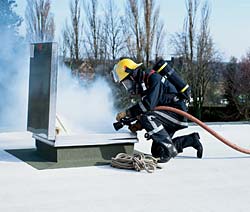 FIRE safety is of monumental importance to building owners and managers, individuals whose fire protection decisions affect both life safety and the preservation of valuable assets. There is a variety of products available to these decision makers to ensure their buildings are properly protected. This article will explore the use of automatic fire vents as a viable and necessary option for fire protection in many types of buildings.
The International Code Council (ICC) recognizes that fire vents are one way in which life safety and protection of buildings and contents can be substantially improved. Compliance with its recommendations should not be regarded as an expense, but rather as a long-term investment in a facility.
Fire vents originally were developed in the wake of a tragedy. On Aug. 12, 1953, General Motors' Hydra-Matic transmission plant in Livonia, Mich., caught fire when a cutting torch ignited a drip pan containing rust inhibitor. At the time, the factory was new and state of the art in design; it was considered by many to be the finest plant built since the end of World War II. Yet within 20 minutes, the 1.5-million-square-foot building was nearly destroyed. Luckily, there were not many injuries and few fatalities. The plant, however, incurred approximately $80 million in damage.
Following the fire, standards for fire protection and life and material safety were brought to the forefront because many speculated fire protection products could have saved the facility. Companies began to introduce fire vents shortly thereafter to glowing reviews by many in the fire protection and industrial communities. Unfortunately, there was no consensus on the role of fire vents within the fire protection community or a unified code in favor of vent usage. This fact was not a testament to the products' ability, but merely one symptom of a lack of coordination among the code bodies.
How Fire Vents Work
Fire vents are designed to maximize fire containment and life safety and minimize damages and material loss. They are installed on the roof of a building and are designed with a latching mechanism that automatically opens the covers in the event of a fire. Once a vent is open, smoke, heat, and noxious gases are allowed to escape from the building. As required by UL and FM testing laboratories, vents are required to open against a 10 PSF snow/wind load to ensure operation in adverse weather conditions.
Fire vents offer a variety of proven advantages in a fire emergency, including:
- Increased visibility inside the building to help occupants escape the fire and reduce the risk of smoke inhalation.
- Aiding firefighters in their containment efforts. On a large structure with many vents, open vents indicate the precise location of the fire. This saves time and allows firefighters to fight the fire more safely and efficiently.
- Fire venting has a tendency to restrict the spread of fire across the building floor because it is more inclined to move upward toward the ceiling.
Since their development in the late 1950s, fire vent usage has been codified in different ways. Today, the governing code organization in the United States also requires the use of fire vents for certain buildings.
Understanding the Code
For more than 50 years, fire vents have experienced varying levels of acceptance due to conflicting code requirements. Until the mid-1990s, there had been three governing code bodies in the United States: Building Officials and Code Administrators International (BOCA), International Conference of Building Officials (ICBO), and Southern Building Code Congress International (SBCCO). While the regulations developed by each regarding fire vents were similar, there were still inconsistencies that resulted in different codes in different parts of the country and disparate revision cycles.
In 1994, the three governing bodies decided to join efforts and formed the International Code Council (ICC). Shortly after the merger, this newly formed code authority convened to establish the recommendations that would later become the 12 International Code reports. These reports touch upon every aspect of the construction industry--including two codes, the International Building Code (IBC) and the International Fire Code (IFC), that address fire safety and protection. The IBC and IFC are quite interchangeable with respect to certain stipulations, although the IFC contains greater detail regarding the specific types of buildings that are required to observe the codes.
Prior to the creation of the ICC, fire vents were required in only two types of buildings, Group F1 and Group S1. Group F1 is a moderate-hazard factory and manufacturing classification and includes buildings that produce and store items such as millwork, wood products, metal, machinery, and furniture. Group S1 is a moderate-hazard storage and warehousing designation and includes facilities that house items of varying flammability and combustion levels, such as lumber, aerosols, bags, cardboard, and certain lubricating oils. Both classifications include areas with large amounts of open space and stacks of flammable objects.
The 2000 IBC and IFC better defined the use of fire vents by adding two new building classifications to the list: hazardous storage facilities (Group H) and high-piled storage facilities. Group H facilities have four subcategories, H1 through H4. This group was established for storage and manufacturing facilities that house hazardous materials ranging from mildly to severely flammable and combustible. Group H1 items include explosives, organic peroxides, and detonable pyrophoric materials. Group H2 items include flammable gases, combustible dusts, oxidizers, and water-reactive materials. H3 items include Class I, II, and IIIA flammable and combustible liquids, flammable solids, and combustible fibers. The H4 Group includes corrosives, toxic materials, and highly toxic materials.
The high-piled combustible storage category was designed to address a modern warehousing concern. New, tall storage rack systems within storage facilities are designed to maximize useable space. This is functional but risky because flammable products are stored in pallets in a tight array. These shelving units have a concentrated load mass and are more likely to ignite and spread fire quickly.
Locating the Vents
The "zone theory" of venting states that the hot gases and flame produced during a fire rise upward, entraining air, and spread outward in a layer on the ceiling. This layer of heat is trapped by the layer of air underneath because the air's density is higher. When the layers have spread to cover the whole ceiling, they deepen. Venting is designed to cycle hot gases from the fire layer out as more is produced, keeping the layer from spreading and deepening.
Installed vents are required to operate both manually and automatically in all buildings, including those with sprinkler systems. For automatic use, vents should be designed to fully open within five minutes after exposure to the fire. Buildings with no sprinkler system must have a heat-responsive device installed to activate the vents.
In high-piled storage buildings, vents must be located uniformly across the roof area, taking into account sprinkler heads and other obstructions. In other buildings, vents should be 20 feet or more from lines of adjacent buildings and 10 feet or more from fire barrier walls.
As a result of the 2000 IBC, industry and local code authorities now have one set of recommendations from which to work; it is important to note that these codes are indeed only recommendations. Local code authorities still have the last and final word on code decisions within their jurisdictions. Each holds the power to accept, modify, or reject any section of the IBC. While this leaves the distinct possibility that code specifications will differ in particular areas, it certainly is less of an issue than in the pre-ICC days.
If you are unsure about the code requirements that apply to your building, contact the fire official having jurisdiction in your area. Based on this information, you can then contact various fire vent manufacturers to determine which products and options are best suited for your application. This research will help you ensure that you are protecting both your workers and your building.
This article appeared in the November 2006 issue of Occupational Health & Safety.
This article originally appeared in the November 2006 issue of Occupational Health & Safety.