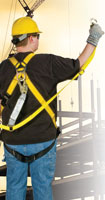
User weight is an important consideration when determining personal protective equipment for workers. Most fall protection product capacity rates up to 310 pounds, a weight aligned with most safety standards' and regulations' test criteria. Users should note that product capacity is more than just user weight, because it includes all clothing and equipment attached to the worker.
Whether in the public or private sector, risk managers with limited resources are constantly faced with the challenge of prioritizing competing concerns, managing the desire to take all possible steps to protect the organization and its employees. In today's economic climate, shrinking budgets are the norm, and securing funding for things like emergency preparedness can be difficult.

To the thousands of visitors planning to attend the American Society of Safety Engineers' Safety 2009 conference and expo, symbols are valuable tools. At the job site, symbols can warn workers of imminent danger, advise them about proper PPE, or convey the quickest egress route during an emergency.
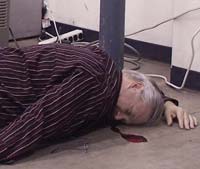
For many organizations, buying automated external defibrillators (AEDs) is the purchase of a bigticket item. For most consumers, a car is a big-ticket item. But buying AEDs is not at all like buying cars, where the effort ends when you park it in your garage for the first time. From then on, all you need to do is drive it around and put oil in it.
Incentive programs demonstrate their power to produce better results during a tough economy, All Star Incentive Marketing President Brian Galonek agrees. In a Jan. 20, 2009, interview with the OH&S editor, he said safety professionals are especially eager to try incentives because they've exhausted the tried-and-true ways of improving safety metrics. Excerpts from the conversation follow.
Whatever can you do to get a handle on safety? Specifically, to prevent injuries to fingers, wrists, hands, and arms that are common to many industries, especially where people use hand tools, assemble, work on machines, lift, load, cut, push, pull, and more?

Since the publication of our first article ("Vision Testing: A Blind Spot in Occupational Safety," February 2009, page 47), we have been asked many questions, and most people wanted references to the research data.
Workers often don't file for hearing loss compensation until they retire. But with workers staying in the workforce longer, will the compensation bill eventually be larger? There are ways to prevent noise-induced hearing loss (NIHL), even for those workers who may already have some level of hearing impairment.
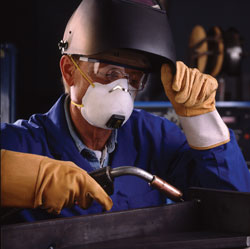
On Feb. 23, 2009, a federal appeals court resolved the final challenges to the Occupational Safety and Health Administration’s Hexavalent Chromium (CrVI) Standard that was promulgated in February 2006. The last challenge argued to lower the permissible exposure limit (PEL) to 1 μg/m3 from 5 μg/m3. This appeal was denied, and OSHA’s PEL was upheld by the court.

No one can predict when a chemical splash will occur. But we can plan for the possibility, put in place preventive and protective measures, and prepare for a quick emergency response.

The string of bad news coming out of New York City in the past year—from Eliot Spitzer's sockladen rendezvous to the domino effect of a failing Bear Stearns to Bernard Madoff and his minions of mini-Madoffs— may make the megalopolis seem more like the notorious Gotham City of the '20s and '30s than the gentrified clean streets of Sex and the City. However, despite the overnight return to its grainy, corrupt past, the city may be one of the only places that can get the nation out of the recession. Companies are tightening their purse strings, cutting everything from office supplies to their workforce, and employees are going to work fearing they may be next on the chopping block.
There's been lots of talk lately about safety culture. How setting your sights on cultural change may be the A-1 approach for engaging the clutch of safer and more productive performance, especially during these beleaguered times.
In the first of this series of articles (March 2009, pages 66-67), we explored the difference between primary and secondary prevention strategies of employee injuries. As we stated, the dramatic reduction of employee injuries in the past 15 years demonstrates the employer's success in preventing an injury from occurring. However, when an injury does occur, the cost of that injury continues to spiral upward. We find ourselves in an environment where the frequency of injuries is down, but severity is up.

Here comes Pete. It looks like he'll be carrying me today. I'm the portable four-gas detector that Pete will use to monitor the air. I'll make sure he doesn't walk into a situation that puts him in danger of being caught in an explosion or being overcome by poisonous gases. It's a pretty important job. I'm in the business of saving lives, and I take it very seriously. If only everyone would treat me like what I do is that critical.

In the 10 years since the American Industrial Hygiene Association and the American Conference of Governmental Industrial Hygienists last held their annual conference and exposition in Toronto, the world has changed—often dramatically, more often subtly. One subtle change is that American attendees of AIHce 1999 did not have to carry their passports just to return home from the event, as they will for AIHce 2009, which convenes at the Toronto Convention Centre May 30 through June 4.
The 10th annual National Work Zone Awareness week was held April 6-10, 2009, with "Drive to Survive—Our Future is Riding On It!" serving as the week's theme. The national kickoff took place April 7 on the George Washington Parkway near a bridge replacement project between Washington, D.C. and Virginia, a fitting location given the federal government's stimulus of infrastructure projects this year. More money brings more work zones, more (temporary) congestion, and more risk.
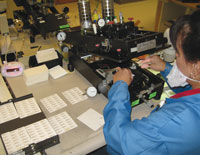
Beryllium is the fourth element in the periodic table. It comes right after lithium and before boron. It's a metal that looks like aluminum but is lighter and stronger. In ceramic form, beryllium oxide (BeO) conducts heat but not electricity and has the highest thermal conductivity of commercially available ceramics. It is used in everything from wireless base stations to satellites and advanced radar systems.