It has always amazed me how a simple thing such as a lack of communication can not only lead to less-than-optimal results, but also that the sub-par performance can sometimes continue for decades! No example of this phenomenon is more readily apparent than the traditional approach used to irrigate injured eyes in commercial or industrial facilities.
Did you know that if you are driving at a speed of 65 miles per hour, you are traveling at approximately 100 feet per second? At this speed, if you were to look down for a few seconds, you would travel the length of a football field. A lot can happen in a very short time.
Part I of this article was devoted to understanding Federal Motor Carrier Safety Administration (FMCSA) expectations of carriers regarding regulatory compliance and the methodology FMCSA uses to measure carrier compliance and assign carrier safety ratings.
Imagine this: A small-town retail store owner struggling to find responsible, dedicated employees is approached by a key employee who generally is engaged in her job and has tenure. She asks for four weeks off for what in the employer’s mind is minor surgery.
In every business environment, there are certain health and safety risks that employees expect to have addressed by their employers: Sidewalks must be shoveled and salted after snowstorms, safety goggles and masks must be supplied in the presence of airborne chemicals, and facilities must be kept clean and up to code to minimize accidents.
Employers increasingly use incentives to motivate their workers to participate in health and wellness programs.Participation is only half of the story, however: A greater variety of incentives is being offered, and more of them are awarded for completing a program (such as weight loss, smoking cessation, or a health risk assessment) than in the past.
Managers are looking for simplified ways to promote safe work practices while maintaining production levels. Too often, current safety programs that begin with great intentions turn into a paper-tracking nightmare or the documentation becomes the ends to the means rather than having a positive impact on employee performance.
With new hazards emerging weekly, ensuring safer, more secure environments is more challenging than ever before. The importance of Personal Protective Equipment (PPE) is constantly being brought to the forefront by natural disasters, such as wildfires, flooding in America’s heartland, tornados, and hurricanes; as well as health concerns about pathogenic microorganisms, such as MRSA and H5N1 virus (avian flu).
A company’s brand name is often its most valuable asset. A brand name takes years to develop but can be irreparably harmed in an instant if a trusted brand causes harm to the consumers who have grown to rely on it.When a company learns that one of its products has caused harm to one or more of its customers, it needs to take swift action to prevent future harm to its consumers and to salvage its brand name.
Although Office Depot’s warehouse facilities have always been in compliance with OSHA standards, by 2004, the company’s managers decided more could be done to lower their accident rate and reverse the company’s steady increase in claims for worker’s compensation and disability insurance.
Some of the nation’s leading experts on all of the facets of Hazard Communication— the regulations, classification schemes, warning labels, material safety data sheets, and authoring systems used for chemicals and mixtures around the world—will be meeting in Arlington, Va., this month.
The last thing most gals think of when they’re getting dressed in the morning is safety.We women, some of us highly influenced by the styles we see in the media, are usually concerned about wearing things that are flattering, fashionable, and fit our unique shape. However, speaking from experience, I believe safety should be the most important “fashion” consideration, especially when dressing for your job.Your safety (and possibly that of others around you) counts on it!
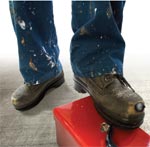
His safety toe work shoes were so caked with layers of sticky, thick, red mud, inside and out, that I doubted he could ever get them clean again. I watched this landscaper cram his feet into wet muddy socks and back into the same mud-caked shoes. It was only 7 a.m. that morning, so it would be a long day with painful results for this worker who was doing tasks ranging from using mowing equipment to setting a retaining wall on a construction site. I asked the job supervisor, who shrugged and answered, “He’s new. He’ll learn.”
Protecting the hearing of employees is extremely important. Although loss of hearing through aging usually follows a normal pattern, when we are exposed to excessive noise, hearing loss can occur prematurely from excessive exposure to noise in the workplace. Hearing loss is a serious hazard that is often painless, progressive, and permanent.
By now you have probably heard of Second Life, the online community created by San Francisco-based Linden Lab in which people, or their animated representatives, can buy virtual “goods” and “land,” construct homes and buildings, conduct business, and essentially live second, imaginary lives—spending, and sometimes making, real money in the process.

In his epic work "The Waste Land" (1922), T.S. Eliot wrote convincingly that “April is the cruellest month,” but a case can be made for September. Throughout American history, all varieties of disasters have transpired in this ninth month of the year—from shipwrecks to plane crashes to terrorist attacks—the aftermath of which have changed the way we live, work, and simply function as a society. Some of these changes have been subtle, others, such as the events of 9/11 seven years ago, drastic.
Any good proof is based upon assumptions. If the assumptions are good, the proof is valid. If the assumptions are bad, then the proof is worthless—or, as writer Angelo Donghia puts it, “Assumption is the mother of screw-up.”