The initial inspection carried proposed penalties totaling $25,500. The re-inspection carries $108,000 in proposed penalties.
Employers cannot rely on online or video training tools as the sole source of training because physical manipulation of actual components of PPE (as opposed to virtual components of PPE) must be part of the program, the agency notes.
Former flight crew members complained they suffered retaliation after raising air carrier safety concerns with the company.
NIDAMED contains an online screening tool and a quick reference guide. An estimated 8 percent of the U.S. population uses illegal drugs, but few who do share the information with their physicians.
The U.S. Fire Administration (USFA) has issued a special report examining the causes and characteristics of outdoor fires. The report, titled "Outdoor Fires," was developed by the National Fire Data Center, part of USFA.
"The significant hazard of a four-story plunge was exacerbated by the lack of required lifesaving rescue equipment," said C. William Freeman III, OSHA's area director in Hartford, Conn.
The company, a small municipal solid waste burner, was accused of not taking the correct measures to control its mercury, dioxin, and furan emissions.

A former NFPA senior electrical specialist, Mastrullo is now an OSHA employee in Boston. NFPA says his evangelism in the cause of electrical safety helped to make 70E and other electrical safety programs more prominent around the world. This photo shows, from left, NFPA Chief Electrical Engineer Mark Earley; OSHA New England Regional Administrator Marthe Kent; NFPA President James Shannon; and Mastrullo.
This combines the British OSHA agency's Pesticides Safety Directorate and Chemicals Assessment Schemes Unit into a single entity responsible for regulating biocides, pesticides, detergents, chemicals, and duties under the Classification and Labelling regime.

The American Trucking Associations' Safety Management Council will present awards in September for best vehicle accident and worker injury incidence, as well as national safety director and HR professional of the year.
The total penalty includes an other-than-serious proposed fine of $3,500 because the company allegedly failed to notify OSHA of the fatality within eight hours of the incident.
The American Industrial Hygiene Association's president, Lindsay Booher, wrote a letter April 2 to the chairman of the U.S. House Education and Labor Committee expressing support for HR 849.
The Consumer Product Safety Commission and various home heating furnace, boiler, and high-temperature plastic vent pipe (HTPV) manufacturers are urging home owners who have not yet responded to the previously-announced 1998 recall, to do so immediately. After May 1, 2009, the remedy consumers receive will change.
The Consumer Product Safety Commission (CPSC), in cooperation with Yamaha Motor Corp. U.S.A., of Cypress, Calif., is announcing a free repair program to address safety issues with all Rhino 450 and 660 model off-highway recreational vehicles. Yamaha has also agreed to voluntarily suspend sale of these models immediately until repaired. Consumers should immediately stop using these recreational vehicles until the repair is installed by a dealer.
Determining the level of hand protection performance required in a safety glove is critical to the right glove specification. However, different standards and different test methodologies are in use, which can be confusing and complex for safety managers. It is imperative that buyers and safety managers of gloves seek out expert advice and counsel to help them make sense of the different and often incomparable data available.
A safety fact sheet on Lyme disease is among the products developed by the Tree Care Industry Association (TCIA) through the recently renewed OSHA alliance. The fact sheet describes the causes, symptoms, treatment, and methods for preventing Lyme disease for people who work or spend time outdoors in grassy or wooded areas.
More than a million U.S. workers are exposed to potentially harmful vibrations from the tools they use at work, says Joseph D. McGarry, president of Gloves-Online.com.
Through the agreement brought on by a shareholder resolution, the company has committed to survey its current U.S. potato suppliers and compile a list of best practices in pesticide reduction that will be recommended to the company's global suppliers (through the company's Global Potato Board).
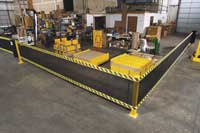
When combined with a well-designed safety plan, industrial safety barriers greatly minimize the risks associated with a host of potentially disastrous accidents that threaten the safety and productivity of virtually any fast-paced industrial environment.
In a field where hand washing and hygiene is of utmost importance, studies indicate compliance among health care providers is well below 50 percent, on average.