IF you have not heard of MRSA (methicillin resistant staphylococcus aureus) yet, you will very soon. MRSA (it is generally verbalized as mersa) used to be found only in hospitals.
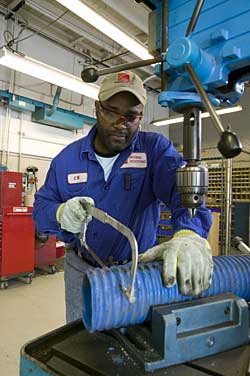
PICTURE, if you will, the new Safety Director at a sheet metal fabricator in the early 1990s. Fresh out of college with a degree in Safety Engineering and a desire to work in industry, he sincerely wants to "help" promote the idea of a safe workplace. He wants to "make a difference."
On the first day of his new job, he is confronted with an accident that results in a severe laceration of a worker's hand. A hospital trip is involved. This one will definitely go down as a Lost Time Accident. There is grumbling about a potential lawsuit.
IMAGINE you are ill and make an appointment with your physician. You walk in the door, register with the receptionist, and are escorted to an exam room. A few minutes later, the physician walks in with a syringe filled with medicine. He asks you to roll up your sleeve. As your eyes widen, you exclaim, "You haven't even examined me yet!" As he walks closer with the syringe, he replies, "That's all right. Most of the time, this usually does the trick."
While this scenario may seem ridiculous, how many times have we approached a safety problem with a "syringe" full of training without diagnosing the underlying issue?
LAST year's spike in mining accidents, which began with the Sago mine explosion Jan. 2 and was followed 17 days later by two fatalities in a conveyor belt fire in the Aracoma Alma #1 mine, also in West Virginia, put a national spotlight on what Cecil E. Roberts, president of the United Mine Workers of America (UMWA), described in his speech before the Senate Committee on Health, Education, Labor and Pensions on March 2 as the Mine Safety and Health Administration's history of "inaction and chronically misdirected efforts."

WITH the warm and humid summer months just around the corner, it is important to remember what kind of illnesses and other heat-related ailments can arise from being out in the heat too much.
CONCRETE pours thick and cool, like a mud milkshake. On a hot day it may even seem inviting, as more than one homeowner has stepped in, shoeless, to level the surface of a driveway. So the idea that this seemingly harmless substance could be responsible for severe burns runs counter to common sense.
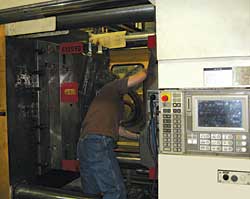
"Wallace, if we lock out this machine every time we have a pill jam, we will never make any product!"
This was the testy response I received from a production manager while performing a lockout audit at a pharmaceutical plant. With the exception of minor tool changes and adjustments and other minor servicing activities, employees are typically prohibited from placing any part of their body into the point of operation while a piece of equipment is energized. But what about the following scenarios?
A difficult issue faced by nearly every safety coordinator for a construction site is what to do about temporary guardrail protection. The temptation is to do the job quickly, get open-sided edges or platforms closed in as quickly as possible, and caution all personnel to be extra careful when it is necessary to approach the edge during the temporary exposure period.
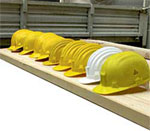
MILLIONS of hard hats are worn every day. In fact, the hard hat is one of the most recognizable pieces of safety equipment in the industrial workplace. It's also one of the most important pieces of safety equipment because it protects the brain. Unfortunately, this ubiquitous piece of personal protective equipment (PPE) is rarely part of an inspection, maintenance, or replacement program.

BACK in the days when it was acceptable to factor loss of life into the planning for major public works projects such as dams and bridges, compliance to safety standards was an afterthought. As personal safety became more of a focus, those unsafe conditions gave way to increasingly stringent current regulations and deviation penalties. Today, there are very clearly defined operational safety protocols and preparation requirements to deal with inevitable accidents due to neglect or other circumstances.
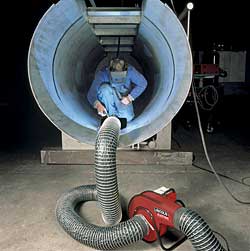
EMPLOYERS are under continuous pressure to improve quality, increase productivity, provide a safe work environment, and control costs. The key to determining the level of effort needed to comply with the new Hexavalent Chromium (Cr(VI)) Standard is to understand how OSHA has intentionally structured the standard.
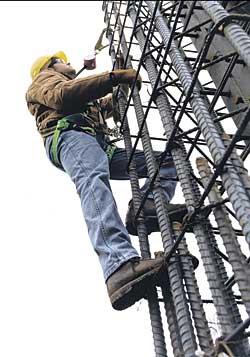
ON-THE-JOB injuries cost employers nearly $1 billion per week in payments to injured employees and their medical care providers, according to Boston-based Liberty Mutual, the leading private provider of worker's compensation insurance in the United States. Where do the injuries come from? Falls are one of the leading causes of deaths in the workplace, according to the National Safety Council.
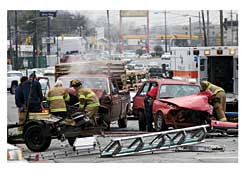
Under Pressure
LIGHTNING-FAST, acutely accurate assessment under pressure and with little information is a matter of course, as is providing consistent, standardized response to life-threatening emergencies--the framework of a first responder's actions. Does it sound easy? These personnel have to project calm reassurance to the victims, no matter what is happening at that moment and, all the while, they're busy saving someone's life.
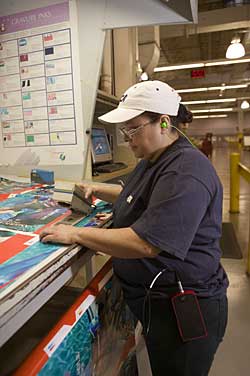
MORE than 30 million workers are exposed to hazardous noise levels in the workplace. It is estimated that costs just for work-related hearing disability exceed $242 million annually! The National Institute for Occupational Safety and Health reports hearing loss is one of its priority areas for research for this century. Noise-induced hearing loss is the most common way for a person to lose hearing; one out of every 10 Americans suffers a loss of hearing severe enough for it to affect daily conversation and how normal speech is understood.
HOW a person thinks about a problem influences how he or she plans and responds. In most science--physical, biological, and social--analytic thinking is common. As established in analytic geometry, one axiom of this type of thinking is that "the whole is equal to the sum of the parts." Consider three examples.
Many professionals seek the holy grail of upgrading their Safety "culture." But just what is culture, and how can you strengthen it?
FORKLIFT trucks are an essential part of most industrial and supply chains around the world. However, statistics indicate they also present a very significant hazard to people occupying the same workspace. Forklift-involved injuries can be severe or fatal because the trucks are heavy and powerful vehicles.