Why Confined Space Conditions Change—and What to Do About It
Pre-entry atmospheric testing is a critical first step in confined space safety, but it can create a false sense of security when conditions shift after workers enter.
- By David Kopf
- Apr 27, 2026
Confined space entry programs often begin with a familiar safeguard: test the atmosphere before anyone goes in. That practice remains essential, but John Villalovos, Applications Engineering Manager at RKI Instruments Inc., cautions that it is only a starting point. In real-world conditions, a safe reading taken before entry can quickly become outdated once work begins.
Villalovos says pre-entry testing can break down for reasons that are both technical and human: In some cases, workers may become complacent if they routinely test the same space and begin treating the procedure as a formality. Fatigue can also play a role, as can gaps in training. On the equipment side, he explains that instruments may not be properly calibrated, may not have been bump tested recently or may even have the wrong sensors installed for the hazard.
“Quite a variety of different ways” can cause a pretesting procedure to fail, he says, which is why safety managers should avoid treating a single reading as proof that a space will remain safe throughout the job.
Why Conditions Change After Entry
One of the most important limitations of pre-entry testing is that confined space atmospheres are not static. Villalovos points to tanks and similar vessels as a clear example. In those environments, gases and vapors can stratify at different levels based on vapor density, meaning the atmosphere at the top of the space may differ significantly from what is present near the bottom.
That matters because work activity itself can change the atmosphere. Residual liquids or hydrocarbons on the floor of a tank can be stirred up, releasing additional vapors. Ventilation issues, leaks, oxidation and decomposing organic material can all alter conditions after entry. Villalovos notes that methane or hydrogen sulfide may be generated in some spaces, while rust can promote oxidation. External sources can also affect the atmosphere. For example, a motor-driven generator operating nearby could introduce carbon monoxide into the confined space.
Temperature is another factor. Villalovos says temperature can affect gas behavior, reactivity and even stratification. Taken together, those variables mean the atmosphere workers enter is not necessarily the atmosphere they will encounter minutes later.
A Safe Reading Is Only a Snapshot
When asked how quickly confined space conditions can change, Villalovos is direct: “Pretty quick.” He says conditions can begin changing immediately, especially if materials are disturbed, and “certainly within 20-30 minutes things could be dramatically different.”
That point is critical for safety managers because it underscores the limits of relying on pre-entry testing alone. An initial test is just a snapshot of conditions at a specific moment and location. It does not guarantee that the atmosphere will remain acceptable once work starts, once substances are disturbed or once nearby operations influence the space.
Villalovos says the size and volume of the confined space will affect how quickly conditions change, but the broader lesson is the same: dynamic hazards require a dynamic approach to monitoring.
When Continuous Monitoring Makes Sense
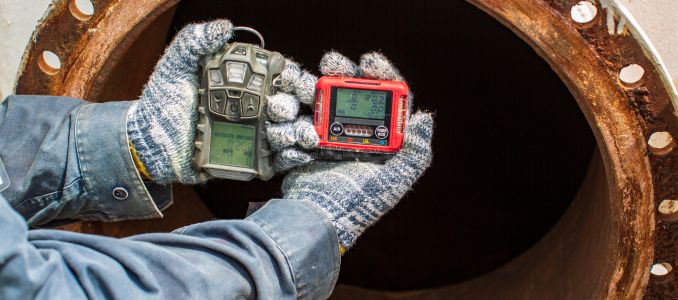
So, when should safety managers move beyond pre-entry testing and use continuous monitoring? Villalovos says that “if they can,” continuous monitoring is advisable. He described more modern protocols in which an attendant or other worker outside the space remains in communication and monitors conditions, while entrants wear small personal portable instruments that track readings as they move.
That mobility matters because workers should not be limited to a single monitoring point. Confined spaces can contain multiple atmospheric zones, and hazards may vary throughout the space. Villalovos emphasized that testing should cover different areas of the tank or space, not just one point.
He stresses the importance of stratification testing. In vertical spaces, he says testing should be conducted at multiple levels because gas concentrations can vary significantly from top to bottom. Ideally, Villalovos says that testing should be conducted about every four feet when checking levels in a space.
The broader takeaway is that safety managers should base their strategy on the actual hazards present and on the likelihood that conditions may become unpredictable during the work.
Building a Better Monitoring Program
For safety professionals looking to strengthen confined space programs, Villalovos recommends starting with a “complete and thorough audit of the space and the hazards.” That means identifying not just likely gases and vapors, but also the environmental and process factors that may influence them, including temperature, humidity and pressure conditions.
He also says monitoring programs should be matched to the specific hazards involved. While many people think first of the standard four-gas configuration—combustibles, oxygen, hydrogen sulfide and carbon monoxide—that may not be enough in every setting. Depending on the environment, employers may also need to consider ammonia, chlorine, sulfur dioxide, oxides of nitrogen, carbon dioxide or other gases and vapors. In other words, the instrument must fit the hazard.
Beyond hazard assessment, Villalovos urges safety managers to conduct regular audits, keep training current, stay aware of improvements in technology and PPE and engage employees in the safety process. He also points to connected-worker software and firmware as an emerging aid, allowing supervisors to track instrument readings and worker movement from a central location, sometimes with geofencing capabilities.
For safety managers, the practical message is clear: pre-entry testing remains necessary, but it is not enough by itself. Confined spaces change. Monitoring strategies must change with them.
This article originally appeared in the April/May 2026 issue of Occupational Health & Safety.