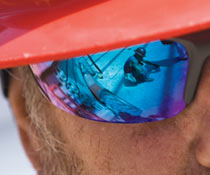
A disgruntled field employee (in front of a crew of scowling, arms-crossed guys) tossed a set of dirty, beat-up safety glasses at me in disgust. "They're scratched, this no good piece of #@*!" he exclaimed. The explanation: A piece of debris or gravel had been slung while on a maintenance job, deeply scratching the lens.

NANOTECHNOLOGY safety regulations may be years away. Many have suggested OSHA can use existing standards and the General Duty Clause to regulate safe nanotechnology practices, but the latter requires having some guidance on exposure limits and best practices from EPA or non-regulatory organizations.

THIS is part of my continuing series of useful links from the Internet. In this month’s edition, we look at Summer Safety. Underground Cables and Electricity In the summer, we may be doing some home remodeling to ensure that we have curb appeal. This means we have to dig up the ground around the home. Before we can do that, we have to get a utility markout by calling at least three days before we start work.
IN the first installment of this series, we discussed the foundation of the injury-free culture, creating alignment around what we mean by “zero injury,” and establishing true ownership for this vision. Once we have created alignment and ownership, what’s next? How does this new vision change our approach to, and thinking about, the basic mechanisms that drive safety performance?
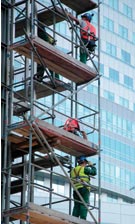
A vast number of those in the construction industry use scaffolding on a daily basis. According to OSHA, nearly 65 percent of workers in the construction industry work on scaffolds frequently. From steel erectors to building equipment installers, bricklayers, window washers, carpenters, and painters, just to name a few, nearly 2.3 million construction workers frequently work on scaffolds. Construction sites are inherently unstable environments, with movement of workers, materials, etc. and changing landscapes. In 2004, approximately 400,000 workers suffered construction-site injuries. The Bureau of Labor Statistics revealed in 1996 that 25 percent of workers injured in scaffold accidents had received no scaffold training. With the high potential for serious injury, construction safety education remains a top priority.
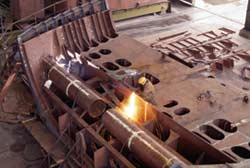
THIS article by Northrop Grumman Ship Systems, Inc. (NGSS) addresses lessons learned from a fatality at its New Orleans facility involving a suspended load. The shipbuilding industry faces many unique hazards. Like all major shipyards, NGSS builds its vessels through modular construction. In modular construction, NGSS builds hundreds of separate units that are assembled into larger units and then integrated into the vessel.
WHILE monitoring and auditing multiple potential layered outfits does impose extra effort on a safety team, it benefits the organization's workforce and bottom line.
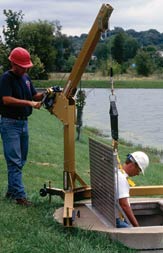
THE American Federation of State, County and Municipal Employees (AFSCME) defines a confined space as an area that has limited openings for entry and exit, has poor natural ventilation that can pose serious risks, and is not designed for continuous occupancy by workers. Workers in various industries are required to inspect, clean, test, and maintain these spaces, making it incredibly important that proper safety precautions are in place to prevent injuries from falls. Confined spaces (such as sewers, tanks, or manholes) are one of the most challenging rescue situations. Access can be difficult given small openings and a lack of space. Along with these concerns, confined spaces often present additional risks, such as the lack of oxygen or noxious air that makes immediate rescue a priority.
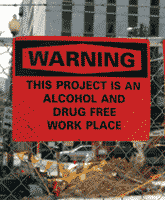
The trends between alcohol and drug use in the workplace are interesting. According to a recent study funded by the National Institute on Alcohol Abuse and Alcoholism, about 15 percent of U.S. workers, or 19.2 million workers, are under the influence of alcohol at least occasionally while on the job. Managers are more likely impaired on the job than are their reports.
ATHLETES and steroids have become a sad combination in modern Olympic and professional sports worldwide. It seems as if a day cannot go by without some reported scandal of an athlete abusing steroids or some other performance-enhancing compound to gain a competitive advantage.
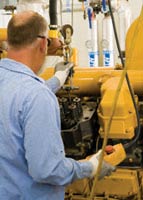
COMPANIES serious about safety performance often talk about the injury-free culture. These three simple words carry a lot of weight and importance. Indeed, it is hard to know how an organization could espouse any different vision of safety. Yet, saying that you want to be "injury free" is not the same as actually moving to this level of performance. For one thing, what do we mean by injury free? Is such a thing even possible?
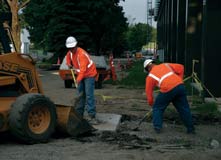
AS the November 2008 deadline approaches for compliance with the Federal Highway Administration's new high-visibility mandate, it is critical that individuals in affected industries know how they will be affected by the changes to come. Affected occupations include road workers and first responders exposed to the low-visibility hazards of moving vehicular traffic.
THE toughest Air Force mission of my life was not in combat. It wasn't even in the cockpit of an F-16. It was a mission I never flew. It happened while I was en route to the United States from the Saudi Arabian desert. My wingmen and I were deployed there for two months flying missions to protect the southern "no-fly zone" of Iraq, and the deployment was over. It was time to head home.
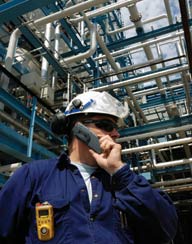
WHEN power plants, oil refineries, and food processing, pharmaceutical, chemical, paint, and plastic plants need to have major service, that work is called a plant turnaround. These times without production are both high stress and high cost, in terms of labor as well as lost production revenue. The positive side can be substantial: increased equipment reliability and a lower risk that broken equipment will cause an unscheduled outage or catastrophic accident.
SAFETY has never been a 9 to 5 proposition. So it's good to see organizations increasingly realize that workers can't switch on safe judgment and actions upon clocking in. But, for the longest time, safety emphasis has almost exclusively been at the work site, exemplified by policies and procedures, observation/monitoring, and ergonomic emphasis on design/redesign/purchase of specific tools.
ONE doesn't need an MBA to recognize that getting high productivity from company assets is a fundamental element to managing a successful business. Any asset that is not maintained and improved eventually will stop producing.
AS facility and safety managers have recognized the need for a range of safety solutions across many applications, much has been written about meeting American National Standard Institute (ANSI) requirements and the importance of routine emergency testing. The ANSI standards are mostly black and white, but there are other issues surrounding emergency equipment that are more like fuzzy shades of gray.