MANAGING workplace safety is an important goal that many corporations have recognized as a logical and effective way to provide a better working environment for employees and to cut corporate costs. A key component in safety management is the software system used to record, manage, and analyze safety-related data. With an effective system, the safety team can see exactly where accidents and unsafe situations are occurring and take proactive steps to eliminate them.
THIRTY-two million workers (roughly 10 percent of our population) are potentially exposed to an estimated 650,000 hazardous chemical products each day in more than 3 million American workplaces, according to recent OSHA statistics. Having a solid safety program helps keep your employees from being a statistic. Safety is a major concern in most businesses across the country, and

FOR decades, studies in the workplace have shown hearing protectors to be underperformers: Real-world attenuation (noise blocking) is less than the published Noise Reduction Rating (NRR) for many workers. Studies like these have spawned a variety of de-rating schemes for hearing protectors that are often misunderstood or misapplied, such as the 50 percent OSHA de-rating or the NIOSH 75/50/30 percent de-rating for ear muffs, formable ear plugs, and pre-molded ear plugs, respectively.
I recently heard a manager delightedly speak about the "miraculous" changes he saw in his company's Safety performance and culture.
No fighter pilot ever flies a combat mission solo. We always fly as a team--with our wingmen, who provide mutual support and maximize our ability to accomplish our objectives.
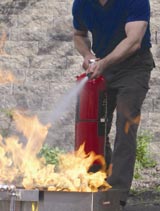
AS many are well aware, OSHA requires that employees be educated in the use of fire extinguishers every year. Specifically, OSHA 29 CFR 1910.157(g) states: "Where the employer has provided portable fire extinguishers for employee use in the workplace, the employer shall also provide an educational program to familiarize employees with the general principles of fire extinguisher use and the hazards involved with incipient stage fire fighting."

JOHN Sidler, 19, was driving to work in Dallas on a rainy Saturday morning in October 2005 when his truck hydroplaned and smashed into a utility pole, crushing his vehicle and knocking him unconscious. Good Samaritans who witnessed the accident rushed to his aid and called 911.

HOW do people get the avian flu? Avian influenza viruses circulate among birds worldwide. Susceptible birds can become infected with avian influenza virus when they have contact with contaminated nasal, respiratory, or fecal material from infected birds. They then shed the virus in their saliva, nasal secretions, and feces.
AS dangerous jobs go, the world of working with electricity might not seem the most romantic. Unlike firefighting or law enforcement, electricians are not often featured in blockbuster movies as heroic, brave saviors of the street. But working with electricity can be comparatively dangerous, and the injury rate for electricians is high.
DURING the past half century, technology has improved virtually every aspect of human life. However, during this period, not much has changed in the world of personal protective equipment. For hearing safety, workers may choose either ear plugs that are inserted into the ear or ear muffs that cover the ears.

OH, no—health and safety training again?! In every industry, this is a common response to the announcement of an upcoming session. People absolutely despise safety training because it is the same old, dull, boring, and repetitive material, year after year.
ACCORDING to the American Heart Association, more than one in three American adults have one or more types of cardiovascular disease. The National Heart, Lung, and Blood Institute’s Framingham Heart Study has followed participants since 1948 and their offspring since 1971. The study estimates the overall lifetime risk of cardiovascular disease (CVD) and found more than half of men and nearly 40 percent of women in the United States will develop CVD during their lifetime.
Why are heat and humidity such a threat to certain workers, such as those who work outdoors or in foundries?
WHEN Hurricane Katrina slammed ashore in 2005, it helped drive home the fact that intense hurricanes are becoming a constant concern for residents along the Gulf Coast and Florida coastal regions. While no hurricane touched the U.S. coastline in 2006, that unusual respite is not likely to be repeated this year, according to a forecast issued by Colorado State University's forecasting team. The El Nino weather conditions that led to a quiet Atlantic hurricane season in 2006 will probably dissipate by summer, leading to above-average hurricane activity for 2007.
EACH day, hazardous chemicals and potential risk of worker exposure is becoming a more complex challenge for many environmental, health and safety professionals. Statistics show that the respiratory condition in the workplace is one of the main cause of illness cases on the job (18,865 cases in 2003; 17,679 cases in 2004; and 20,128 cases in 20051).
CAPABLE of processing more than 36,000 bits of information an hour and utilizing more than 65 percent of the pathways to the brain, the human eye contributes nearly 85 percent of an individual’s total knowledge. Yet because the eye is often minimally protected, it is particularly vulnerable to injury--especially in the workplace.