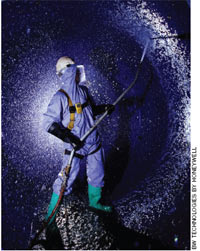
When it comes to hauling cargo such as liquefied natural gas (LNG), oil, or BTEX (benzene, toluene, ethylbenzene, xylenes), safety personnel must be made aware of all safety concerns, especially during transportation at sea. Marine personnel can potentially be exposed to dangers that include oxygen deficiency or enrichment, explosive gases, and toxic effects from cargo and maintenance chemicals.
No facility is exempt from slip-and-fall injuries. Even in non-manufacturing environments, slips and falls to the same level account for more than 15 percent of OSHA reportable injuries and more than 70 employee deaths each year, according to the U. S. Bureau of Labor Statistics.
Now that American industry seems to have focused all of its energies on the newest hot topic—going “green”—many issues that formerly seemed to grab so much attention, such as the health effects of mold, have faded into the background. The fact is that mold continues to be a problem in the residential, commercial, and industrial markets, and it must be dealt with on an ongoing basis. This article takes a look at the state of mold remediation and what’s new in the area.
Proper equipment and PPE are critical for safe operation of a chain saw, a potentially dangerous tool that is tougher to handle than it appears. The most important components of a chain saw user’s PPE ensemble may be his eye and face protection, although protective gloves and footwear are included.

October's final night is much darker than the harmless fun you may imagine. Ghosts and goblins may be prowling the streets with witches, warlocks, princesses, pirates, and countless other costumed carousers, minds fixed on sweets and treats. The truth is, they have good reason to be frightened.
A senior building maintenance employee was working on a building that was undergoing renovations. The job included the installation of an emergency exit light above a doorway. The maintenance employee was positioned on a 10-foot fiberglass stepladder. As he was rechecking the 110-volt electrical wiring using a multi-meter tester, he experienced a strong electrical shock sensation. He was reaching above and behind the light at the time and fell approximately 8 feet to the floor. He sustained a fractured left heel, as well as a compression fracture of his lower back. This employee was hospitalized, according to the OSHA accident report.
Look around: Automated external defibrillators (AEDs), which give life-sustaining defibrillation therapy to a sudden cardiac arrest victim, are popping up all over the world.
When it comes to reducing ergonomic injuries -- soft-tissue injuries and others that are extremely prevalent and costly for many companies -- developing the right culture is especially important. Ergonomic problems are typically cumulative in nature. One-shot interventions or would-be quick fixes usually fall flat when applied to Ergo injuries that reflect daily choices and actions, wearing down and debilitating workers over time.

We can scarcely blame the alarming federal deficit on OSHA and MSHA funding, but then again, their funding has increased steadily in recent years. Congress and the Bush administration both are responsible for this. There was no urgency this year to finish work on the U.S. Labor Department's FY2009 budget, which covers operations and expenses from Oct. 1, 2008, to Sept. 30, 2009.
It has always amazed me how a simple thing such as a lack of communication can not only lead to less-than-optimal results, but also that the sub-par performance can sometimes continue for decades! No example of this phenomenon is more readily apparent than the traditional approach used to irrigate injured eyes in commercial or industrial facilities.
Did you know that if you are driving at a speed of 65 miles per hour, you are traveling at approximately 100 feet per second? At this speed, if you were to look down for a few seconds, you would travel the length of a football field. A lot can happen in a very short time.
Part I of this article was devoted to understanding Federal Motor Carrier Safety Administration (FMCSA) expectations of carriers regarding regulatory compliance and the methodology FMCSA uses to measure carrier compliance and assign carrier safety ratings.
Imagine this: A small-town retail store owner struggling to find responsible, dedicated employees is approached by a key employee who generally is engaged in her job and has tenure. She asks for four weeks off for what in the employer’s mind is minor surgery.
In every business environment, there are certain health and safety risks that employees expect to have addressed by their employers: Sidewalks must be shoveled and salted after snowstorms, safety goggles and masks must be supplied in the presence of airborne chemicals, and facilities must be kept clean and up to code to minimize accidents.
Employers increasingly use incentives to motivate their workers to participate in health and wellness programs.Participation is only half of the story, however: A greater variety of incentives is being offered, and more of them are awarded for completing a program (such as weight loss, smoking cessation, or a health risk assessment) than in the past.
Managers are looking for simplified ways to promote safe work practices while maintaining production levels. Too often, current safety programs that begin with great intentions turn into a paper-tracking nightmare or the documentation becomes the ends to the means rather than having a positive impact on employee performance.
With new hazards emerging weekly, ensuring safer, more secure environments is more challenging than ever before. The importance of Personal Protective Equipment (PPE) is constantly being brought to the forefront by natural disasters, such as wildfires, flooding in America’s heartland, tornados, and hurricanes; as well as health concerns about pathogenic microorganisms, such as MRSA and H5N1 virus (avian flu).