The IT/MIS model has more to do with configuration management and much less with the job at hand, with little thought given to people in the field.
Baltimore is known as a "City of Firsts" for good reason. In 1743, its Maryland Jockey Club became the first professional sports organization in the United States; in 1774, the city opened the first post office system in the country; in 1816, it became the first city to illuminate streets with hydrogen gas; and in 1920, its Rustless Iron & Steel Co. became the first factory to manufacture stainless steel. And that's just scratching the surface.
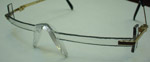
You'll find the new ANSI/ISEA Z87.1- 2010, American National Standard for Occupational and Educational Personal Eye and Face Protection Devices, is easier to understand and use than the 2003 edition, but don't be fooled into thinking it was a snap to finish it.
Companies and leaders alike are often quick to point to training deficiencies or lack of an established behavioral pattern (habit) as the root cause of accidents. Training seems to become the easy solution; or, worse, it is viewed as some sort of magic potion. Safety training can certainly be an answer, but is it the right answer?
The general consensus of those responsible for on-the-job safety is that unsafe acts cause most all on-the-job injuries. The safety field recognizes that companies with world-class safety have a certain culture in which people do not engage in the unsafe acts that result in an actual loss. Because most injuries result from human actions, the key battle in the safety war is for the minds of the workers.
Members of the Safety Equipment Distributors Association are bound for downtown Baltimore this month and the association’s 2010 Safety Leadership Forum in better spirits than a year ago. The event kicks off with a June 15 reception at 6 p.m., less than three hours after the expo of ASSE’s annual meeting has closed, which allows distributor members who exhibited there to attend the SEDA meeting economically, said Kaymie Thompson Owen, SEDA’s associate director.
Throughout my 27 years spent working in manufacturing, I've worked with electricity in some way or another. I've been a maintenance mechanic, maintenance supervisor, equipment technician, appliance repairman, TV/VCR technician, and more. Although I've been extremely fortunate never to have encountered a fatality that was caused by electricity, almost everyone I've worked with has been zapped, tingled, or shocked at some point in their lives, either on or off the job.
Every organization has diff erent characteristics and safety challenges that must be considered when starting or enhancing an automated external defi brillator program. Only then can a workplace determine how many AEDs to purchase, where to place them, and how many employees to train.
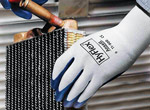
Today, branded manufacturers are placing greater emphasis on product differentiation as customers become more sophisticated in their expectations. Hand protection products must meet customer requirements at every level, providing the protection, comfort, and dexterity that help promote worker safety and productivity.
The 2009 downturn didn’t stop W.W.Grainger, Inc. from hosting two “Total MROSolutions” events in Orlando for thousandsof customers in January 2010, and the companyliked what they were saying. “Wethink it’s a great time for Grainger topick up share for a lot of the reasonsthat David mentioned,” GraingerChairman, President and CEO JamesT. Ryan said after the second event’sJan. 21 keynote speaker, David Manthey,focused his remarks on consolidationamong distributors and signs ofa slow recovery.
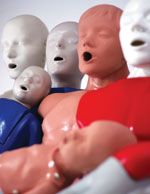
Way back in the day, we used to pack up our cleaned CPR manikins, legs and all, into giant hard cases and drag those behemoths back to the storage room. The best you could hope for was to avoid getting a hernia trying to heave “Anne” up onto the rolling cart.
The health care industry is a hotbed for continual waves of technological innovation and advancement, so why are front-line medical workers relying on respirator technology that hasn't changed much in more than 20 years? And why are manufacturers of personal protective technology so slow in responding to continuous complaints about respirator comfort and breathability?

People's reaction to being hit with cold water has been used in comedy routines for many years. Providing it's not you being doused, it can be really funny. But cold water is no joke when used in emergency showers and eye/face washes. While a cold shower might be invigorating, it can be downright dangerous to run un-tempered or cold flushing fluid through industrial emergency equipment.
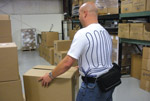
NIOSH notes in its publication "Occupational Exposure to Hot Environments," (1986) that although workers can acclimatize themselves to different levels of heat, each worker has an upper limit for heat stress beyond which that worker can become a heat casualty. Further, it has been shown that a worker's ability to focus attention and the worker's reaction times can be dramatically reduced by even a 2 percent dehydration level due to heat stress.
Since the inception of the NFPA 70E 2000 Edition 10 years ago, there has been a major evolution in our understanding of the electric arc flash hazard.
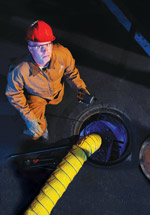
If you are responsible for the health of your gas detection program, now is a great time to get it into shape. And if you want to keep your gas detection program healthy and keep your people going home safely at the end of each day, exercise your data analysis muscles by following a routine of reviewing the information stored in your gas detectors.

The last time the nation's foremost industrial hygiene groups gathered in Denver in a large-scale way, American astronaut Neil Armstrong was still two months away from stepping down from the Apollo 11 landing craft, making "one giant leap for mankind."