
Demographic Shifts and Rising Claim Costs Drive Need for Age Aware Safety Programs
While older employees sustain fewer total injuries, physiological changes and comorbidities cause modern workplace slips, trips and falls to become exponentially more severe.
- By Andrew Hart
- Jun 15, 2026
An Aging Workforce
Workers aged 55+ now represent a rapidly expanding share of the workforce, with their participation having doubled over the past two decades. They are essential to industries like manufacturing, healthcare, transportation, utilities and construction; sectors already facing labor shortages. But with age comes a distinct risk profile that organizations must proactively address.
Physiological changes, reduced strength, slower reaction time, diminished balance, sensory decline and longer healing periods, affect how older workers experience and recover from injuries. While they tend to have fewer non‑fatal injuries due to experience and hazard awareness, the injuries they do sustain are more severe, more complex and more likely to be fatal when compared to other age demographic groups.
Chronic conditions amplify this risk. Nearly half of workers aged 55+ have at least one major chronic condition such as arthritis or hypertension, and many have multiple. These conditions influence mobility, stamina, sensation and fall risk, and they slow recovery. Medication use adds another layer, as some prescriptions impair alertness, increase dehydration risk or elevate fall susceptibility.
Presenteeism, working while ill or physically compromised, is especially concerning in this demographic. When chronic disease intersects with demanding job tasks, the likelihood of errors, strains and serious incidents rises.
Safety programs must evolve to account for age‑related vulnerabilities. This includes ergonomic redesign, reduced high‑impact exposures, chronic‑condition‑aware safety planning and return‑to‑work pathways that reflect slower healing and higher reinjury risk.
Workers' Compensation Claim Trends Among Older Workers
Older workers aren’t getting injured more often, but when they do get hurt, the consequences are significantly more severe. For employers, this shift means rethinking safety, claim management and return‑to‑work strategies as the workforce continues to age.
According to a February/March 2026 Business Insurance article, injury frequency among workers aged 60+ has risen modestly (up 2.8% in 2024), but the real challenge is the growing severity, duration and medical complexity of these claims. Older workers are more likely to experience musculoskeletal injuries, fractures, slips, falls and joint‑related issues, and these injuries tend to require more imaging, more specialist care and longer therapeutic recovery.
Comorbidities are a major cost driver. Even one chronic condition can double the cost of a claim; two or more can increase costs fivefold. These conditions also extend recovery time, with indemnity durations averaging nine days longer than those of younger workers.
Because of this, early medical engagement and proactive claim management are becoming essential. Employers who implement modified duty, reduced hours or gradual return‑to‑work pathways see better outcomes, both medically and financially. These strategies also help prevent the social isolation that can slow recovery, particularly for older employees. Investing in early reporting, flexible accommodations and age‑aware safety practices isn’t just compassionate; it’s financially strategic.
Bureau of Labor Statistics (BLS) Data on Aging Workers
BLS Census of Fatal Occupational Injuries (CFOI)
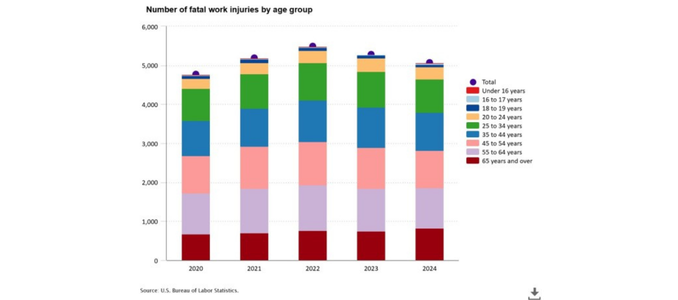
Below, you will find a chart that breaks down Census of Fatal Occupational Injuries (CFOI) fatal workplace injuries by age groups from 2020 to the most recent data available from 2024. Over the five-year period shown, workers aged 55 and older consistently account for around 35% of all workplace fatalities nationwide.
BLS Survey of Occupational Injuries and Illnesses (SOII)
Non‑fatal injuries among older workers in the 55-64 and 65+ age groups most commonly stem from falls, overexertion and contact with objects or equipment. Slip‑trip‑fall events remain a major contributor, often linked to flooring conditions, clutter, footwear and environmental factors. Overexertion injuries highlight the ongoing need for ergonomic redesign: manual handling, repetitive motion and awkward postures disproportionately affect aging bodies.
Because older workers generally have slower reaction times, reduced resilience and less physical reserve, even routine hazards can lead to more serious outcomes. Current national data shows that workers aged 55–64 experience a median of 21 Days Away, Restricted, or Transferred (DART), and workers aged 65+ experience a median DART of 23.
Chronic strain patterns often go unnoticed until they result in injury. Employers who analyze ergonomic risks by job classification frequently uncover high‑risk tasks in manufacturing, warehousing, healthcare and retail. These insights allow organizations to target interventions where they matter most.
Ultimately, preventing injuries among older workers requires a combination of environmental controls, ergonomic improvements and age‑aware hazard assessments that recognize how common exposures become more dangerous with age.
Falls and Fractures
As workers age, falls become the defining safety challenge, and the data makes that impossible to ignore. Fall‑related injuries rise sharply with age, and because older adults experience reduced balance, slower reflexes, joint stiffness and lower bone density, these incidents lead to more fractures, longer recovery times and higher medical complexity. Fall prevention isn’t just another safety initiative, it’s the single most impactful strategy for protecting an aging workforce.
According to BLS data, falls increase dramatically with age, rising from about one‑third of all injuries among workers aged 55–64 to 45% among workers 65+. This trend holds across industries and regions, underscoring that the root cause is physiological rather than job‑specific. Age‑related changes, balance decline, slower reflexes, joint stiffness and reduced bone density, make falls both more likely and more damaging.
Fracture rates reflect this vulnerability. In the U.S., fractures rise from 8% in the 55–64 group to 13% in the 65+ group, while sprains and strains decrease proportionally. Because fractures require long recovery periods and often involve significant functional limitations, preventing falls is the most effective way to prevent high‑severity injuries.
Ground surfaces: floors, pavements, outdoor paths and other walking/working surfaces are the leading direct source of injury for both the 55 to 64 and 65+ age groups. This reinforces that slip‑trip‑fall prevention is foundational to workplace safety among older worker demographics.
Companies can meaningfully reduce risk by focusing on floor maintenance, walkway audits, lighting improvements, handrails, ladder policies and slip‑resistant footwear programs. Job task reassessment, reduced climbing, safer stepping techniques, and training on navigating uneven surfaces further strengthen prevention efforts.
Key Takeaways
- Injury severity increases with age: Older workers experience fewer injuries overall, but those injuries are more severe, more costly and more likely to be fatal.
- Chronic conditions amplify risk: Comorbidities, medication use and age‑related health changes increase fall risk, strain risk and recovery time.
- Recovery takes significantly longer: Older workers require more medical care, more therapy and more time away from work, with DART days and indemnity durations notably higher.
- Falls and fractures dominate injury patterns: Fall rates rise sharply with age, and fractures become more common due to reduced bone density and slower reflexes.
- Ergonomic strain remains a major contributor: Manual handling, repetitive motion and awkward postures disproportionately affect older workers and drive overexertion injuries.
- Work environments must adapt: Flooring conditions, clutter control, lighting, handrails, slip‑resistant footwear and walkway inspections are foundational to prevention.
- Proactive reporting and claim management matter: Early medical engagement, early reporting and tailored claim strategies reduce severity and long‑term costs.
- Flexible return‑to‑work strategies improve outcomes: Modified duty, reduced hours and gradual ramp‑ups support safer, faster recovery.
- Aging workforce growth reshapes risk: Workers 55+ are the fastest‑growing labor segment, especially in high‑risk industries, making age‑aware safety planning essential.
Sources:
- About Chronic Diseases | Chronic Disease | CDC
- Aging and Work | Aging | CDC
- Aging Workers Data and Statistics | Aging | CDC
- BLS CFOI Chart, Number of fatal work injuries by age group
- BLS non-fatal injuries, DART, All U.S., Private Employment, 2023-2024 biennial period, Age Group 55-64
- BLS non-fatal injuries, DART, All U.S., Private Employment, 2023-2024 biennial period, Age Group 65
- Business Insurance, February/March 2026, “Aging Workers Change Comp Dynamics: Recovery from injuries frequently takes longer as medical complexities rise,” pg. 18-21
- Census of Fatal Occupational Injuries Summary, 2024 - 2024 A01 Results
- Employer-Reported Workplace Injuries and Illnesses, 2023-2024 - 2024 A01 Results
- What to do about our aging workforce—the employers’ response : Monthly Labor Review : U.S. Bureau of Labor Statistics