Two companies, a subcontractor and the general contractor on a New Hampshire job site, were fined after a worker tripped and fell 14 feet during the dismantling of a stairway.
Thirty years ago, inadequate building design contributed to the deaths of 85 people in the Las Vegas high-rise, which was one of the deadliest hotel fires in U.S. history.
The Justice Department announced Monday that a federal court jury convicted Keith Gordon-Smith and his asbestos abatement company, Gordon-Smith Contracting Inc., of violating CAA asbestos work practice standards and lying to hide the violations.

The good and bad about the proposed rule published in May will be open for discussion Jan. 18 at DOL headquarters in Washington, D.C.
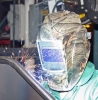
The three authors of the paper published in the Journal of Occupational and Environmental Health conducted the research because there have been few studies on welders' exposures, especially in construction.
"We found employees working without any form of fall protection at heights up to 15 feet, even though this employer well knows the requirement for fall protection whenever employees work at heights of 6 feet or above," said Patrick Griffin, OSHA's area director for Rhode Island.
OSHA's inspection found USA Demolition employees exposed to falls from 10 to 20 feet while working without fall protection on the building's roof.
Nov. 8 is a rarity on the safety and health calendar: An OSHA final rule became effective as of that date, having been published Aug. 9, 2010.
It was not sold as an individual product but was packaged with power tools sold by Canadian Tire Corporation Ltd. of Toronto from January 2004 to May 2010. Health Canada says the company has sold compliant oil since then.
The online page allows users to track the trend lines for elevated blood lead levels in adult workers from 2002 through 2008 in construction, manufacturing, mining, and service industries.
"Excavation is recognized as one of the most hazardous construction operations. However, cave-ins are easily avoided when the proper precautions are taken," said Domenick Salvatore, director of OSHA's Wilmington Area Office.
Fatal incidents where rescue capability is not standing by and available are all too frequent.

While the time savings vary greatly, a rough estimate is that safety managers spent 40 percent of their time delivering training in the pre-online era and now spend 10 percent of their time on it.
OSHA warned gas power plant operators they could face similar fines if the same thing happens at a plant they build or renovate.
"Falling is the great safety hazard for workers on roofing projects, and B.O.S.S. Construction has demonstrated a pattern of disregard for its workers' safety by failing to ensure fall protection is in place on jobsites," said OSHA Area Director Jule Hovi.
Thought to be the first system of its kind, it works by measuring and analyzing the acoustic behavior of soil to establish when a landslide is imminent so preventive action can be taken.
"Falls are the number-one reason workers performing construction work are hurt or killed. There is no excuse for an employer in the construction industry to not provide the necessary equipment and training for workers performing roofing work," said Charles Adkins, OSHA's regional administrator in Kansas City, Mo.
The latest two are dated Sept. 30 and Oct. 1. Both concern interpretations of construction standards.
The 2016 target for federal agencies' rate for lost-time injuries and illnesses is 1.07, which is a 27 percent improvement from 2009's 1.48, according to the DOL plan.
The worker was crushed when he became caught between a fixed metal barrier and a large paper roll that was moving on a conveyor. OSHA identified other hazardous conditions that were not related to the fatality; those resulted in two repeat and two serious citations.