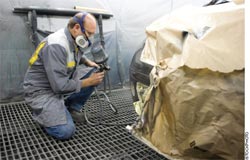
The U.S. Environmental Protection Agency has released its final rule on emissions from auto refinishing operations. As a result, shops should expect to ramp up the time they spend on recordkeeping and training. The rule affects “area sources” of emissions; that is, those operations whose potential emissions are less than 10 tons a year of a single hazardous air pollutant or 25 tons per year of a combination of pollutants.
What can stop a speeding bullet or bomb fragments, repel fire, and protect the wearer from caustic or toxic substances and even the deadliest of pathogens? Personal Protective Apparel (PPA) can. To me, it is a superhero of safety!

Safety videos have long been popular with trainers, and several companies continue to produce high-quality videos on a wide range of topics. With the popularity of YouTube and greater bandwidth available to millions of Americans, the era of free online videos has arrived -- a tsunami of junk, genius, coarse humor, celebrity and wannabe embarrassment, spin, advertising, and even quality.
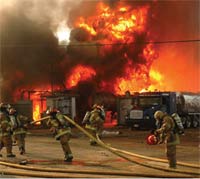
The BP US Refineries Independent Safety Review Panel (“Baker Panel”) and the U.S. Chemical Safety and Hazard Investigation Board both recommended improved industry-wide process safety metrics in their final reports dealing with the 2005 explosion at the BP Texas City, Texas, refinery. This has also been a subject of frequent discussions among process safety organizations such as the Center for Chemical Process Safety (CCPS), as well as magazine articles and other forums.
For the better part of 30 years, I have been involved in a variety of nuclearrelated projects. This is what I know: For the most part, if you give the craft accurate drawings, the tools they need to perform their work, and clear direction, they will perform for you every time. If your staff has a well-defined scope, open communication, and management support, they will perform, as well. If you are doing all of these things and still find project success elusive, what’s missing? I have found that management credibility in regard to safety is the key.
Safety professionals have long been the mainstay of EHS performance. Even as methodologies evolve, new tools emerge, and thinking changes, organizations have counted on these practitioners to guide the core of EHS functioning. Still, changes in the business landscape are beginning to change that role. Businesses have moved to flatter organizational models, leaders have less discretionary time, and competition is increasingly global.
It seems that each year, new hazards in the home, workplace, and community are identified that endanger our health and well-being. Bloodborne pathogens such as bird flu and the mutant bacterial staph, MRSA, continue to threaten our health. New toxicity hazards have been discovered in chemicals that have been used for decades.

OSHA’s recent guidance document for protecting against the skin ailments related to portland cement exposure was a handy reminder that impact hazards are not the only one to be addressed by your foot protection program.

It was interesting and horrifying to watch at the same time: a dedicated worker who, at first glance, was cleaning his work PPE. On closer examination, he had a large bucket of tepid water with a wide range of gloves being dunked and hung up to dry. These gloves had handled raw sewage and were moldy from improper storage after chemicals use or animal blood.
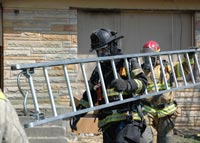
2007 was a tough year for American firefighters, and not only because nine South Carolina comrades died while fighting a fire in June. Preliminary data from the U.S. Fire Administration shows there were 115 on-duty firefighter deaths in the United States during the year, up from 106 the previous year. Although slightly down from 51 percent of the total in 2006 to 47 percent in 2007, heart attacks and strokes continued to be the leading cause, with 54 deaths.
How can you triumph over difficult challenges, even when your company has dual dangers of intensively physical work and an aging workforce?
Two important tradeshows are happening this month. First, the 2008 Fire Department Instructors Conference takes place in Indianapolis April 7-12. About 28,000 firefighters are expected to attend the 80-year-old event, billed as the world's largest firefighter training conference and exhibition. <br />
Then, from April 25 to May 1, the American Association of Occupational Health Nurses will hold its 2008 AAOHN Symposium & Expo in Salt Lake City. This conference is a golden opportunity for occupational nurses to learn and network with fellow colleagues.

Once the junction of the Union Pacific and Central Pacific railroads on a joining a transcontinental route that opened the doors to the American West, Salt Lake City (often referred to as the "Crossroads of the West") will play host this month to another kind of meeting--that of thousands of occupational nursing professionals at the 2008 AAOHN Symposium & Expo. Its dates are April 25-May 1 at the city's Salt Palace Convention Center.
As most safety people know, ergonomics is the science of fitting job tasks, workstations, and equipment to individual workers. Ergonomics looks at all aspects of a job, from the design of tools, tasks, and equipment to adequate lighting and how the overall workstation is set up. And its principles can be applied everywhere—in the workplace, at home, and to recreational activities.
When performing an inspection at a business, you should inspect its fire extinguishers. Looking at the psi gauge to see whether the arrow is in the green and inspecting the tag to determine whether it is current or the extinguisher needs to be inspected will tell you some things about it, but there is a bit more you should know.
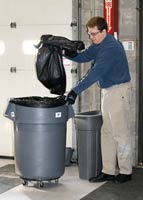
Recent studies show non-hospital-based workers have relatively high exposure rates to bloodborne pathogens. Vonachen Services Inc., a janitorial services contracting company with about 125 employees working in health care facilities, has built its BBP success through hands-on supervision and a strong training program.
Facilities that operate across multiple shifts face a significant challenge when it comes to maintaining the alertness of their employees. According to the National Sleep Foundation, "Sleep deprivation is greatest among shiftworkers, who average only 6.5 hours of sleep compared to 6.8 hours for people on regular '9 to 5' work schedules and 6.9 hours for all respondents."