In the past, cut-resistant gloves were treated as a commodity, with little training and education of wearers. Now, the emphasis is on information and communication.
Safety directors have good intentions when determining the types of safety eyewear to provide for their programs. After all, program managers are truly interested in protecting the eyes of their employees.

The Centers for Disease Control (CDC) tells us that proper hand washing is the single most important action each of us can perform to help stop the spread of diseases.
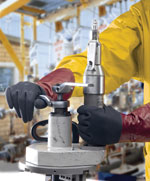
In today's fast paced and ever-changing manufacturing environment, the "personal" aspect of personal protective equipment (PPE) is more important than ever. The process of researching, developing, and manufacturing new products must go full circle, beginning and ending with the workers who wear PPE to perform a variety of tasks day after day.
At some point, most learners will have little experience with traditional approaches to learning that don't involve technology. Finding newer methods is essential.

When it was announced that fatality rates on U.S. roadways had sharply declined in the past 40 years, traffic control experts had a quick explanation: They pointed to the increased use of visual cues, such as reflective signs, raised pavement markers, and rumble strips.
Are you getting the highest levels of respiratory protection that are currently available today?
Buy-in. It is a critical element to a valued safety and health process. The problem is, no one seems to be able to agree on how best to get there from here.
The economy is bad, business is down, and companies are laying off employees in record numbers. They need to cut expenses. An easy target is the company's incentive program. It doesn't produce goods, make sales calls, clean the building, or repair equipment. It just costs money the company doesn't have. Or does it?

June 3, 2008, turned into a nightmare for Chris and Janet Augeri. Instead of celebrating their son Rob's 31st birthday, they were making plans for his funeral.
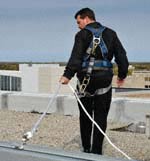
Learning how to minimize the risk of potentially dangerous or fatal fall hazards allows organizations to take a proactive approach to worker safety. In November 2007, the American National Standards Institute (ANSI) released a comprehensive family of standards, known as the Z359 standard or "Fall Protection Code," to help organizations learn how to reduce risk.
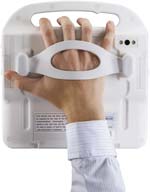
Building a mobile computer for health care involved totally sealing it and adding features such as a fingerprint reader for biometric sign-in, an integrated camera, and a built-in bar code scanner for scanning patients' wrist bands and medicines, said Greg Davidson, Senior Business Development Manager for Health Care for Panasonic Computer Solutions Company (Secaucus, N.J.). He talked about creating computers for these and other challenging environments during a Dec. 1 conversation with OH&S Editor Jerry Laws.
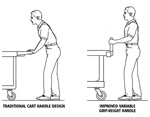
You're in the market for a material handling product, something that can help your employees move those loads quickly and safely. You surf the Web and flip through catalogs, but how do you start to narrow your choices? The same way best-in-class manufacturers create innovative products: research, testing, and knowledge.
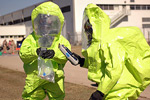
Process Hazard Analysis (PHA), a regulatory requirement under OSHA's 29 CFR 1910.119(e), is a collection of methodologies to address process hazards. Societal and technological changes are affecting sources, intensity, and frequency of hazards. For instance, digital controls and smart instruments have reduced maintenance requirements inherent with analog instruments.
The future will be defined by how organizations respond to globalization, culture and performance; prioritization of safety initiatives; development of employee engagement; and the relationship between organization and employee.
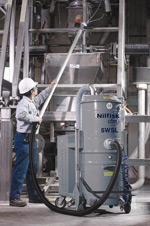
Employees and managers should be trained to recognize and
prevent combustible dust fires, and facilities should have a damage
control plan that includes sprinklers, explosion protection systems,
and deflagration venting.
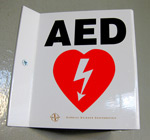
Almost every workplace has a fire extinguisher. Quite a few are equipped with automated external defibrillators. A few suppliers of emergency oxygen units and kits are hoping to see those products someday gain a foothold comparable to AEDs, and possibly even comparable to extinguishers.