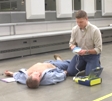
The agency says its facilities experience an average of one sudden cardiac arrest per year among more than 46,000 employees. In the next three years, 97 percent of those employees should have AEDs at their disposal at work, according to the new plan.
The product, Gotham Compact Fluorescent Downlights, was manufactured in the United States and China between Nov. 1, 2007, and July 31, 2008, and sold by electrical distributors and sales representatives nationwide through July 2008 for between $250 and $350.
The U.S. Centers for Disease Control and Prevention has awarded $24 million to fund 55 projects in 29 state and local public health departments that could serve as innovative approaches for influenza pandemic preparedness.
The agency posted 14 letters of interpretation last Friday on topics ranging from HazCom to emergency eyewash, safe sharps, and construction safety training.
The U.S. Fire Administration has announced the availability of a CD-ROM training package for responding to ethanol incidents, titled "Responding to Ethanol Incidents and Ethanol Fixed Facilities and Assessment Guide." A cooperative effort between USFA and the International Association of Fire Chiefs, with assistance from the Ethanol Emergency Response Coalition, this training is intended to address the needs of emergency responders when faced with incidents involving ethanol and ethanol-blended fuels.
The funds, awarded to the Texas Workforce Commission, will be used to provide temporary employment on projects for the cleanup, demolition, repair, renovation and reconstruction of destroyed public structures, facilities and lands within the affected communities.
"This funding will help the New York metropolitan area to acquire equipment, training, and support to further our mission of preventing dangerous radiological and nuclear materials from entering a high-risk urban area."
The Occupational Safety and Health Administration released several public service announcements Friday to help protect employees from hazards such as electrocution and falls from heights during hurricane cleanup and recovery operations.
The new certification exam covers hazmat identification, handling and shipping; emergency planning and response; sampling and analysis; site investigation and remediation; and project management.
The new policy will be enforced starting 30 days from now.

The Metrolink engineer's cell phone records confirm he had sent and received messages last Friday, when his train ran through a red signal and hit another train, killing 25 people.
The federal government is making $5 million available immediately to begin funding work to repair roads, bridges, and airports damaged by Hurricane Ike, U.S. Secretary of Transportation Mary E. Peters announced yesterday during a visit to the Houston region. She added that more funds will be made available for repair and reconstruction work once damages assessed for the region's transportation network have been completed.
The Agency for Healthcare Research and Quality's a new Web-based tool helps hospitals and emergency planners identify resource requirements to treat a surge of patients from major disasters, such as an influenza pandemic or terrorism.
Physio Control Inc. has issued a recall of the LifePak CR Plus Automated External Defibrillators (AED), which is used by emergency or medical personnel to treat adults in cardiopulmonary arrest.
Once the rule is in effect, teams must have twice as many gas detectors and carry more oxygen than is currently required.
The U.S. Chemical Safety Board has announced a public meeting on Sept. 25 in Beckley, W.Va., to reveal its investigation report on the causes of the January 2007 propane explosion at the Little General Store in Ghent, W.Va.
"Because of the unique operating and supply-chain challenges faced by manufacturers, we determined that a new sector council would best address the needs of companies that did not fit precisely within the original 17-sector structure," said DHS Secretary Michael Chertoff.
Travel in the Chicago suburb of Des Plaines, Ill., is difficult today because of flood-related road closures.
In all, 13 people died and 127 others were hurt when sections of the I-35W bridge over the Mississippi River fell on Aug. 1, 2007.
Courses include a Demolition-Specific OSHA 10-Hour Certification, offered in both English and Spanish on Oct. 15 and training in confined space rescue and aerial lift equipment safety.