“Controlling the mosquito vector can work, but it is very expensive and difficult to sustain,” says Anna Durbin, M.D., who is leading the study at Johns Hopkins. “In the long run, vaccination would be a more efficient and cost-effective approach.”
The company received repeat citations for failing to make a reasonable estimate of employee exposure to hazardous chemicals such as hydrogen sulfide and carbon monoxide; it received willful citations for failing to implement confined space entry procedures.
According to the Department of Justice, the amount of the civil penalty is “precedent-setting” yet “appropriate in light of the unacceptable risk” created by the underground storage tanks at the defendants’ 17 gas stations in Maryland and Delaware.
Rather than be deflated by the news that drivers in Dallas, Los Angeles, Orlando, San Antonio, and Birmingham are the worst in the country at keeping their tires properly inflated, hundreds in those areas can get free RMA tire gauges today, if their vehicles can get them there.
The company's "refusal to honor the requirements of this agreement reflects an irresponsible approach to worker safety and health, leaving workers vulnerable to injuries and possible fatalities," said Robert Kulick, OSHA's regional administrator in New York. "This situation is unacceptable and will not be tolerated."
According to Dr. James Muntz, drinking water before outdoor activities is good, but if you plan to be active in the heat for an hour or more, sports or electrolyte drinks are a good supplement as drinking too much water in a short period of time can drop the body's sodium levels, causing a condition called hyponatremia.
A report released Aug. 2 by Safe Work Australia evaluates two possible approaches for using control banding to ensure safety when working with nanomaterials but admits workplaces there have little knowledge of it.
With kids going back to school soon and football practice already underway in many communities, the American Association of Neurological Surgeons (AANS) is issuing an injury prevention message about football and cheerleading.
More than 50 public meetings are in the books for this project of CDC and ATSDR about chemical exposures and public health. An action agenda is scheduled for release in December.
Recent FDA testing has found Listeria contamination throughout the defendants' facility and in a sample of its finished product. Although the company promised to address and correct deficiencies following inspections in 2006, 2007, and 2009, a 2010 inspection confirmed that the company continued to operate without adequate controls, the agency said.
Among the wide range of dangers inspectors listed were the risk of laceration, amputation, or crushing injuries; electrical hazards; fire and explosion hazards stemming from combustible dust; improper storage of flammable liquids; and insufficient monitoring of exmployees’ exposure to hexavalent chromium.
The agency’s latest action, with penalties of $420,000 against the mail facility in White River Junction, Vt., follows its citations against five individual postal facilities in June in various parts of the country -- all centering around insufficient electrical safety practices -- with fines adding up to more than $1.3 million for the month, plus DOL's filing on July 6 against USPS for enterprise-wide relief.
The 33 serious violations OSHA found in its inspection include improper machine guarding, inadequate PPE, a deficient hazard communication program, electrical hazards, and deficient use of lockout/tagout devices for energy sources that prevent the inadvertent start-up of machines.
Two workers were burned while applying primer inside a tanker trailer. One worker died and another remains hospitalized with burns to more than 90 percent of his body. A third worker, the attendant monitoring the confined space in the event of an emergency, was blown off the tank when the vapors ignited.
"The gravity of this type of hazard cannot be overstated," said Paul Mangiafico, OSHA's acting area director in Hartford, Conn. "The collapsing walls of a trench can crush or bury workers in seconds.”
Willful violations were issued for failing to develop specific procedures to protect workers from the unexpected release of electrical energy, and for failing to provide adequate machine guarding for employees working around rotating shafts.
An investigation found workers were exposed to potential fire and explosion hazards from combustible dust collected in an inadequately designed dust collection system and several electrical safety deficiencies, including unguarded or ungrounded live electrical parts and equipment, and workers not trained in electrical safety-related work practices, among other things.
Dry, hot skin with no sweating is not a good sign; it’s one of the symptoms of heat stroke and can be deadly. When working in the heat, try to have a cool cup of water every 15 minutes.
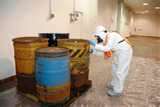
The first of two important EU phase-in deadlines arrives a few days before the UNECE Sub-Committee of Experts on the Globally Harmonized System of Classification and Labelling of Chemicals meets Dec. 7-9 in Geneva.
The company was cited for 43 safety and health violations for hazards ranging from inadequate PPE and machine guarding to failing to determine employee exposure levels to hexavalent chromium.