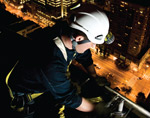
One of the questions most frequently asked is, "What kind of training do I need to be a Competent Person in regard to fall protection?" Although it seems like a straightforward question, the answer can be a little tricky. Many people believe the singular requirement to achieve Competent Person status is completion of a fall protection course, but it's just not that simple.
"Steel mills remain a dangerous place to work, and it is inexcusable to fail to correct serious dangers, particularly after they've already been identified by OSHA. . . . We expect better," said OSHA Area Director Jule Hovi in Toledo, Ohio.
Employees not wearing PPE and the employer's failure to develop, implement, or maintain a written hazard communications program for employees working with mortar or cement were among the 11 repeat violations, which, together with five serious violations, have proposed penalties totaling $146,000.
The 2004 death of Keith Webb, 53, during the unloading of a ship docked in the Thames River exposed Tate & Lyle PLC's failure to train employees to enter and exit ships' holds.
"Improperly utilized fall protection equipment is just as deadly as failing to use fall protection at all," said OSHA Area Director Rosemarie Ohar. "Workers who lack adequate and effective fall protection are just one slip, trip or misstep away from a potentially fatal plunge."
"This company was previously cited for workplace hazards and did not take the necessary steps to be in compliance, resulting in this avoidable tragedy," said Lisa Levy, area director of OSHA's office in Hasbrouck Heights, N.J.
Sept. 30's revised compliance directive for the Steel Erection Standard says it is no longer a de minimis violation if steel erection workers are wearing PPE but the requirements for a fully planked or decked floor or use of a net aren't met.

Between the National Safety Congress and A+A, taking place amid Dusseldorf's lovely scenery, the world's PPE providers and safety professionals will have plenty to chew on before the holidays.
In addition, the company faces fines for three serious violations relating to poor egress procedures from the trench, failure to provide proper training for trench operations, and placing excavated materials too close to the edge of the trench.
OSHA cited the company with one willful violation for failing to provide an adequate protective system for employees working in an excavation 8 to 10 feet in depth and one serious violation for failing to ensure employees were wearing high visibility vests.
According to the investigation, the worker was covered by almost 240-degree asphalt released from an open valve on the transfer system due to a pressure increase that separated the transfer hose from the system.
Proposed penalties against the two companies total more than $97,000. John Healy, OSHA's area director in Englewood, Colo., said the agency "will be stepping up its enforcement of fall hazards, especially in those areas of the state that experienced significant hail damage this year--areas where we expect to see an influx in roofing work."
"There can be no delay in exiting a workplace during a fire or other emergency when the difference between escape and injury or death can be measured in seconds," said Kay Gee, OSHA's acting area director in Manhattan.
The site's lack of eyewash or shower stations near where employees were exposed to corrosive materials were among the 10 serious health violations for which OSHA cited the Georgia company.
"The procedures for protecting trench workers are easy enough to implement, but what's required first is employer and employee dedication to workplace safety and health," said Greg Baxter, OSHA's regional administrator in Denver.
The new IPAF safety video uses scenarios extracted from its popular operator training course, which is used to train about 80,000 people per year.
A follow-up OSHA visit found uninspected overhead cranes; uninspected lifting hooks; defective and unmarked lifting slings; unguarded live electrical parts; damaged electrode holders and insulation; incorrectly stored compressed gas cylinders; unmarked and unchecked fire extinguishers; and slipping hazards from an oil spill in a work area.
"OSHA has inspected this company on five occasions going back to 1997, resulting in numerous violations, including many we found again on this most recent inspection," said OSHA Area Director Kathy Webb, North Aurora, Ill.
"One wrong step can end a worker's career or life," said Kay Gee, OSHA's acting area director in Manhattan. "We want to emphasize to all contractors the importance of supplying effective fall protection safeguards and training to their workers."
The intensive weeklong event, Feb. 14-20, will include more than 50 seminars ranging from one to three days in length on all manner of safety and health topics.