Used in statewide deployment programs, the units also are deployed in Europe, Asia, Africa, and South America, the company said.
HHS Secretary Michael E. Leavitt recently addressed global preparedness for potential flu pandemics on an HHS blog. He urged all nations to work together.
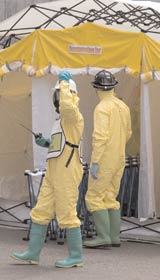
TANK overfills. Forklift punctures. Floods. Earthquakes. Willful destruction. Spill response planners are tasked with creating plans for any possible spill incident that could occur at a facility. Often, however, the “best” or “ideal” plan to handle a situation is scrapped because of budgetary, manpower, or space constraints. Sometimes, less-than-perfect plans are developed because plan coordinators aren’t aware of the wealth of resources available in their communities. Acknowledging that the facilities may not need to purchase or store all of the items they could ever possibly need is an important first step toward achieving a more ideal spill response plan.

JOHN Sidler, 19, was driving to work in Dallas on a rainy Saturday morning in October 2005 when his truck hydroplaned and smashed into a utility pole, crushing his vehicle and knocking him unconscious. Good Samaritans who witnessed the accident rushed to his aid and called 911.
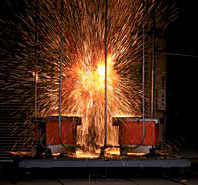
ANY petrochemical worker or electrician exposed to electric arc has something in common with a meth lab cleanup team. Shawn Arbuckle of Denver's National Jewish Medical and Research Center describes the scene: "When we work in a cleanup, we don't know exactly what we'll be exposed to, but we do know the potential is there for fire and chemical exposure."
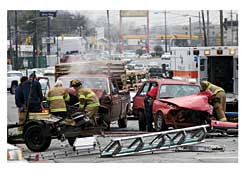
Under Pressure
LIGHTNING-FAST, acutely accurate assessment under pressure and with little information is a matter of course, as is providing consistent, standardized response to life-threatening emergencies--the framework of a first responder's actions. Does it sound easy? These personnel have to project calm reassurance to the victims, no matter what is happening at that moment and, all the while, they're busy saving someone's life.
SIX years ago in New York City, and again two years ago in New Orleans, responders had to collaborate and communicate in crisis environments where tried-and-true technologies were of little use.
Devastating catastrophes and the work of key individuals have contributed to the evolution of modern occupational health and safety.
Editor's note: Safety and hazmat professionals can be and should be major contributors to overall emergency preparedness, says Steve Laughlin, CHMM, of CJ&K Training Services in Lindenhurst, Ill. Laughlin, who coordinates Emergency Response Scenarios at annual conferences of the Academy of Certified Hazardous Materials Managers, Inc., believes such events alert the response community to safety professionals' skills and knowledge.
Editor's note: End users' confusion about multiple classes of protective apparel will ease as they become familiar with new editions of NFPA standards for responders' protective apparel, says Jeffrey O. Stull, president of International Personnel Protection Inc. of Austin, Texas.
SINCE September 11, 2001, hospitals across the United States have invested in equipment to facilitate safe operations and communication during a crisis involving airborne infections or nuclear/biological/chemical (NBC) contaminants. The extent of this investment varies from one region of the United States to another and from one hospital to the next, but this much is clear:
WHAT exactly is "OSHA First Aid," and what do you need to do to comply with regulations for your industry?
IN recent years, we Americans have experienced more than our share of natural and man-made disasters. From the six major hurricanes that struck Florida during the past two years to oil spills, tornadoes, and the devastating acts of terrorism on Sept. 11, 2001, and the Oklahoma City bombing, first responders and cleanup personnel have been required to work with a variety of catastrophic situations and related hazards.
THE operating philosophy and the challenge facing the emergency services component of a major U.S. city is to be prepared for anything and to protect the area's 2 million residents. The city's Bureau of Operations includes the fire department, emergency medical technicians, paramedics, four heavy rescue units, and a special hazardous materials team.
YOU are sleeping soundly in your own bed, for a change, after spending the better part of two weeks at the site of a chemical warehouse fire, where you assessed exposure--or the lack thereof, as it turned out--of neighboring buildings and the employees who inhabit them.
THE anthrax incident of 2001 was a small bioterrorism attack in terms of the amount of agent used (the letter addressed to Senator Daschle contained only two to three ounces of anthrax spores, and the other letters contained similar amounts) and the resulting morbidity and mortality. (There were only 22 cases of anthrax and five deaths).
ONE doesn't normally think about water conservation during an emergency. A fire, for example, needs to be contained and extinguished as quickly as possible. And that usually means using copious amounts of water.
Editor's note: "White powder" incidents continue to occur in the United States, largely at mailrooms. U.S. Postmaster General John E. Potter asked Congress in April for $51 million for security costs associated with a Biohazard Defense System, a Ventilation and Filtration System, and a mail sanitization facility to be located in Washington, D.C.
FORTUNATELY, it's not every day that a 10,000-gallon holding tank fails or a forklift harpoons a drum of solvent sitting next to a floor drain. But no matter what spills, facilities need to be prepared.