The multi-year study of 10 organizations employing more than 150,000 workers indicates that employers who focus only on medical and pharmacy costs in creating employee health strategies may misidentify the health conditions that most impact the productivity of their employees -- while underestimating the impact of other factors.
The Food and Drug Administration recently announced that it had obtained a permanent injunction barring Neilgen Pharmaceuticals Inc. of Westminster, Md., its parent company, Advent Pharmaceuticals, Inc. (Advent), of East Windsor, N.J., and two of their officers, Bharat Patel and Pragna Patel, from manufacturing and distributing any unapproved, adulterated, or misbranded drugs.
St. Louis-based Express Scripts, Inc., already one of the largest pharmacy benefits management companies in North America, says it will manage more than 750 million prescriptions annually.
National Public Health Week 2009, which ends today, asks supporters to commit to making the United States the world's healthiest nation within a generation.

New findings could lead to new drugs that would disarm the increasingly antibiotic-resistant pathogen Pseudomonas aeruginosa--shown here being fed on by a Caenorhabditis elegans worm--rather than attempting to kill it.

Automated external defibrillators are among 25 medical devices for which FDA is telling all manufacturers to submit safety and effectiveness information so the agency can evaluate their risk levels.
Chronic Obstructive Pulmonary Disease was the underlying cause of death for 718,077 people 25 and older in 2000-2005, with annual deaths rising from 116,494 in 2000 to 126,005 in 2005, according to the study published in JAMA.
The company, a small municipal solid waste burner, was accused of not taking the correct measures to control its mercury, dioxin, and furan emissions.

The American Heart Association's National Start! Walking Day is Wednesday, April 8. The goal is to promote healthy living and healthy co-worker relationships, according to the organization.
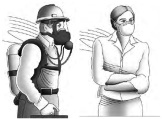
Among other things, the agency's new, 51-page guidance document explains how to use Assigned Protection Factors numbers and Maximum Use Concentration limits, per the 2006 revisions to its Respiratory Protection standard.
Michael Sears is a soft-tissue injury reduction specialist. He's one of the (too few, from my experience) exceptional breed of chiropractic physicians who, rather than focusing on scheduling ever-ongoing sessions with clients, instead emphasizes self-care and personal control of well-being. Perhaps this is because he's also a restorative Yoga instructor.
The "Getting Through Tough Economic Times" guide provides practical advice on identifying health concerns, developing coping skills and finding help.
Preventing disability rather than managing it will be the new model for the claims management system of the Ohio Bureau of Workers' Compensation. An April 29 forum will discuss how to identify workers at risk of long-term disability.
The 94th annual meeting in the series will take place at the sumptuous Manchester Grand Hyatt hotel in San Diego, Calif.

Two special reports will help employers boost the ROI of their health and wellness offerings and ensure they, and their employees, are financially healthy, too.

Occupational foot protection is very often ignored until a serious injury occurs. Safety professionals should take the following steps to ensure their facilities and employees are following best practices when it comes to foot protection.

Both wellness and workplace occupational health and safety (OHS) have benefits to employees and employers alike. While both can be implemented separately, there are proven additional benefits to combining the two programs into one overall Employee Health, Safety, and Wellness (HSW) Program where the total is greater than the sum of the parts. Combine your efforts in these 12 areas and enjoy improved wellness.

Three centers of excellence funded in 2006 and 2007 are researching beneficial approaches to make the workplace safer and healthier for health care workers and other groups.

The efforts of APIC and other organizations this year are aimed at significantly reducing health care-associated infections. APIC CEO Kathy Warye, shown here, hailed a recent CDC study showing gains against MRSA among ICU patients.