
To the thousands of visitors planning to attend the American Society of Safety Engineers' Safety 2009 conference and expo, symbols are valuable tools. At the job site, symbols can warn workers of imminent danger, advise them about proper PPE, or convey the quickest egress route during an emergency.

Today marks the start of this year's hurricane season. With more than 35 million Americans living in regions threatened by Atlantic hurricanes, now is the time to prepare.
Training is critical, including a relevant, compelling message that explains the reasons for precautions as much as the precautions themselves.
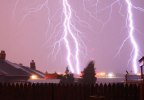
Also, because summer is the peak season for one of the nation's deadliest weather phenomena--lightning--NOAA is calling attention to Lightning Safety Week, June 21-27, by offering a number of new, free resources to increase safety awareness.
With Memorial Day here, pools across the country are opening. A new report was recently released by the Consumer Product Safety Commission (CPSC) that provides updated figures on child drowning deaths and injuries in pools and spas. CPSC's latest data reveals that nearly 300 children younger than 5 drown in pools and spas each year, and about 3,000 suffer pool or spa-related injuries requiring attention at hospital emergency rooms.
The Department of Homeland Security's Federal Emergency Management Agency (FEMA) has issued a special report, part of its Topical Fire Report Series, examining the causes and characteristics of fires in medical facilities.

"The decision to declare an influenza pandemic will fall on my shoulders," Dr. Margaret Chan, director-general of the World Health Organization, said Friday. "I can assure you, I will take this decision with utmost care and responsibility."
The Food and Drug Administration (FDA) has approved a new manufacturing facility used to produce influenza virus vaccines. The facility is approved for seasonal influenza vaccine production and could be used for the production of vaccine against the new 2009 H1N1 influenza strain.
The U.S. Fire Administration (USFA) and the National Institute of Standards and Technology (NIST), in cooperation with the Fire Protection Research Foundation, the Polytechnic Institute of New York University, the Fire Department of New York City, and the Chicago Fire Department, have completed work on evaluating several firefighting tactics under wind driven conditions.
The U.S. Fire Administration is reminding the public that time is running out to submit an application for the 2009 Assistance to Firefighters Grant (AFG). Completed applications must be submitted no later than 5 p.m. EDT on Wednesday, May 20, 2009.
The Department of Homeland Security's Federal Emergency Management Agency (FEMA) has issued a special report examining the causes and characteristics of residential multiple-fatality fires. The report, titled "Multiple-Fatality Fires in Residential Buildings," was developed by the National Fire Data Center, part of FEMA's U.S. Fire Administration (USFA). The report is based on 2004 to 2006 data from the National Fire Incident Reporting System (NFIRS).

The Food and Drug Administration and the Federal Trade Commission are alerting the public to be wary of Internet sites and other promotions for products that claim to diagnose, prevent, mitigate, treat, or cure the 2009 H1N1 influenza virus.
The U.S. Fire Administration has completed its review of a recently released study conducted by the TriData Division of the System Planning Corporation, analyzing firefighter presumptive cancer legislation and attempting to prove or disprove a correlation between firefighting activities and the occurrence of cancer. According to USFA, while this study is considered thoughtful and well-presented, its results are scientifically inconclusive and indicate that more expansive study is in order.
"Planning for pandemic influenza is critical, and the business community must not delay in considering the impact of a pandemic and to adjust their company's employee health and safety plans accordingly," says AIHA President Lindsey Booher, CIH, CSP.
Researchers have detected common plant toxins that affect human health and ecosystems in smoke from forest fires. The results from the new study also suggest that smoldering fires may produce more toxins than wildfires--a reason to keep human exposures to a minimum during controlled burns.

HHS Secretary Kathleen Sebelius also announced her agency has begun moving 400,000 treatment courses to Mexico to help slow the spread of the H1N1 virus there.