
Assistant Secretary Joseph A. Main said the "Rules to Live By" program "should make great strides in preventing fatal accidents."
On a 2-1 vote, the U.S. Chemical Safety Board approved urgent safety recommendations on gas purging safety at a Feb. 4 public meeting in Raleigh, following extensive testimony and public comment.

The Toxic Substances Control Act may allow EPA to obtain more useful data than it now gets about the health effects of commercial chemicals. But the extent of EPA's authority to collect such data is unclear and untested, a new Government Accountability Office report concludes.
The Department of Homeland Security's Federal Emergency Management Agency (FEMA) has issued a special report, part of its Topical Fire Report Series, examining the causes and characteristics of fires in hotels and motels.
The Food and Drug Administration, along with the Centers for Disease Control and Prevention and the Department of Agriculture's Food Safety and Inspection Service, recently reported it is continuing to work closely with the Rhode Island Department of Health and other states in the investigation of an outbreak of Salmonella Montevideo infections associated with certain Italian-style sausage products including salami/salame.

The International Apparel Federation and two allied organizations have organized a conference Tuesday in Paris about product safety and chemical safety regulations in the United States and the European Union, while, outside, the big Texworld 2010 conference takes place.

After the Maritime and Coastguard Agency finishes its consultation with stakeholders, regulations could be in effect by Oct. 1 to implement EC Directive 83/477/EEC and protect workers from asbestos exposure.
Industry operations covered include the transfer of cargo between ships, trucks, pipelines, and other modes of transportation, and the operation and maintenance of piers, docks, and associated buildings and facilities.
Anyone intending to manufacture, import, or process them for an activity that is designated as a significant new use would have to notify EPA at least 90 days in advance, giving the agency time to evaluate the intended use and bar it, if necessary.

In a news release titled "OSHA's VPP Will Continue to Thrive" and a video, the association's executive director -- an OSHA veteran himself -- says it will weather this tempest.
"This case is a clear example of what can and does happen when adequate and effective scaffolding and fall protection are lacking at a jobsite," said OSHA's Brenda Gordon, commenting on the incident in Boston's Roxbury neighborhood.
Although North Carolina is one of 22 states that operate their own job safety and health programs, under approval and monitoring by federal OSHA, this inspection was conducted by federal OSHA because the contractor was working on a federal installation.
"With the full support of the mining industry, ‘Rules to Live By' should make great strides in preventing fatal accidents," said Joseph A. Main, assistant secretary of labor for mine safety and health.

Participants will receive an educator kit with graphics, simulations, supplies, a script, and a sound level meter needed to present the program in their own classrooms.
An inspection found that the Atlanta-based company also failed to fully implement a hearing conservation program and did not have an established written hazard communication program on exposure to hazardous substances. Proposed fines exceed $135,000.
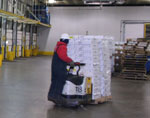
The loading dock is usually regarded as the primitive "backroom" of food-handling operations, but it's a crucial part of the supply chain and the food protection chain.

A common failure of these programs is doing nothing, because it is easy to put this topic off during a tough economy.
The eyewear company, part of Sperian Protection, says the tips, articles, and tools available there will help companies improve their cultures.
Agency inspectors found that combustible particulate solids, which were generated during trimming and repair operations, were not collected into an adequately designed dust collection system, were allowed to accumulate on machinery and surfaces, and were not adequately cleaned up to prevent such buildup.

Of the 167 retail trade workers killed in 2007, 39 killed were convenience store employees, 32 worked at gasoline stations, and 7 worked at liquor stores.