The report takes a look at the number of 2010 firefighter injuries, injuries by type of duty, exposures to infectious diseases, and how a community’s size affects the number of injuries within a fire department.
NIOSH recently compiled a fact sheet on lung disease that can result from exposure to flavoring chemicals containing diacetyl.
The new www.YouKnowStyrene.org from the Styrene Information & Research Center includes a section about exposure limits and health studies.
The resources include a list of potentially life-threatening infectious diseases, including emerging infectious diseases, and specifying those diseases routinely transmitted through airborne or aerosolized means.
The case includes nine per-instance willful citations for failing to require respirator use by six workers exposed to dust above the permissible exposure limit and failing to adequately protect three dust collection units which collect dusts such as starch, potato base, cellulose fiber, and pea protein.
Jim Johnson, past chairman of AIHA’s Respiratory Protection Committee, said he hopes training modules will be ready by the 2012 AIHce conference in Indianapolis.
Data presented Oct. 31 at the American Public Health Association's 139th Annual Meeting showed nearly all construction workers will experience one or more work-related injuries or illnesses over a lifetime, plus a greater risk of premature death.
Two new web pages are dedicated to raising awareness of both year round, and particularly during November, which is both Lung Cancer Awareness Month and COPD Awareness month.
The revision in the emergency management drill requirements in Standard EM.03.01.03 for the home care accreditation program would allow some organizations to use annual tabletop exercises rather than functional ones.
Low barometric pressure and low humidity, combined with the seasonal drying of many areas in underground coal mines, have been key factors in past mine explosions.
"Workers at this welding shop are left vulnerable to hazards that could cause serious injuries or even death," said Prentice Cline, director of OSHA's Charleston Area Office.
OSHA issued the company a willful safety violation for failing to remove a crane from service that required necessary repairs before resuming crane operations.
Mine inspectors are checking underground mines with large fleets of diesel equipment, while the PPE blitz targets health care workplaces, among others.
Published in the Oct. 7 issue of CDC's MMWR, the study examined data from six states participating in the SENSOR program and the National Electronic Injury Surveillance System. Forty percent of state cases were work-related.
"The most common causes of home fires include cooking, heating, electrical malfunction, smoking materials, and candles,” said FEMA Regional Administrator Ken Murphy.
The final day's activities Oct. 6 in Columbus, Ohio, included a mine rescue stakeholder meeting with MSHA Assistant Secretary Joe Main, and an awards banquet in the Battelle Grand Ballroom.
OSHA inspectors found that workers were exposed to respiratory and confined space hazards while cleaning waste tanks used to store petroleum hydrocarbons at a job site in Channahon, Ill.
The Sept. 28 decision in Secretary of Labor v. Southern Scrap Materials Co., Inc. allowed the commission to resolve all 10 cases with this designation by the end of fiscal 2011.
Nine employees were performing cutting and fire watch operations inside the hopper space, an area between the cargo hold and the bottom plate of the vessel, with limited means of entry and exit when the flash fire occurred.
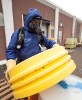
It is imperative for hazmat teams to understand the requirements of NFPA 1994 and NFPA 1992. Doing this not only determines your safety during use, but also gives peace of mind while in the hot zone.