Rethinking the Hierarchy of Controls
Too often organizations start with PPE instead of eliminating hazards at the source. Applying the Hierarchy of Controls in the correct order is key to sustainable risk reduction and safer workplaces.
- By Francesco José Addabbo
- Mar 05, 2026
In the complex landscape of modern occupational health and safety, the Hierarchy of Controls stands as the most critical framework for protecting workers. However, in many industrial and commercial environments, this hierarchy is widely known but not consistently applied in the intended order of priority. Preventive action often intensifies only after a significant incident or a "near-miss" has occurred. In these scenarios, organizations typically respond by introducing stricter administrative controls or increasing the reliance on personal protective gear, addressing the symptoms of worker injuries rather than preventing the underlying exposure in advance. This reactive pattern highlights a systemic need to reconsider how the Hierarchy of Controls is understood, taught, and implemented across various sectors. Despite being a fundamental risk management principle, many organizations erroneously begin their prevention strategies at the bottom of the pyramid with personal protective equipment (PPE). They fail to recognize that PPE represents the final, and statistically least effective, level of protection available. Reexamining the practical application of this hierarchy allows safety professionals to shift the organizational mindset from injury response toward true hazard elimination and sustainable risk reduction.
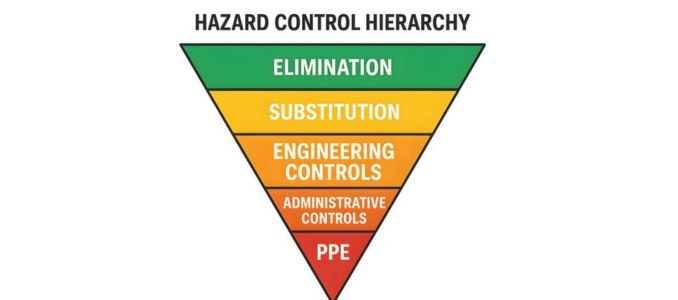
The concept now known as the Hierarchy of Controls emerged during the early decades of the twentieth century, when rapid industrialization exposed workers to increasingly complex mechanical, chemical, and operational hazards. Early safety practices were largely reactive and frequently placed the burden of responsibility on worker behavior rather than on the inherent design of the hazard. As industrial engineering and occupational hygiene evolved, safety professionals recognized that effective prevention required addressing hazards at their source. By the mid-twentieth century, regulatory institutions and international safety organizations began promoting systematic prevention strategies emphasizing hazard elimination and engineering solutions instead of relying solely on personal protection. Over time, this structured prioritization evolved into the formal Hierarchy of Controls, ranking risk control strategies from most effective to least effective: elimination, substitution, engineering controls, administrative measures, and finally, personal protective equipment. Today, this hierarchy remains a foundational principle in occupational risk management and is embedded in international standards worldwide.
To understand why the hierarchy is structured with such strict prioritization, we must analyze the inherent reliability of each tier. At the pinnacle, elimination and substitution represent the concept of "inherent safety." By physically removing a toxic chemical from a process or replacing a high-voltage electrical system with a low-voltage alternative, the possibility of human error leading to a catastrophic accident is virtually removed. Substitution, for instance, is often overlooked by management due to perceived initial costs or procurement challenges. Yet, replacing a volatile solvent-based cleaning agent with a non-toxic aqueous one can eliminate the entire need for complex ventilation systems, expensive monitoring equipment, and specialized respiratory PPE. This "Prevention through Design" (PtD) approach ensures that safety is an integrated feature of the industrial process rather than a cumbersome addition that workers must manage.
A practical example of this shift from a reliance on PPE to the implementation of engineering controls can be observed in specialized mail-handling and logistics operations. In a recent operational safety assessment, we identified a recurring hazard where employees frequently suffered lacerations, punctures, and skin abrasions while reaching into deep, sharp-edged mailboxes or narrow sorting bins to retrieve items. Initially, the standard reactive response from the safety committee was to mandate the use of heavy, cut-resistant gloves (PPE). However, this "solution" created new problems; the gloves reduced the tactile sensitivity and dexterity required for precise sorting tasks, leading to decreased productivity and inconsistent compliance among the staff. To resolve this without blaming the workers for their behavior, we implemented an engineering solution by introducing a generic mechanical "pusher" tool. This simple modification allowed for the safe advancement of items within the box or bin without requiring the employee to insert their hands into high-risk areas. By substituting a high-risk manual reach with a simple mechanical advancement tool, we eliminated the hazard at its source. This demonstrates that engineering controls are far more reliable and effective than relying on individual personal behavior or the integrity of protective gear alone.
Administrative controls aim to reduce worker exposure through organizational measures rather than physical modification of the hazards themselves. These include workplace procedures, task rotation, comprehensive training programs, safety signage, and routine inspections. Programs such as lockout/tagout (LOTO) procedures demonstrate how administrative measures can limit exposure by strictly regulating how work activities are performed around hazardous energy. However, administrative controls possess an inherent and well-documented weakness: they rely entirely on human diligence, constant supervision, and the absence of fatigue or distraction. If a procedure is perceived as too complex, or if it significantly slows down production quotas, workers may naturally find "workarounds" that bypass the safety measure. Therefore, while administrative controls are superior to PPE, they require constant auditing and a high level of organizational discipline to remain effective over time.
Personal Protective Equipment represents the final and most vulnerable level within the hierarchy. Equipment such as gloves, protective footwear, eye protection, and hearing protection creates a physical barrier between workers and existing hazards, but it does not remove the hazard. The effectiveness of PPE depends heavily on several factors: correct selection for the specific hazard, proper fit for the individual worker, rigorous maintenance, and, most importantly, consistent and correct use by the human being. Effective safety management therefore requires the integration of multiple control levels rather than a singular reliance on PPE as the primary line of defense. It is crucial for safety leaders to communicate that PPE is the "last line of defense." If the equipment fails, is damaged, or is worn incorrectly for even a moment, the worker is immediately and fully exposed to the hazard.
In practice, the selection of controls is often influenced by economic and operational constraints. Studies conducted in developing industrial environments have shown that limited funding and insufficient regulatory oversight frequently restrict the implementation of high-level engineering solutions. Under such conditions, organizations tend to rely heavily on PPE because it represents the fastest and most operationally feasible control to introduce without interrupting production activities or requiring significant capital investment. Interestingly, sectors that demonstrate a stronger management commitment to worker education and leadership reported measurable improvements in safety performance and significant reductions in medical-related costs. These findings highlight the absolute importance of leadership when higher-level controls cannot be immediately implemented due to technical or financial barriers.
Higher-level controls, such as elimination or engineering redesign, often require careful planning, significant investment, and sometimes temporary operational disruption. These "hard controls" may involve equipment modification, workflow redesign, or even production stoppages to install new systems. When organizations reverse the hierarchy and prioritize protection over hazard removal, safety improvements may appear only temporary while the underlying hazard remains unchanged and dormant. This often creates a "false sense of security" within the workforce, where the presence of PPE masks the fact that the danger is still present and potentially catastrophic if the barrier fails.
To bridge the gap between simple compliance and true operational safety, organizations must foster a culture that prioritizes the "hard controls" of elimination and engineering. This requires a profound shift in mindset from the boardroom to the shop floor. Management must be willing to invest in long-term solutions, such as automated systems or ergonomic redesigns, which may have higher upfront costs but yield massive returns in reduced injury rates, lower insurance premiums, and increased employee morale. When workers see that an organization is willing to change the physical environment to protect them, rather than just handing out more gear and placing the burden on them, trust in the safety program grows exponentially. This cultural shift is the missing link in many safety programs that struggle to move beyond the bottom tiers of the hierarchy.
Even highly controlled and technologically advanced environments continue to contain inherent hazards. The aviation industry provides a clear example: the dangers associated with flight and high-speed machinery are not eliminated but are significantly reduced through rigorous engineering design, redundancy systems, maintenance programs, and standardized operational procedures. Aircraft safety depends not on eliminating danger entirely—which is impossible in flight—but on controlling risk through multiple, overlapping protective layers. This reflects the true objective of the Hierarchy of Controls: systematic risk reduction rather than the unrealistic elimination of all possible hazards. High-noise production environments also illustrate the complexity of PPE implementation. Providing hearing protection alone does not guarantee safety if the noise levels are not reduced at the machine level. Workers may avoid using equipment due to discomfort, communication difficulties, or social factors. Responsibility for PPE management also remains a critical legal and ethical issue; even when workers use personally owned equipment, employers retain the responsibility for ensuring that such equipment meets required safety standards and provides adequate protection for the specific task at hand.
The effectiveness of PPE depends largely on its condition and the training provided to the user. Safety professionals should therefore implement structured inspection procedures before work activities begin. Pre-task PPE inspection checklists completed by workers encourage individual accountability, reinforce hazard awareness, and help identify damaged or unsuitable equipment before exposure occurs. As the final line of defense, PPE must always function within a broader, multi-layered prevention strategy guided by the Hierarchy of Controls. Regulatory environments also influence how these controls are prioritized. European occupational safety systems strongly emphasize legal compliance and employer responsibility through the General Principles of Prevention, while U.S. safety management frameworks more explicitly promote the Hierarchy of Controls as a decision-making model for hazard reduction.
Conclusion
Effective occupational safety cannot and should not rely solely on personal protective equipment. True prevention requires thoughtful planning, engineering consideration, and continuous collaboration between management and the workforce. When organizations apply the Hierarchy of Controls systematically, safety moves beyond reactive compliance toward sustainable risk reduction integrated into everyday operational decision-making. By prioritizing hazard elimination and engineering solutions, companies not only protect their employees more effectively but also foster a more resilient and safety-conscious workplace culture. The ultimate goal of any safety professional is to create a workplace where safety is "built-in" rather than "bolted-on," ensuring that every worker returns home healthy and whole at the end of every shift. Integrating these principles is not just a regulatory requirement; it is a moral imperative that defines the future of industrial health and safety excellence.
References:
- American National Standards Institute (ANSI). (2011). Prevention through Design: Guidelines for Addressing Occupational Hazards and Risks in Design and Redesign Processes (ANSI/ASSP Z590.3). American Society of Safety Professionals.
- European Agency for Safety and Health at Work (EU-OSHA). (2023). The General Principles of Prevention: A Guide to the Hierarchy of Controls in the European Union. Publications Office of the European Union.
- Manuele, F. A. (2014). Advanced Safety Management: Focusing on Z10 and Serious Injury Prevention (2nd ed.). John Wiley & Sons.
- National Institute for Occupational Safety and Health (NIOSH). (2015). Hierarchy of Controls. Centers for Disease Control and Prevention.
- Occupational Safety and Health Administration (OSHA). (2016). Recommended Practices for Safety and Health Programs. U.S. Department of Labor.