How Wearable Technology is Helping Mitigate the Skilled Labor Shortage
Industrial leaders are turning to wearable technology—from exosuits to smart sensors—to reduce injuries, extend careers, and tackle the growing skilled labor shortage.
- By Karl Zelik
- Oct 03, 2025
America’s industrial industry is in the midst of a deepening labor crisis, as one study projects there will be 1.9 million unfilled jobs by 2033. This shortage is already reshaping the industry. To stay competitive, industry experts are exploring solutions to retain employees and create safer conditions for new workers. One promising tool is wearable technology.
Three compounding trends lie at the heart of the issue:
- An Aging Workforce
Baby Boomers and GenX-ers make up 40% of the skilled trades. Many of these workers are retiring—some because they’ve reached the end of their careers, others because their bodies can no longer keep up. Years of heavy lifting, repetitive motion, and awkward postures lead to chronic musculoskeletal disorders (MSDs), forcing early retirement and taking decades of expertise with them.
- Younger Workers Aren’t Replacing Them
Younger generations are less likely to pursue careers in logistics and manufacturing trades. The U.S. Bureau of Labor Statistics states that the median age of a manufacturing worker is 44. The industrial sector continues to suffer from a branding issue, often viewed as having fewer desirable occupations than other fields like healthcare and tech.
- Physically Demanding Work Accelerates Attrition
Logistics and manufacturing work remains physically taxing. Prolonged bending, lifting, and overhead tasks lead to fatigue and injury, creating high turnover rates. The U.S. manufacturing industry saw $1.7 billion in losses last year from overexertion injuries alone—about one of every four injuries reported from this sector.
Wearable Technology: A Promising Solution
Industrial leaders are turning to various emerging technologies, including a growing class of wearable technologies that help reduce physical strain and cognitive demands on workers. These devices do not replace human labor, but assist it, making physically demanding tasks safer, easier, and more sustainable.
Key technologies include:
- Back and shoulder exos: Assist workers during lifting, bending, ground-level, or overhead tasks to reduce bodily strain and increase endurance.
- Powered gloves: Enhance grip strength and reduce hand fatigue.
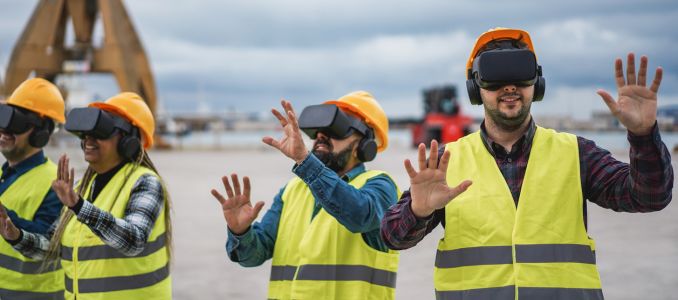
- Augmented reality headsets: Provide real-time, contextual data to boost efficiency.
- Body-worn sensors: Monitor conditions such as heat, noise, and posture to help manage worker safety.
These wearable tools function as human augmentation systems that make labor-intensive roles more viable across age, gender, stature, and experience levels. Yet, the trajectory of wearables in logistics and manufacturing has been anything but linear—as exemplified by exos (exoskeletons and exosuits).
Brief Recent History of Exos
While the history of exos dates back over 100 years, the last decade has seen the most rapid and transformative developments. Interest surged in the late 2010s—especially in auto manufacturing and logistics—with some companies beginning to mandate shoulder-support exos. But despite promising injury reduction outcomes, growth stalled and exo usage mandates were rolled back.
This revealed the need for:
- Exos that were more comfortable, versatile, and easy to use.
- Implementation strategies that streamlined training and task-matching.
- Sustainment plans that boosted worker buy-in and long-term adoption.
- Industry case studies and longitudinal evidence that demonstrated ROI.
In the early 2020s, the exo industry made several major leaps forward. Today’s exos are lighter, more comfortable, and more job specific. Lessons from earlier efforts led to smarter deployment, broader adoption, and clearer evidence of long-term value. Exos are now experiencing a second, larger surge in growth.
The Real Value of Exos
In the last few years, the value proposition of exos has crystallized, stemming from three main areas:
1. Performance Enhancement (Due to Less Fatigue and More Endurance)
Multiple academic and industry studies have found back-assist exos make lifting easier, reduce back muscle fatigue —typically by 20-60%—and enhance productivity. A Brock University study demonstrated that back exo users completed their palletizing tasks 6% faster and shipped the equivalent of 160 more boxes in an 8-hour shift. Clemson University found that wearing an exo improved participants’ maximum acceptable lifting load by 6–7%, while reducing back muscle activity by 9–13%. Vanderbilt University found that exo users increased their lifting endurance by 28-75%, while also reducing ergonomic risk.
These findings have been corroborated in multiple industry studies, such as a multi-month trial led by Amerisure Insurance and Auto-Wares, where exos were found to increase productivity by 14.7% and reduce worker fatigue by 41%.
2. Long-Term Injury Reduction
Longitudinal data indicate that exos are significantly reducing MSD rates. Toyota and Boeing evaluated the long-term use of shoulder exos and reported that certain job roles saw injury rates drop to zero after implementation. At Ford, an 18-month study of nearly 200 employees found that medical visits in the exo group were 52% lower than those in the control group.
After more than 281,000 hours of work—post-exo deployment—at four distribution centers, there were zero back injuries reported. Based on historical data, these companies expected to have 10.5 back injuries within this cohort and timeframe. These workers also reported a 25% drop in bodily discomfort, highlighting worker well-being benefits both on the job and at home.
3. Recruitment and Retention Benefits from Boosting Morale and Signaling a Culture of Safety
Although there's limited industry data showing exos directly improve recruitment and retention, qualitative evidence suggests they can influence work culture and overall satisfaction.
For example, Americold highlighted a younger employee describing exos as a sign that “the company cares.” Some companies have begun showcasing wearable tech during recruitment to signal a commitment to innovation and worker safety.
The Business Case For Exos is Clearer
Exos have matured beyond qualitative and speculative benefits. Now with quantitative, long-term evidence and ROI calculators, companies can assess their operational impact. Today’s growth wave of exos is being fueled by clearer long-term impacts and ROI. Some companies have now scaled up and fully deployed exos for specific jobs. Others require exos for new hires to ease the transition into physically demanding roles.
Exos have evolved from a technological curiosity to a data-backed business advantage that can reduce injuries, lower workers' comp costs, improve productivity, and increase retention by supporting overall employee health.
Wearable Tech is NOT About Trading Off Productivity for Safety
An early concern with exos was whether boosting performance would offset the safety benefits. We now know this is not a true trade-off. Reduced fatigue, MSD risk, and discomfort have been proven to go hand-in-hand with improved productivity. For instance, in a multi-month testwith case pickers at a major grocery chain, workers wearing back-assist exos reported:
- 39% less effort needed
- 30% less back discomfort
- 8% increase in productivity
What Industrial Leaders Should Know
For leaders in the industrial sector exploring wearable tech, start with a focused pilot program—for instance, three to six months—with a well-defined user group and sufficient sample size that workers don’t feel like isolated “lab rats.” Involve frontline workers in device selection and early feedback.
Collaborate with internal safety teams and external implementation experts to ensure proper fit, training, and rollout. Track key metrics like fatigue, discomfort, productivity, absenteeism, and injury rates to measure impact.
Wearables work best as part of a broader safety and operations strategy—not as a standalone fix. They are proving to be a practical and scalable tool that can reduce MSD risk, extend careers, ease onboarding, and create safer, more inviting workplaces. In a tight labor market, wearable tech offers a promising worker-focused path forward to mitigate the skilled labor shortage.