Welding Safety Best Practices
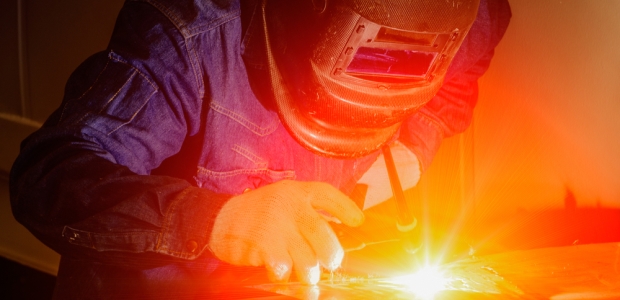
Welders must be protected from electric shock, welding fumes, fire, and injuries that can be caused by insufficient PPE.
- By Jerry Laws
- Apr 01, 2017
If the president and Congress do agree this year to fund a big federal infrastructure program, it stands to reason that the boost in construction spending puts a spotlight on the safety of the builders and welders who would be at work on the front lines. They'd be facing some of the same occupational hazards—excessive noise, work at heights and in confined spaces, respiratory hazards, and more.
There are many key protections welders require, starting with eye protection, as called for by OSHA's 29 CFR 1910.252, the welding, cutting, and brazing standard. This standard's section (b)(2) specifies eye protection that must be provided.
The standard refers to a specific eye protection OSHA standard, 1910.133, which contains charts listing the minimal shade numbers needed for protecting welders' vision during various types of welding, and also says welders' lenses must comply with the ANSI/ISEA Z87.1 standard, the American National Standard for Occupational and Educational Personal Eye and Face Protection Devices. The standard's current version is a 2015 edition, and it’s available for purchase at www.safetyequipment.org.
There are several hazards central to welding that must be accounted for in welders' training, equipment, and set-up for a job. These include electric shock, welding fumes, fire, and injuries that can be caused by wearing PPE that is not sufficient to protect against the level of hazard encountered during the task. Most welding equipment has a voltage that presents a risk of electric shock. "The most common type of electric shock is secondary voltage shock from an arc welding circuit, which ranges from 20 to 100 volts. Bear in mind that even a shock of 50 volts or less can be enough to injure or kill an operator, depending on the conditions," an article OH&S published three years ago pointed out.
Exposure to welding fumes and gases is a primary hazard. Welders must be acquainted with safety data sheets for the welding consumable products they are using, as well as the use of ventilation to ensure exposures are minimized. Permissible exposure limits come into play here, limits established by OSHA and the American Conference of Governmental Industrial Hygienists. Welders rely on respiratory protection, ventilation, and a variety of products for fume extraction.
Although some studies have estimated a 30-40 percent higher lung cancer risk to long-term welders from exposure to fumes that contain manganese or hexavalent chromium, or nickel, two studies published in Cancer Medicine in 2012 by Canadian and British researchers1 did not find an increased risk of lung cancer linked to occupational exposure to gas and/or arc welding fumes among medium/heavy smokers, but the authors did identify a higher risk due to both gas and arc welding fumes among study participants who had never smoked and among mild smokers, and they concluded the risks are higher among subjects with higher cumulative exposure. (They had investigated relationships between occupational exposure to gas and arc welding fumes and the risk of lung cancer among workers in Montreal from multiple industries.)
Fire Safety
Much of the text in the OSHA 1910.252 standard concerns fire prevention. It covers basic precautions, relocating combustible materials if possible, having fire extinguishing equipment on hand, and fire watches. It includes this section:
1910.252(a)(2)(xv)
Fire prevention precautions. Cutting or welding shall be permitted only in areas that are or have been made fire safe. When work cannot be moved practically, as in most construction work, the area shall be made safe by removing combustibles or protecting combustibles from ignition sources.
The American Welding Society's safety and health fact sheet on fires and explosions2 summarizes the nature of fire hazards and how they can be avoided. It, like the OSHA standard, says combustible materials should be at least 35 feet away from a welder's work area to prevent them from being ignited by sparks, spatter, or molten metal.
"Fires and explosions can be prevented by being aware of your surroundings, minimizing the combustibles in them, and taking the appropriate protective precautions," the fact sheet states. It advises the welder to provide adequate ventilation in work areas in order to prevent flammable gas, vapor, or dust accumulations, and also to thoroughly check the area for any evidence of fire after the welding or cutting operation is completed.
"When needed, have a qualified firewatcher in the work area during and for at least 30 minutes after the job is finished," it explains. "After welding or cutting, make a thorough examination of the area for evidence of fire. Remember that easily visible smoke or flame may not be present for some time after the fire has started. Be alert, combustibles such as wood dust can smolder for extended periods of time (days)."
PPE and Training Requirements
Burns and eye injuries are the most common types of injuries for welders. The right PPE—protective clothing, gloves, welding helmets, respiratory protection—are the addressed in both 1910.252(b)(3), which says employees engaged in welding, cutting, or brazing tasks shall wear protective clothing, and by 1910.132, the general OSHA PPE standard.
The PPE standard says step one is the employer's hazard assessment, followed by PPE selection and worker training. Once trained, workers should understand when PPE is needed and what types of PPE are needed; how to put on and take off their PPE properly; the limitations of their PPE; and the proper care and maintenance of this protective equipment.
References
1. https://www.ncbi.nlm.nih.gov/pmc/articles/PMC3544431/
2. http://www.aws.org/standards/page/safety-health-fact-sheets
This article originally appeared in the April 2017 issue of Occupational Health & Safety.