"These employees were just one misstep or tumble away from a fatal or disabling plunge," said Arthur Dube, OSHA's area director in Buffalo, N.Y.
NIOSH has engaged The National Academies' Institute of Medicine to review the draft NIOSH Current Intelligence Bulletin: "Asbestos Fibers and other Elongated Mineral Particles: State of the Science and Roadmap for Research."
A study examined factors contributing to occupational deaths in East Attica, Greece, in the five years preceding the 2004 Olympics. A 2002 increase to 19 deaths was linked with construction of large-scale public works projects, the investigators concluded.
Angie Shepherd, general engineer at NIOSH's National Personal Protective Technology Laboratory in Pittsburgh, is one of the first two recipients of the President's Leadership Award from ASTM International.

An MMWR case study and post on the NIOSH Science blog by two men in the NIOSH Education and Information Division cite potential occupational hazards associated with 1-bromopropane (1-BP), which is used in dry cleaning and as a substitute for ozone-depleting chlorofluorocarbons.
"Employees who were removing asbestos-containing materials at this site lacked basic safeguards that must be in place before performing such work," said Robert Kowalski, OSHA's area director in Bridgeport, Conn.
ISO has issued a standard to provide the minimum performance requirements for protective clothing worn in situations where users may be exposed to radiant, convective or contact heat, flames, arc flashes and molten metal splashes.
Here it is December, and we’re talking about hot work. No, we aren’t talking about working when it’s hot—but, sometimes, we have to. We’re talking about working on equipment, making it hot, and having to be careful with the heat we generate and the surrounding environment.

Understanding and protecting against arc flash and other electrical hazards and meeting the requirements of NFPA 70E has become more widely practiced in the past several years, and “8 cal” has become the industry standard for daily-wear FR clothing. This refers to the amount of protection from incident energy, expressed in calories per centimeter squared, that a fabric will provide in an arc flash exposure. It’s also expressed as an “ATPV” (Arc Thermal Performance Value) or arc rating.
The U.S. Consumer Product Safety Commission, in cooperation with DuPont, of Wilmington, Del., has announced a voluntary recall of DuPont's Heavy Duty Acidic Cleaner bottles. Consumers should stop using recalled products immediately unless otherwise instructed.
OSHA's next action on the rule, which several groups urged the agency to write back in 1999 and 2001, is the March 2009 completion of a peer review of health effects and risk assessment.
Two requests for comments by Jan. 15 or 16 are important to users of SCBAs and other protective respirators, and to the manufacturers. NIOSH may create a new subpart to the 42 CFR Part 84 standard for the suits.

Meanwhile, fall protection in construction accrued the highest total penalty amounts of all the categories in FY 2008.
"Working without fall protection is like walking a tightrope blindfolded in that one slip or misstep can swiftly result in death or disabling injuries," said C. William Freeman III, director of OSHA's Hartford Area Office.
The Northeast's rate of 4.9 injuries per 100 fires was more than twice the rate for the rest of the country, according to a summary published in the NFPA Journal's November/December issue.
According to a new survey released today by Kimberly-Clark Professional, 89 percent of safety professionals polled at the 2008 National Safety Council (NSC) Congress have observed workers failing to wear personal protective equipment (PPE) when they should have been.
3M recently started a giveaway promotion to coincide with the launch of its new Lexa™ MinimIzeR™ safety glasses. The eyewear is designed for welders, helpers, and other personnel around the immediate welding site, such as supervisors or engineers, to minimize their chances of accidental exposure to "flash burn."
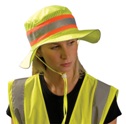
A full wardrobe of stylish gear is ready for the Nov. 24 effective date of the FHWA rule requiring high-visibility apparel (such as this OccuNomix International, LLC outfit) for those working in highway work zones, including emergency responders.
The association's 25th annual conference will take place in August at the same San Antonio convention center where ASSE's PDC will be held June 28-July 1, 2009.

The four states with the next-highest rates in 2008 are Montana, Ohio, Vermont, and New Hampshire. The lowest rate, $1.08 per $100 of payroll, belongs to North Dakota.