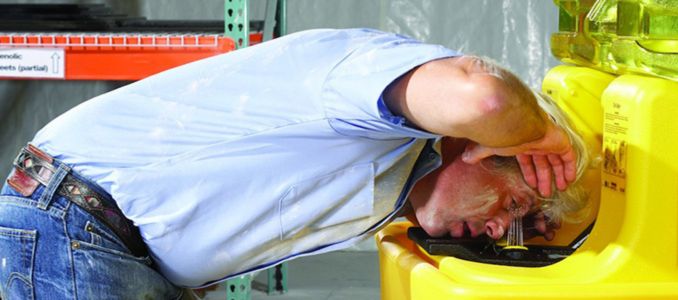
Ensuring Eye Safety in Dynamic Work Environments
By ensuring ANSI compliance, proper placement, maintenance, and worker training, portable eyewashes play a critical safety role.
- By Ryan Pfund
- Nov 20, 2025
In nearly every industry, workers are exposed to hazards that put their eyes and faces at risk. Whether handling caustic chemicals, grinding metal, mixing cement, or working outdoors in dusty environments, the risk of exposure to irritants and contaminants is constant.
According to the U.S. Bureau of Labor Statistics, thousands of employees suffer eye-related injuries every year1 — injuries that often result in lost time, medical expenses, and in severe cases, permanent damage.
Immediate rinsing with tepid water is critical following exposure. The ANSI/ISEA Z358.1-20142 standard requires that emergency eyewash and drench systems provide a continuous 15-minute flush to effectively wash out contaminants. This quick response can mean the difference between a full recovery and long-term impairment.
Plumbed Solutions Aren’t Always Enough
Many industrial facilities rely on plumbed eyewash or shower units installed near hazardous work areas. But not every workspace is equipped with the plumbing infrastructure to support them. Today’s work environments are often more mobile, temporary, or remote than in the past.
Some examples include:
- Construction sites where crews move frequently as projects progress.
- Oil and gas fields where workers are stationed far from permanent facilities.
- Agricultural operations where field crews may be exposed to fertilizers or pesticides without nearby plumbing.
- Temporary maintenance areas inside existing facilities, where production lines are reconfigured or renovation is underway.
In these scenarios, relying solely on plumbed equipment creates a dangerous gap in emergency preparedness. Workers may find themselves far from the flushing equipment they need — or worse, with no access at all.
Meeting Workers Where They Are
Portable eye/face washes provide an effective way to extend emergency washdown protection to places where plumbing cannot. These self-contained units are engineered to deliver the required continuous flush of tepid water, ensuring compliance while protecting workers in the most challenging settings.
Key advantages include:
- Mobility and Flexibility. Portable units can be easily moved to wherever the hazard is, following workers as conditions shift. For instance, a construction team working on different levels of a high-rise can move the unit along with them.
- Compliance Assurance. Units designed to meet ANSI standards deliver a full 15-minute flush, supporting regulatory compliance even when plumbing isn’t available.
- Quick Deployment. Portable eyewashes can be set up in minutes — ideal for fast-changing job sites.
Types of Portable Units
Portable units come in a variety of configurations, from self-contained gravity-fed stations to pressurized units with large fluid capacities.
- Gravity-fed Units. Rely on elevated tanks that allow water to flow downward through the nozzles. These are often used indoors or in controlled environments. Models often have a clear tank for easy inspection and can be mounted on a wall, work surface , or an optional waste cart.
- Pressurized Units. Contain fluid under pressure, ensuring steady flow. These are well-suited for remote, outdoor, or mobile applications. Made of corrosion-resistant stainless steel, pressurized units come in heated models to prevent freezing in frigid temperatures.
Selecting the right model depends on the hazards present, duration of potential exposure, and the environmental conditions.
Key Considerations for Employers
Employers who choose portable systems must ensure they are implemented correctly. Several factors play a role in their effectiveness:
- Location and Accessibility. ANSI recommends eyewash stations be within 10 seconds or 55 feet (17 meters) from a potential hazard. Units must be easy to reach and free from obstructions.
- Capacity and Duration. To comply with standards, the unit must deliver a 15-minute continuous flow of tepid water (60–100° F/15.5–37.7° C) to be considered compliant. Employers should verify the capacity of the unit aligns with their risk profile and workforce size.
- Maintenance and Inspection. As with all emergency equipment, regular inspection and maintenance are critical. Portable units require frequent checks to confirm fluid levels, cleanliness, and functionality. Employers should implement a weekly inspection protocol and assign accountability to safety personnel.
- Training and Familiarity. Workers must be trained not only on hazard awareness but also on how to use portable eyewash equipment. In an emergency, every second counts, and hesitation can worsen outcomes. Conducting regular drills reinforces familiarity and confidence.
- Environmental Factors. Extreme heat, freezing temperatures, or outdoor exposure can affect unit performance. Employers should select units suited to their environmental conditions, considering insulated or heated models when necessary.
Building a Culture of Preparedness
Providing portable eyewash equipment is only part of the equation. Employers must integrate these units into a broader safety strategy:
- Job site hazard assessments should identify areas where plumbed units are not feasible and portable solutions are necessary.
- Clear signage should mark eyewash locations.
- Routine inspections should confirm equipment readiness.
- Employee training should reinforce how the correct use of emergency fixtures, including portable units, is a proactive investment in their health and safety.
When workers know they are protected — even in temporary or remote areas — it builds confidence and reinforces a culture of safety.
Beyond Compliance
At its core, the value of portable eyewash equipment extends beyond regulatory compliance. It protects workers from one of the most life-altering injuries — loss of sight. Vision impairment impacts every aspect of an employee’s professional and personal life and can carry enormous costs for employers in lost productivity, liability, and workers’ compensation.
As workplaces become more mobile, decentralized, and temporary, safety programs must adapt. Portable eye/face washes are a practical, compliant, and lifesaving solution for environments where plumbing cannot follow.
By filling the gaps left by plumbed systems, portable eyewashes help organizations safeguard their most valuable asset: their people.
REFERENCES:
- https://tinyurl.com/mtbpwczw
- https://tinyurl.com/455m478p
This article originally appeared in the November/December 2025 issue of Occupational Health & Safety.