The company also faces 24 serious citations for missing or inadequate guarding of mechanical power presses and press brakes, uninspected power presses, and lack of a hearing conservation program, among other alleged violations. Total proposed fines exceed $70,000.
A public meeting focusing on the draft document's thoroughness and scientific and technical soundness is slated for Jan. 22, 2009 in Cincinnati. Written comments are being accepted from Oct. 15, 2008, through Jan. 31, 2009.
In addition to limiting the radioactive waste dose limit to 15 millirem per year for the first 10,000 years after disposal, the final standard will require the Department of Energy to consider the effects of climate change, earthquakes, volcanoes, and corrosion of the waste packages to safely contain the waste during a 1 million-year period.
OSHA has cited Pepsi-Cola and National Brand Beverage Ltd. of Pennsauken with $195,000 in proposed penalties for alleged workplace safety and health violations.
Issued under the authority of the Labor-Management Reporting and Disclosure Act of 1959 (LMRDA), the final rule further implements the LMRDA goal of securing the right of labor union members to have meaningful information about union finances and expenditures.
The U.S. Environmental Protection Agency announced Thursday that it has reached an agreement with Merit Energy Co. LLC and Shell Exploration & Production Co. that resolves federal allegations that the companies continued to operate a facility in Michigan after Shell had made improper modifications to the plant.
The Sturgis Converting & Distribution Center, considered a high-hazard site, achieved a 0.0 total case incidence rate in 2005 and 2007, the Michigan Occupational Safety and Health Administration said.
The U.S. Food and Drug Administration recently announced the awarding of 17 one-year grants totaling $5.2 million to various state and local regulatory agencies to enhance food and feed safety.
"We have worked hard to provide high-quality, affordable health care to our associates and I think this additional focus on wellness steps us up to a new level," said Walmart U.S. President & CEO Eduardo Castro-Wright.
The U.S. Food and Drug Administration recently announced the selection of ten contractors to receive up to a total of $2.5 billion for information technology (IT) and data center management services over the next ten years.
No facility is exempt from slip-and-fall injuries. Even in non-manufacturing environments, slips and falls to the same level account for more than 15 percent of OSHA reportable injuries and more than 70 employee deaths each year, according to the U. S. Bureau of Labor Statistics.
According to EPA, the Mattoon, Wis.-based manufacturer failed to comply with certain requirements of its state operating permit for its wood-fired boiler that emits air pollutants, including particulate matter (smoke, dust, ash) into the atmosphere.
"Facilities that use toxic chemicals must provide complete and accurate information about these chemicals so residents and emergency responders are aware of possible chemical hazards in the community," said Enrique Manzanilla, Communities and Ecosystems director for EPA's Pacific Southwest region.
Officials with the California State Division of Labor Standards Enforcement (Labor Commissioner's Office) issued citations totaling more than $269,000 in fines to agriculture businesses in a statewide, two-day enforcement sweep.
The American Industrial Hygiene Association (AIHA) recently announced they are working on an action plan to address Consumer Product Safety Commission (CPSC) requirements that were issued Monday, Sept. 22, for the accreditation of third party conformity assessment bodies (laboratories) to test children's products for lead content.
Employers who use forklifts in their workplaces have a new resource to help keep their employees safe on the job. The Powered Industrial Trucks (Forklift) eTool is the latest Web-based training tool unveiled by OSHA.
It has always amazed me how a simple thing such as a lack of communication can not only lead to less-than-optimal results, but also that the sub-par performance can sometimes continue for decades! No example of this phenomenon is more readily apparent than the traditional approach used to irrigate injured eyes in commercial or industrial facilities.
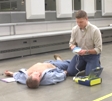
The agency says its facilities experience an average of one sudden cardiac arrest per year among more than 46,000 employees. In the next three years, 97 percent of those employees should have AEDs at their disposal at work, according to the new plan.
The agency also will hold a public hearing on the proposal on Oct. 14 via webcast.