
It is the culmination of many years' work by a consortium of partners dedicated to reducing occupational injuries and illnesses among youth, NIOSH says.
The event will focus on best practices for effective hearing protection programs.
The second annual event is intended to help employers of about 4,000 laborers who move from Arizona to California to harvest crops.
Safety committee chairmen in both houses of Congress want answers from MSHA about the Crandall Canyon mine disaster Aug. 6, which claimed nine lives in all. MSHA has already appointed its own investigative team.

COMPANIES serious about safety performance often talk about the injury-free culture. These three simple words carry a lot of weight and importance. Indeed, it is hard to know how an organization could espouse any different vision of safety. Yet, saying that you want to be "injury free" is not the same as actually moving to this level of performance. For one thing, what do we mean by injury free? Is such a thing even possible?
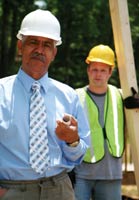
WOULD you like to shift the tide of your maturing workforce from resistant and at risk to involved and secure? The Baby Boom, the birth bulge from 1946 to 1964, is now a Gray(ing) Wave that makes up 40 percent of the U.S. workforce. Many organizations are concerned they will have to pay the costs associated with their aging workers.
SAFETY has never been a 9 to 5 proposition. So it's good to see organizations increasingly realize that workers can't switch on safe judgment and actions upon clocking in. But, for the longest time, safety emphasis has almost exclusively been at the work site, exemplified by policies and procedures, observation/monitoring, and ergonomic emphasis on design/redesign/purchase of specific tools.

MORE than ever, construction companies are under pressure to provide both employees and subcontractors with effective safety training. OSHA and many states mandate safety training for employees, and recent laws such as California’s AB 1127 hold contractors responsible for the safety of on-site subcontractors. Adding to the incentive to provide safety training for workers is the realization by most companies that helping to ensure employee safety is simply good business.
THE explosion at BP's Texas City, Texas, refinery that killed 15 contract construction workers and injured 170 other workers in March 2005 is still reverberating. A lawsuit, an investigation by the Chemical Safety and Hazard Investigation Board (CSB), a glossy safety report from BP (along with $1.6 billion set aside for claims), and a bill in the Texas Legislature to mandate a state occupational safety and health plan were the first wave.
HERE'S the situation:
Business is tough in today's global marketplace. Everyone is being asked to do more with less. Not just a trend, this seems to be the way of the future.
Safety and risk management professionals have not been insulated from the need to become more efficient. If you are in the safety and risk management field, surely you must agree this is the case.

OH, no—health and safety training again?! In every industry, this is a common response to the announcement of an upcoming session. People absolutely despise safety training because it is the same old, dull, boring, and repetitive material, year after year.

IMAGINE that upper management has charged you with a brand-new assignment, developing an "employee wellness program." This could be a tall order for anyone. There's no standardized program to follow. However, if you are a safety and health professional, you have one trick up your sleeve: your safety and health program.

This article speaks to the training of Industrial Athletes, the men and women whose jobs require strength, agility, and stamina in a variety of industrial sectors. Keeping their bodies healthy and fit is the key to optimal performance and reduced injuries on the job.

REACHING the pinnacle of safety success, world-class performance with a spotless injury log, can seem unattainable for any number of reasons. Deadlines, culture, turnover, upper management support, and resource shortages can set you back. Yet companies and workplaces achieve it again and again through passion, persistence, accountability, and empowerment.

IMAGINE you are ill and make an appointment with your physician. You walk in the door, register with the receptionist, and are escorted to an exam room. A few minutes later, the physician walks in with a syringe filled with medicine. He asks you to roll up your sleeve. As your eyes widen, you exclaim, "You haven't even examined me yet!" As he walks closer with the syringe, he replies, "That's all right. Most of the time, this usually does the trick."
While this scenario may seem ridiculous, how many times have we approached a safety problem with a "syringe" full of training without diagnosing the underlying issue?
AS a safety professional, you have learned how to quickly identify hazardous environments, led the effort in determining the best ways to protect your employees from those hazards, and spent countless hours training those same employees on everything related to safety. It's a safe bet you can probably recite an OSHA standard quicker than a quote from your favorite novel.
You are Fire Capt. Johns. Your fire chief has just radio-relayed your orders. You ascend a ladder to the second floor, carrying more than 50 pounds of equipment with Probational Officer Ed in tow. You break open a locked window and enter a room that feels like a furnace. A smoke-filled, gloomy haze blankets the limited vision your respirator mask allows. How can you hope to locate the victims in this smoke and heat?
Editor's note: The promise of AEDs has not been fully realized for several reasons, most notably our failure to train potential users in a way that truly prepares them for the experience, contends Frank J. Poliafico, RN, director of the Initial Life Support Foundation (www.ilsf.info, 610-566-2824) of Media, Pa.
THE supervisor is on his daily walkthrough inspection when he notices damaged products staged to be shipped that morning. Upon inspection, it is clear a forklift caused the damage. There is no report of damage or injury from the prior shift, and of course the operators on duty have no idea how it happened. Relieved the product was found prior to being shipped, the supervisor separates the damaged product, knowing it will mean short shipping the customer.