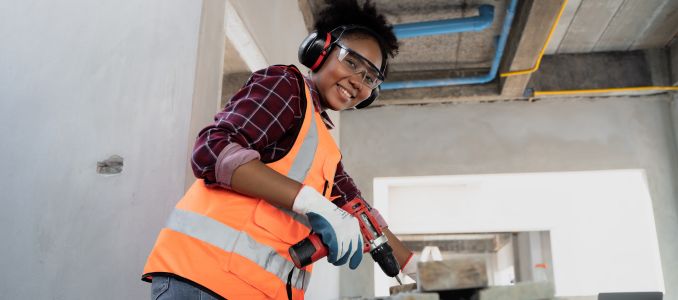
Female PPE Beyond "Shrink It and Pink It"
Move beyond one-size-fits-all. Discover a six-step, employee-driven approach to implementing PPE programs that actually protect women in the workforce.
- By Wyatt Bradbury
- Mar 18, 2026
There are more than 80 million female workers in the U.S. workplace, making up 47.6% of the total workforce. Yet, for decades, women have not had adequate PPE that should serve as a last line of defense against dangers on the job.
Why not? Doing nothing was simply the easiest approach. It was an easy problem for employers to ignore, and it was an easy problem for female workers to bury so as not to call unwanted attention to themselves.
However, over the last five years, this situation has significantly improved. Thankfully, we’ve gone from “shrink it and pink it” in our PPE marketplace—or worse, men’s size small—to a variety of women-specific products. High-visibility garments, footwear, hearing protection, head protection, eye protection, and hand protection designed for the unique needs of women are all available from a variety of distributors.
A key contributor to these improvements in providing better protection for female employees was 2023’s Technical Report Z590.6 Guidance of Personal Protective Equipment for Women from the American National Standards Institute (ANSI) and American Society of Safety Professionals (ASSP).
However, despite the availability of these products, the problems women face regarding PPE in the workplace persist.
For me, even as a writer of the standard, I had to see how awful a safety vest fit a highly female-dominated department at a project site before I made a change. I was knowledgeable about the issue; we were providing a line of footwear specifically for women, and we were absolutely willing to evolve from “shrink it and pink it.”
But it still took me seeing an employee wearing equipment that absolutely did not fit for me to engage the safety committee, multiple vendors and distributors, and drive through a significant change.
Unfortunately, it seems that many employers are waiting for a similar hands-on experience—seeing a female employee in an ill-fitting male harness or trying to figure out why a fit test keeps failing—to finally make a change. My hope is that this article will serve as an alternative wakeup call for other health and safety professionals and business leaders to engage with all employees to truly understand their challenges, and especially better support female employees.
With the awareness I gained, we immediately began to have a new set of conversations with our female employees about their needs in the workplace. We asked about their vest fit, utility, and other specific needs. From that point, we had enough information to take the issue beyond that single department to the safety committee to start looking at new product options across the board.
We scoured the internet. We started getting as many samples as we could find. We brought in multiple distributors and manufacturers. Between our employees in the field, our safety committee, and the plethora of samples, we then dug into all the various options.
We identified that a surveyor’s vest was of stronger construction and had more volume and security in the pockets. We identified pocket placement and the need for a radio tab. We also identified that our requirements for Class III vests could also be revised to a more comfortable—and more available—Class II. It was also decided that the men’s and women’s vests needed to match (or closely match), despite the design and sizing being unique to each gender.
As we were exploring the available options for vests, other challenges were identified in our PPE system. These were issues that needed to be worked through administratively. Ultimately, financial capital, shelf-space, and administrative needs to essentially double our available safety vests simply became the new normal that we adjusted to based on our learning as an organization.
After many conversations with vendors, numerous field trials, and valuable employee feedback, male and female options were selected that satisfied our employees’ criteria. We moved forward with the change and implemented the new vests across the project.
For employers willing to wake up to the PPE needs of all their workers—especially female employees—there are six steps I recommend.
Step 1: Identify the problem and where it exists
This is probably the most comprehensive step and the one that may take the most time. The first approach to identifying the problem and where it exists in your organization is to understand the state of available PPE in the workplace. Talk to the women in your organization who are using PPE Daily.
Ask if it fits, meets their needs or if there is anything that can be done to make it easier to work safely while using PPE. Find out if there are specific instances when adjustments are always needed, if it seems to become an inconvenience or ultimately fails. The employees wearing PPE will know what works and what doesn’t.
Do this with genuine curiosity. Ensure you’re creating an environment of psychological safety by making your intent to drive real improvement and change known. Consider the avenues your organization has in place to receive feedback and leverage those channels, such as safety committees or team huddles.
In all cases, be genuine, transparent, and seek to understand. If this is the first time your organization is undertaking continual improvement, it may be more difficult, but that is not a reason to avoid it. That just means you may have to be more persistent, transparent and patient as you’re influencing the workplace culture while simultaneously addressing PPE fit.
A secondary approach is to observe how people are working in PPE.
Often, if the PPE doesn’t look like it fits, is constantly being adjusted or does not seem to be functioning properly, it probably isn’t. Look at a variety of situations and across all tasks. This will also give you an idea of where PPE may be missing, not identified or not being used, which is a chance to really explore why. Here, fit (or lack thereof) may be a factor. As with the first point, be genuinely curious and seek to learn. Even if you find non-compliance, don’t automatically default to discipline. Use it as a chance to engage and learn about their day-to-day and the challenges they face.
Finally, start looking through records, such as fit testing, to see where issues have arisen in the past. Look at workers’ compensation claims and injury reports to see where improperly fitting PPE may have contributed to injury or illness. Use the lagging data to determine where issues exist and where to be proactive to address hazards that PPE has been less effective at controlling—potentially due to the PPE itself. Work with those employees who may, for example, repeatedly face challenges passing a fit test to help them obtain equipment that better suits their needs and body structure.
Remember that PPE is ultimately about your workers’ protection; ensure it suits them.
Step 2: Socialize and normalize
Once you identify the problem, don’t isolate it to just female employees or a specific subset of your worker population. Engage your safety committee, other functions, and as many employees as are interested and may have relevant input. Get employees interested in the solution and start coming up with your list of challenges or must-haves, with any required changes, even beyond just fit. Use this as a chance to drive utility, efficiency, and comfort.
Step 3: Engage your vendors
Include your vendors, distributors, and manufacturers in the conversation. Have them talk with your procurement teams, operational leaders, risk management, health and safety committees and even front-line workers. Leverage to learn about new products on the market and how you can obtain samples to distribute for feedback and testing among the female workforce. Use them as a force multiplier to solve as many challenges as you have related to PPE.
Step 4: Trial, trial and trial
Try out samples in real-world scenarios, stress test and collect expanded feedback. This can help identify other areas of opportunity to improve your safety and health systems. Get feedback on as many products from as many female employees as are available. The more time spent testing, the higher the likelihood of challenges being proactively identified and solutions being implemented.
Step 5: Decision point
Ensure your employees feel like they own the decision and that it represents the feedback they’ve shared. Once the decision is made, implement the new approach that recognizes the unique PPE considerations of women in the workplace.
Step 6: Continual improvement and sustainment
Don’t stop with this one solution. Keep looking for opportunities to continually improve. Use what you learned and apply it to make health and safety protection enhancements for all employees throughout your organization.
In summary, PPE for women has improved significantly in recent years, but availability alone doesn’t solve the problem. As the last line of defense against workplace hazards, PPE must fit the people who rely on it. That means employers need to actively evaluate programs, listen to workers, and commit to solutions that truly meet everyone’s needs.