What We Learned From Quantum Summer School 2022
A conversation with David Stewart
CT talks with David Stewart, managing director of Purdue's Quantum Science and Engineering Institute, about the directions quantum education is taking as the Quantum Science Center's program planners reflect on this year's Quantum Summer School and look forward to next year.
Mary Grush: What are the challenges of shaping a curriculum for a quantum program or event?
David Stewart: The quantum field is so vast that it is difficult to plan a summer school that appeals to all interests without diluting the material. There must be a balance between basic pedagogy and very specific training in order to provide a worthwhile experience to all attendees.
Grush: What would you recommend other curriculum planners consider, even if they are just including quantum topics in other, long-established curricular areas?
Stewart: It is important to leverage the efforts universities across the country have made and continue to develop quantum curriculum. Many NSF- and DOD-funded centers specifically aim at quantum curriculum development and have achieved great results, such as launching MS programs in quantum engineering.
It is important to leverage the efforts universities across the country have made and continue to develop quantum curriculum.
Grush: Who was involved in shaping the 2022 Quantum Summer School program? How did they work, to evolve a highly relevant event program?
Stewart: Purdue leads the workforce development efforts of the Quantum Science Center under the direction of Alexandra Boltasseva, the Ron and Dotty Garvin Tonjes Professor of Electrical and Computer Engineering. She has been our guiding light in shaping the summer school, but our committee includes other faculty, management, and students who all provide their unique perspectives to make the school the best it can be.
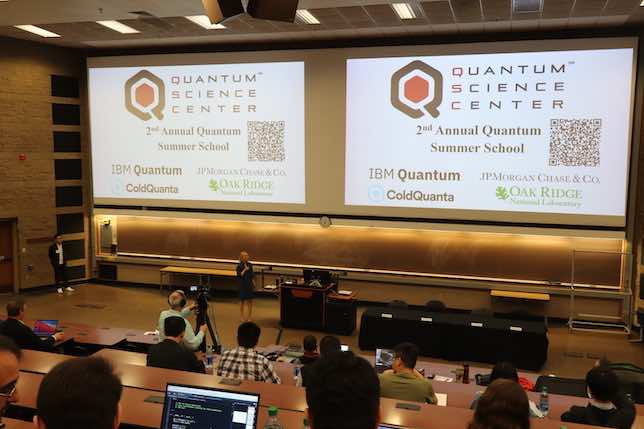
The Quantum Science Center's Workforce Development Lead Alexandra Boltasseva welcomed attendees to the 2022 Quantum Summer School before QSC Director Travis Humble's introductory remarks. Photo by Yuheng Chen, Purdue University
Grush: How was the 2022 Quantum Summer School different from the previous year's event?
Stewart: The most obvious difference is that we went from completely virtual in 2021 to a hybrid in-person and virtual event in 2022. It was fantastic to have so many students and lecturers on campus.
Grush: Were there any specific quantum areas that had the most impact on planning the program for the 2022 Quantum Summer School?
Stewart: We try to compose our school around the main research themes of the Quantum Science Center, which are quantum materials discovery and development, quantum algorithms and simulation, and quantum devices and sensors for discovery science.
We try to compose our school around the main research themes of the Quantum Science Center, which are quantum materials discovery and development, quantum algorithms and simulation, and quantum devices and sensors for discovery science.
Grush: I know you posted most of the presentations. Is there anything else you've done to leverage Quantum Summer School 2022 content for a wider audience?
Stewart: We promoted on Twitter during the school, and all the recordings are still posted on the Purdue Quantum Science and Engineering Institute YouTube channel.
Grush: You had several quantum leaders give lectures and training sessions during the summer school. What do they say about the importance of quantum workforce development and education?
Stewart: I asked that question to one of our lecturers, Vladimir Shalaev, the Robert and Anne Burnett Distinguished Professor of Electrical and Computer Engineering at Purdue. He said, "Our future is quantum. But the rate with which quantum technologies will enter and improve our everyday lives depends greatly on workforce development; therefore training the next generation of quantum scientists and engineers is a critical task to accomplish."
"Our future is quantum. But the rate with which quantum technologies will enter and improve our everyday lives depends greatly on workforce development." —Vladimir Shalaev
Grush: What changes will you make for the next Quantum Summer School?
Stewart: We are still brainstorming for next year, but some early ideas to make it even better include: having specific tracks for various topics, increasing networking opportunities, and possibly having an "intro to quantum" session that could open the door for more undergraduates to attend.
Grush: What are your biggest hopes for student learning as we head into quantum's future?
Stewart: The number of educational quantum programs continues to increase, from summer schools like these, to increased university curricula, and even quantum games for K12 students. My hope is that through all these programs we are inspiring the next generation of quantum scientists and engineers to dream big, push boundaries, and take risks.
My hope is that through all these programs we are inspiring the next generation of quantum scientists and engineers to dream big, push boundaries, and take risks.
Today's students are the ones who will make the transformative changes of the future for the betterment of society, and I hope that we will instill in them not only the knowledge they need, but also confidence, enthusiasm, and
perseverance.