
The agency asked Tuesday for comments about packaging that uses adjectives such as "silver" or "smooth," pastel or white colors, using the letter L, and displaying terms such as "natural" and "no additives."

The society cited growth and interest in these sectors' safety for launching them. The Utilities Branch will address EHS issues in solar and wind power generation, water and wastewater, and telecommunications, among other areas.
The company offers in vitro diagnostic kits, and analyte-specific, general purpose, and research-use-only reagents for nucleic acid analysis. EPA said the company failed to obtain a hazardous waste storage license, among other things.
Tim Fisher, ASSE's director of Practices and Standards, said ASSE is developing technical briefs for ANSI/ASSE A10.47-2009, "Work Zone Safety for Highway Construction," and ANSI/ASSE A10.16-2009.

For aviation, unless the cells or batteries are transported in a container approved by the FAA administrator, they would have to be stowed in crew-accessible cargo locations or locations equipped with an FAA-approved fire suppression system.
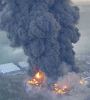
The Department of Homeland Security has not agreed to exempt them, and it published a new request for comments today about the models it is using for vapor cloud explosions and pool fires. The industry asked to be exempted.
The colorless, odorless, tasteless gas is the second leading cause of lung cancer in the United States, behind cigarette smoking, the agency notes.

Saying it is aware packages may have shifted and been damaged in transit when secured with flexible strapping, the agency wants comments as it contemplates a rulemaking. Exemptions allow its use for certain hazmats.
"Our inspections, and a worker fatality at the Blakely (Ga.) plant, show the need for management to get serious about the safety and health of its employees," said Robert Vazzi, OSHA's area director in Savannah, Ga.
A final rule effective Wednesday means passengers may bring any of 11 different POCs aboard aircraft and use them, with the approval of the aircraft operator.

NIOSH Director Dr. John Howard has informed OSHA's assistant secretary that NIOSH and NIEHS research on the alternative butter flavoring 2,3-pentanedione "suggests that, in rats, 2,3-pentanedione causes airway epithelial damage similar to that produced by diacetyl."

OSHA today issued 71 citations against CES Environmental Services Inc., a familiar foe in recent years to safety and environmental federal authorities. This time, the proposed penalties total $1.4 million.
The agency has developed a new Web-based tool and interactive map that allows the public to get detailed information by location about the enforcement actions taken at approximately 4,600 facilities.
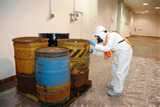
The clock is ticking. Companies will have three years from promulgation to come into compliance with the final rule and two years to implement training requirements.
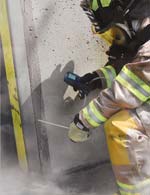
Are user seal checks necessary to ensure protection? And, if so, when should they be performed? A white paper prepared by the American Industrial Hygiene Association's Respiratory Protection Committee asks these and several other questions to resolve important issues.
EPA completed a short-term cleanup removing asbestos from the former mill building and hazardous substances in drums and containers on the Blackburn & Union Privileges Superfund Site, in Walpole, Mass.
These additions address salvage cylinders, alternative packaging for hazardous wastes, aerosols transported for recycling or disposal, and authorizations for rail tank cars to exceed maximum capacity and weight limits with specific Federal Railroad Administration approval.
Environmental Protection Agency Region 5 has settled with Clear Lam Packaging Inc. for alleged violations of the Resource Conservation and Recovery Act requirements for treatment, storage and disposal of hazardous waste. The Elk Grove, Ill., company will pay a $20,750 penalty and perform an environmental project costing at least $221,000.

The nine contracts worth up to $400 million have been awarded by the U.S. Department of Health and Human Services' Biomedical Advanced Research and Development Authority and can lead to prototype devices for responders.
The settlement is expected to reduce sulfur dioxide emissions by almost 35,000 tons per year -- the equivalent to the emissions from 500,000 heavy-duty semi trucks, which is more than all the trucks registered in Indiana, Illinois, Kentucky, and Ohio combined.