"The most common causes of home fires include cooking, heating, electrical malfunction, smoking materials, and candles,” said FEMA Regional Administrator Ken Murphy.
The Department of Homeland Security has launched a secure, online CSAT Site Security Plan tool.
The Oct. 3 announcement of an update to the Chemicals Management Plan also included a commitment to complete assessments on 500 substances, including phthalates.
OSHA inspectors found that workers at the company's site in Schertz, Texas, were repairing vehicle wheels using welding equipment that was not properly guarded and without the use of required personal protective equipment.
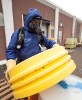
It is imperative for hazmat teams to understand the requirements of NFPA 1994 and NFPA 1992. Doing this not only determines your safety during use, but also gives peace of mind while in the hot zone.
Hazmat handlers need more than just HazCom training. Incorporating required elements from OSHA, EPA, and DOT works well.
The joint fall meetings and conference of the Fire and Emergency Manufacturers and Services Association and the Fire Apparatus Manufacturers' Association will take place Oct. 5-7 in Arlington, Va.
The funding will be used to develop and implement training and related materials for mine emergency preparedness, as well as for the prevention of accidents in underground mines.
In this case, a coal chute became jammed and the operator left his controls to attempt to un-jam it. Through miscommunication, another employee took the controls and moved the transport vehicle, which hit the worker, crushing him between a guardrail and the jammed coal bin chute.
OSHA opened an inspection after a worker was found dead inside the rotating drum assembly of a machine used to screen recyclables from other refuse on March 30.
Taking the next step in the process of enacting a national work health and safety regulatory scheme, Safe Work Australia opened the comment periods Sept. 26 for draft codes on fall protection, first aid, chemical safety, and more.
OSHA's Dallas Area Office initiated a safety and health inspection at the company's facility in Texas following receipt of a complaint that employees were not adequately protected from being injured by rotating machinery parts, and employees were exposed to toxic welding fumes while fabricating trailers and noise levels above approved health standards.
The January 2010 collision of the tanker Eagle Otome near Port Arthur, Texas, occurred when the double-hulled tanker lost power and drifted into barges being pushed by a towboat, causing a leak of about 462,000 gallons of crude oil.
FAA alleges Simplot, a food processing and agricultural company, offered a non-standard fiberboard box containing a five-gallon plastic jug of bactericide and fungicide to UPS.
In 2007-2008, the most recent year for which waterborne disease outbreak data are finalized, 134 outbreaks were associated with recreational water and 36 outbreaks were associated with drinking water.
According to the complaint, the employer discharged a dental assistant who raised concerns about an office procedure that required workers to remove protective caps from contaminated needles before putting the needles in disposal containers for sharps.
The agency said it will work with voluntary standards organizations to prevent this type of problem from happening again.
The violations involve uncorrected deficiencies in ammonia processing equipment, not developing and implementing safe work practices for all mechanical and maintenance tasks, and incomplete written standard operating procedures.
Stone Zhang, DNV's director of operations for China Energy, said the company wants to share its expertise and bring best practices from all over the world to the Chinese pipeline industry.
Developed after the Fukushima Daiichi crisis began, the IAEA Action Plan on Nuclear Safety is up for endorsement at the agency's 55th General Conference in Vienna this week.