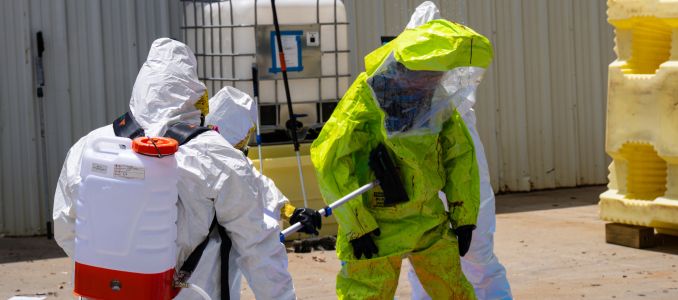
Industrial hygienists play a critical role in HAZMAT response by guiding exposure assessment, PPE selection, and long-term health protection.
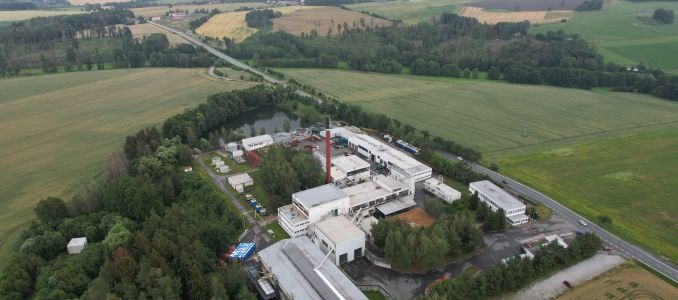
Hydrogen sulfide gas is a hidden but deadly hazard in animal rendering, where workers risk exposure during decomposition and processing—highlighting the need for strict monitoring, protective controls, and stronger safety practices.

The 2025 EHS Hazmat Summit in Louisville will bring together hazardous materials and EHS professionals for keynotes, technical training, and networking focused on compliance, emergency response, and emerging environmental challenges.

Learn how chemical exposures in water treatment plants can impact your health, and explore practical strategies to stay safe and protect your well-being on the job.

Improper chemical storage caused a fire at Bio-Lab’s Conyers facility, leading to OSHA citations and $61K in fines.

Blackline Safety grows fire and hazmat reach and launches its new EXO 8 Gamma monitor for gas and radiation detection.

Two Vancouver house flippers face $116,300 in fines for improper asbestos removal during a renovation project.

Three experienced professionals have joined AHMP’s board of directors to strengthen hazardous materials management and workplace safety in 2025.

Qualawash Holdings LLC faced similar violations during an OSHA investigation in 2020.
The Alliance of Hazardous Materials Professionals-hosted event addresses key issues in the management of hazardous materials.
The organization aims to educate workers and reduce their exposure to lead hazards.
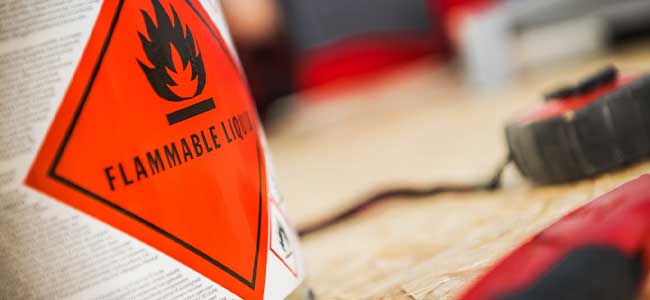
Learn about one professional's experience with the terms flammable and combustible liquids.

In what ways can emergency responders be affected by the exposure?

Looking for information at your fingertips during work? NIOSH might have an app for you.

SPONSORED
Flammable gas leaks continue to pose a real threat to workers and assets across the process industry. Gas and flame detection provide an early warning against this risk. But no single detection technology alone is 100 percent effective, which is where a layered approach comes in. By integrating the following four layers of protection, you can minimize the risk of flammable gas leaks going undetected.

Episode 79
In this episode, editor Sydny Shepard talks with former Cal/OSHA Associate Safety Engineer Paul Andersen about the standards, regulations and rules associated with emergency eyewash and showers.
The safety industry continues to see developments in innovation and technology despite no trade shows to show off new products in person.
Industries should keep records of waste generation and testing, report any unprecedented events, be prepared to handle emergencies with trained professionals, and have reliable hazardous waste storage options such as tanks and containers
More businesses are focused on providing environmentally friendly products, and consumers are educating themselves about the companies they support.

While most of us are staying home and social distancing, some workers are not that lucky. Among those most at risk of COVID-19 are janitors, domestic workers, housekeeping and office cleaning crews.