
A Bright Idea for Life Safety
The Lightstep technology to be installed in three Upper Iowa University buildings this winter is a life safety product that answers post-9/11 needs for safe, fast emergency evacuations, UIU’s president says.
- By Jerry Laws
- Aug 18, 2011
One of the outcomes of the 9/11 terrorist attacks on the World Trade Center was a new law, Local Law 26, which took effect in April 2006. The law requires office buildings in the city six stories or higher, or occupied by more than 500 people, to have an emergency action plan for evacuations. By July 2006, all doors leading to exits and all exit stairs had to have photoluminescent markings.
As the 10th anniversary of the attacks is marked next month with events across the country, a company based in Northern Ireland is preparing to install its intelligent evacuation system in three buildings on the Upper Iowa University campus in Fayette, Iowa, during a break between academic terms. The Lightstep Technologies system will be installed between Dec. 16 and Jan. 9, while students are away, inside a new, apartment-style student residence hall, the Liberal Arts Building, and the Student Center.
The residence hall houses about 90 students, with some apartments equipped with kitchen facilities, which increases the potential for fires. UIU President Dr. Alan G. Walker said if this initial demonstration project works well, the system may be installed in two more identical residence halls that are under construction.
Lightstep Technologies has its headquarters in Belfast, Northern Ireland, with a U.S. office in Alexandria, Va., and a United Arab Emirates office in Dubai. During an Aug. 17 phone interview, both Walker and Lightstep Technologies Executive Chairman Kieran Patterson called the system a breakthrough that enables facility managers and owners to meet Local Law 26 and similar laws enacted after 9/11, ensuring safe and fast emergency evacuations.
The Fayette project will be the first U.S. installation of the technology.
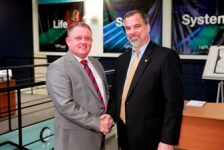 "The work itself isn't that difficult because a lot of the infrastructure is already in place at the university. They're new buildings and they're very well designed," Patterson said. "Our system is designed in such a way that it can be very easily retrofitted. We can do it quite effectively between the terms, which is why we decided to do it in December."
"This technology is not going to replace or supplant what we're required to do by the Life Safety Code, building codes, and things like that," Walker said. "The traditional life safety [equipment] will still be in place. What I saw here was an opportunity to be a model for this new technology because I think it had a lot of validity."
Walker is a former firefighter trainer and still is a member of a local volunteer fire department. He said the technology takes the same approach used in evacuation lighting on commercial airplanes, where the lights are placed on the floor. "This takes that idea and fleshes it out, makes it much more sophisticated," he said. "Most fires occur at night, and most fires occur in some kind of residence situation.... You've got a hostile environment in the middle of the night, and people are waking up to it. They're confused. And it's a race against time and confusion that we're dealing with here."
Walker said he began thinking about his own experience in hostile environments, where the floor is the safest place, away from heavy smoke and toxic gases, as fire safety educators explain when teaching children. In such an environment, occupants usually can’t see exit signs that are placed high and above doors, however.
"People don't realize how quickly an environment can turn hostile. They don't realize how quickly they can't see their hand in front of their face," he added. "People panic. That contributes to the risk, it contributes to the loss of life. People don't die in fires because they burn up; they die because they're in there too long, and they breathe toxic and superheated gases. And that's what kills 90 percent of the occupants in a structure fire [who die]. That's what we’re up against.
"The more I thought about it, the more I realized how much sense it really made, which is why I became interested in it," Walker said.
The Breakthrough
Patterson said Lightstep engineers did study how aircraft evacuation systems were developed when designing the company’s product. “The lighting part of it is the static part; there’s a very sophisticated technology behind it,” he continued. The system can decide within milliseconds whether a stairwell is overcrowded with evacuees and then calculate and identify with lighting the shortest, fastest path to the best alternative evacuation route.
"We're very proud of the intelligence behind it," he said. "We actually thought that it couldn't be achieved, that there couldn’t be the level of intelligence that we'd thought about or dreamt about. And I can remember the day [in 2007] that we actually cracked the code, it was just a fabulous feeling. Over the next 12 months, we realized we had groundbreaking technology that was a world leader."
He said California is starting to consider laws similar to Local Law 26, and building owners everywhere are concerned about their liability and realize they must help occupants evacuate safely. Abu Dhabi, for example, is about to revise its evacuation standards; officials there read about UIU/Lightstep partnership and invited the company to deliver a keynote presentation at a recent conference there. "We are getting international recognition for life safety. Anywhere that there's a number of people who need to be evacuated quickly, it's suitable for," Patterson added.
"My observation is what really changed the most [since 9/11] is heightened activity relating to planning, mitigation, training, updating of equipment – at least in terms of the response community – and so forth. I haven't seen a lot of new technology, particularly a technology that holds the kind of potential and promise that this technology does," said Walker, who has visited the company's Belfast plant, where he saw the technology demonstrated in simulated hostile environment conditions. He said he expects UIU will conduct its own demonstrations next year, after the system is in use, to show members of the press and officials from other universities how it works. Walker said such events fit the mission of the university very well, which he described as doing research and demonstration projects and creating knowledge.
"It's a perfect partnership for us," Patterson said. Walker and UIU have become ambassadors for life safety to a university in Belfast and others, he said, adding that the partnership will create U.S. jobs.