Bull’s Eyeeeaaaahhh!
The hazards of this job are legion. The main one has hooves.
- By Marc Barrera
- Jul 01, 2008
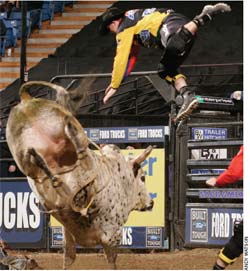 A bull rider charges into the arena, his heals dug in, one arm
outstretched, the other holding on for dear life as he does
his best to stay atop his ride. He counts down the seconds
until a horn signals time is up, then must take a leap of
faith off his bull, entrusting his safety and health to the bullfighters
watching his back.
A bull rider charges into the arena, his heals dug in, one arm
outstretched, the other holding on for dear life as he does
his best to stay atop his ride. He counts down the seconds
until a horn signals time is up, then must take a leap of
faith off his bull, entrusting his safety and health to the bullfighters
watching his back.
It can easily be said that bull riding, with all of its hazards, is a
dangerous sport that requires tough athletes. But bullfighting, on the
other hand, requires cowboys to constantly put themselves directly
in the path of danger. Bullfighting is downright deadly.
Joe Baumgartner, a professional bullfighter who has been selected
every year to participate in the Professional Bull Rider World Finals
since 1994, says that in order to be successful in his field, your primary
concern must be the safety and health of the bull rider. “You don’t
worry about keeping yourself safe,” he said. “Your job, what you’re
paid to do, is keep the cowboy safe. A lot of times, you just blow in
there and you know you’re going to get creamed. If you can do it, and
get yourself creamed but not the cowboy, then you did good.”
The Horns of a Dilemma
Many schools exist now that teach young cowboys how to bull ride
and bullfight, but for Baumgartner it was opportunity, not instruction,
that made the choice for him. “I was working for a guy that
owned bucking bulls, and he had a rodeo. He needed somebody to
fight bulls, and I thought, ‘Well, why the heck not? I’ll
try it,’” he said. “It was pretty exciting. It came pretty
easy. I’ve watched guys do it, and I’m kind of one of
those guys that can learn by watching other people.”
Of course the possibilities of getting hurt are
enormous, he adds. Even a bullfighter as experienced
and skilled as Baumgartner has had his share of injuries.
“You damage your hands a lot because all the
time you’re reaching or grabbing bulls by the horns.
I’ve had a couple of knee surgeries and a couple of
metal plates put in my eye. I broke the small bone in
both of my eyes last year at different times. It was
kind of a bad year last year,” said Baumgartner. He
emphasized that the most dangerous position to be in
is not in front of a bull, but under it. “The most dangerous
thing is if they knock you down and step on
you. That’s by far the worst. Horned bulls, they can
flick their horns at you and hit you with the horns,
and you can break stuff. I’ve had bulls break my ribs
by hitting me with their horns, but the stuff that kills
you is when you have 1,800 to 2,000 pounds stepping
on you. That’s what hurts.”
Tough Enough
But in his business, Baumgartner said, there is a difference between
being injured and getting hurt. “When you’re injured, you can still
go, you can still work, but when you’re hurt, that’s when you’ve got
to sit at home,” he said. “A bull ran through my knee and I had to
have it totally reconstructed. I tore my ACL, my PCL,
and the meniscuses were all tore up.”
As a result, Baumgartner was laid up, recovering,
for some time. Unlike other professional sports, in
bullfighting if you can’t work, you don’t get paid, he
said. So, whenever possible, Baumgartner has had to
work through a lot of pain. As an example, Baumgartner
described a recent injury when a bull hit him
in the chin with one horn and on the hand with the
other. “My right hand was totally immobilized,” he
said. “In a lot of sports they would have said, ‘Heck,
I’m going on the injured list.’ Me, I don’t usually run
on my hands too much. I try to stay on my feet, so I
wasn’t too concerned about it.”
Bullfighters wear less protection than a professional
football player yet routinely face bulls that are
five to six times heavier than any linebacker. Baumgartner
describes his PPE as consisting of a kind of
football girdle with a chest protector similar to those
used in motocross. With the exception of the head,
this outfit covers your vital organs and your hips.
Many bullfighters also wear a helmet.
In Baumgartner’s case, he goes about his business old-school.
“Those helmets take away your vision,” he said. “So my cowboy
hat’s my helmet.”
This article originally appeared in the July 2008 issue of Occupational Health & Safety.