Tailor Made for Safety
First responders are constantly working to secure our safety. The LifeShirt wearable system is designed to secure theirs.
- By Marc Barrera
- Jul 01, 2006
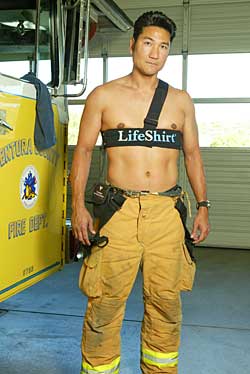 SINCE 9/11 and the events that followed, a spotlight has shown on the dangers
faced by first responders, which has resulted for many Americans in a
newfound sense of appreciation and support for police officers,
firefighters, and military personnel for the tireless service they
perform on a daily basis, often with little thanks.
SINCE 9/11 and the events that followed, a spotlight has shown on the dangers
faced by first responders, which has resulted for many Americans in a
newfound sense of appreciation and support for police officers,
firefighters, and military personnel for the tireless service they
perform on a daily basis, often with little thanks.
Among the first responder community, firefighters are particularly
exposed to large amounts of heat stress on the job, which can lead to
headaches, nausea, dizziness, cramping in the muscles, and even heat
stroke. But few are aware that firefighters face this danger not only
on the job but in training, and its effects there are no less dangerous
or real.
Steven T. Edwards, director of the Maryland Fire and Rescue
Institute of the University of Maryland, said that each year, 10
percent of firefighter fatalities and more than 7,000 injuries
requiring medical treatment occur during training. Edwards felt that a
large part of the problem was due to a lack of testing tools that can
monitor a trainee's condition in real time during training activities.
"We were looking for a way of measuring the physical aspects of a
firefighter as they go through a training activity and acquire some
good baseline data as to heart rates, levels of exertion, and things of
that nature to determine what training activities actually do to the
human body," he said. "Previously, a lot of firefighter studies had
been done in the past where you'd have a firefighter walking on a
treadmill or a firefighter riding on a stationary bike that was
tethered to electronic instrumentation that would record their body
functions."
Progress Is Made
In June 2005, MFRI was awarded a $750,000 grant from the U.S.
Department of Homeland Security to improve the safety of firefighter
training. The LifeShirt® System from VivoMetrics Inc., a
California-based company founded and headed by Andrew Behar, was the
center's tool of choice for the study.
VivoMetrics (online at www.vivometrics.com)
describes the LifeShirt System as "the first non-invasive, continuous
ambulatory monitoring system that can collect data on pulmonary,
cardiac, and other physiologic data, and correlate them over time." For
Edwards, its non-invasive design and physiological monitoring abilities
were key components to its success in the study.
"Using the VivoMetrics shirt, we were able to monitor firefighters
in their actual activities," Edwards said. "They could go through a
smoke maze, extinguish structural fires, and things of that nature, and
we recorded every heart beat, respiration, and things like that through
the entire period that they were at our training academy."
Endless Possibilities
Although Edwards was using the LifeShirt exclusively for the
purpose of monitoring training only, his success with the device, its
easy-to-use color-coded interface, and its adaptability with other
tools convinced him the device has further applications in his field
and others.
"You would be able to use it on a hazardous material call, when
[first responders are] in encapsulated suits on the scene of a
structural fire and actually be able to determine when someone is in
danger before they're actually to that point of collapsing or having a
major issue," he said.
Behar agreed the color-coded interface--which uses green, yellow,
and red to indicate levels of a subject's health--is most appropriate
for emergency situations, when quick decisions have to be made. "A
person can be trained very rapidly to look at a map and know that if a
dot turns from green to yellow, then you should probably get on the
radio and ask the person what's going on or ask the team leader what's
happening there," he said.
Behar recalled an example that occurred in April 2006 when
VivoMetrics combined its system with Thermo Electron Inc. and created
the LifeShirt 300 for testing by the U.S. Air Force's hazmat team. By
integrating VivoMetrics' system with GPS tracking and Thermo's
radiation dosimeters, safety managers were able to monitor each team
member individually on a satellite map during field scenarios from a
command post two miles away. On the first day of use, a team member's
dot turned yellow. The safety manager could see that the individual's
respiration rate was higher than the previously set threshold. Tracking
the GPS signal with their satellite map, they were able to get to the
subject quickly to check on her.
"What happened was that she decided to go for a jog. It wasn't what
she was supposed to be doing, but she was jogging," said Behar. "We
went back in our tent and everyone looked around and said, 'Wow,
yesterday we would not have known that there was anything going on.
Today, we knew in under a second, and we were able to respond to
something that potentially could have been dangerous.'"
Its ability to integrate with other tools and allow users to tailor
it to their needs is a big reason LifeShirt holds such promise. Behar
noted the mining industry as one example of an industry poised to
benefit. By combining the system's physiological monitoring
capabilities with gas sensors and GPS tracking, safety managers could
monitor from their computer workstations each miner's breathing
thresholds, methane gas buildup, and location at all times. Should an
accident occur, rescuers would know where to dig, what the oxygen
conditions are for each individual, which individuals are still alive,
and what trauma they've suffered, in order to plan an appropriate
rescue.
"The safety officers and commanders have done incredible work
keeping their team safe," Behar said. "We're hoping to improve their
ability to do their work by giving them good tools and data. That's
really our goal, is to try to help people to do their job better,
because they definitely don't have enough information."
This column appeared in the July 2006 issue of Occupational Health & Safety.
This article originally appeared in the July 2006 issue of Occupational Health & Safety.