Feeling Sick? Consult a Crystal Ball
This new imaging device shows promise in improving medical treatment.
- By Marc Barrera
- Feb 01, 2006
 WHAT if you were sick and your doctor told you she could gaze into a crystal
ball and show you what ails you? You might be skeptical or even begin to
question your choice in physicians, but the truth is there is such a "crystal
ball"--except it uses technology, not magic, and it's actually made of
glass.
WHAT if you were sick and your doctor told you she could gaze into a crystal
ball and show you what ails you? You might be skeptical or even begin to
question your choice in physicians, but the truth is there is such a "crystal
ball"--except it uses technology, not magic, and it's actually made of
glass.
Dr. James Chu, professor and director of medical physics for the department
of radiation oncology at Rush University Medical Center in Chicago, has been
using such a device for more than a year in the treatment of cancer patients.
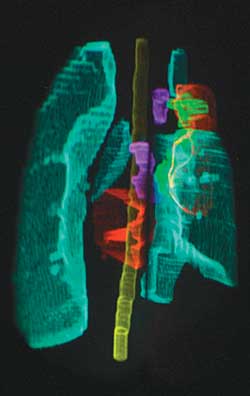
The Perspecta® Spatial 3D System from Actuality Systems Inc. creates a floating,
hologram-like image from any information you send it, even data from CT scans.
Unlike similar imaging devices, it doesn't require special viewing goggles.
Instead, the device is an enclosed glass sphere mounted onto a black base. The
sphere fills with fog as a rapidly rotating laser spins a multi-color image that
can be viewed 360 degrees horizontally and 270 degrees vertically.
"Essentially, we load up all of the patient's information on this 3-D system
and then have the patient sit down with us to look at where the tumor is, look
at where the normal tissues are, and look at how the radiation dose is covering
the tumor and not covering the normal tissue," Chu said. "One patient liked it
so much, the next day he brought his wife and kids over to see it."
Chu said the ability to better inform patients on their condition sets their
minds at ease and makes them more cooperative, resulting in better treatment.
For example, one patient being treated for head and neck cancer couldn't see the
harm of a little movement during radiation therapy despite Chu's warnings. The
patient argued that sitting still for so long caused his neck to be sore.
"We tried to explain to the patient that when we deliver treatment, it's
important for them to hold still because you want to stay away from the salivary
gland," he said. "We were able to show him how close the salivary gland is to
the tumor, how close the high radiation dose line is from the salivary gland,
and how big of an effect would a two-millimeter movement have."
Important Gains, However You Slice It
Usually, when patients
receive a CT scan, doctors must individually evaluate hundreds of
two-dimensional image slices, often going back and forth through the data for
several days in order to get a clear picture of the patient's condition.
"It takes quite a while to go through the slices and also when you go through
those slices, by the time you get to the last slice, you may not remember what
you saw at the beginning," Chu said. "How to integrate that information in your
head is now not that trivial. This particular device allows you to see the
entire distribution in 3-D, in just one view, so it is much more efficient and
much more correct in 3-D visualization."
Chu feels the device has proven very useful, but it still hasn't reached its
full potential. He has consulted with Actuality to develop additional tools
necessary to expand its capabilities. One example he gave was the need for a 3-D
ruler to measure areas of radiation treatment. "For example, on this particular
3-D display you find out that the radiation dose is not covering the tumor, and
you need to know how much of the tumor is not being covered," he said. "So you
need to have a way to go in there to measure the 3-D distance between the
radiation high dose surface and the edge of the tumor. And once you know the
distance, you'll be able to change your treatment plan to provide better
coverage."
Currently, the device takes a few moments to load up an image, making it
impossible to use it in real-time treatment applications, Chu said. However, the
company is addressing this problem in newer models, he said, and thinks someday
the necessary processing speed and software will be available to use the device
to guide treatment.
"If you are treating a lung tumor, the tumor does not sit still," Chu said.
"The tumor moves with every breath the patient takes, so we're trying to shoot a
moving target. But how does the target move during treatment? It's very
important for us to know."
Other Applications
The device is also being used as a tool in the
oil and gas exploration industry, in geology, and even by the military. But as
advances are made to the device, Chu said, he sees it finding an ever-expanding
role in the medical field. "I've shown it to cardiologists and neurosurgeons,
and they're all excited about it," he said. "In the future, I wouldn't be
surprised if this kind of device will find some applications in the operating
room, as well."
This column appeared in the February 2006 issue of Occupational Health
& Safety.
This article originally appeared in the February 2006 issue of Occupational Health & Safety.