I Think It's Mold! (Now What?)
What kind of risks does mold growth pose to an organization? How should those risks be assessed?
- By Alfred C. Draper III
- May 01, 2005
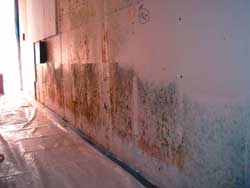 "I don't see what the big deal is. It's just a little mold."
"Oh, no! We have mold problems. This is bad, real bad."
Which of those two reactions is appropriate, given the risks associated with mold and the context of the various challenges industrial hygienists and occupational health professionals deal with every day? The answer, for those of us who pride ourselves on good science, risk assessment, and safety and health programs, is "Neither of the above." The answer can be found in having a complete understanding of mold causes and risks, assessing the specific risks, and responding in a timely, efficient manner.
Understanding the Risks
So just how hazardous is mold, and what are the real risks to a facility and its occupants? Here's what we know: Mold is naturally occurring fungi that can thrive wherever moisture is present, especially in combination with poor ventilation and humidity above 60 percent. As an allergen, mold can be particularly troublesome for the elderly, the very young, and those whose immune systems are already compromised by illness or disease. In general, mold should be of greatest concern in schools, day care centers, nursing homes, hospitals, and apartment buildings. According to a 2002 study, as many as one-fourth of all occupational asthma cases may be related to exposure to mold or mold spores.
The hype about mold peaked during the late 1990s. It helped to focus attention on the issue but also scared people unnecessarily. Fears about "toxic" mold and "black" mold may have been good for business, but there is little value in talking about "toxic" mold because that implies there is "non-toxic," health effects-free mold. The reality is that the impact of mold is generally believed to be dose-related: The more exposure you have, the greater the potential health effects--although the dose-response relationship is not well-established and there can be wide variations in people's symptoms.
In our experience as a large environmental contractor, the bottom line on the health effects of mold is this: Mold can be a significant health hazard, especially to sensitive populations, and any risk assessment and corrective action must take into account the severity of the problem and the impact on workers, residents, and visitors.
Other Reasons to Respect Mold
However, health impact should be only part of the equation in understanding the risks and the importance of risk assessment and corrective action. Other reasons to respect the mold include the structural integrity of buildings, aesthetics, insurance premiums, and resale value. Mold is a parasitic saprophyte, which means it cannot manufacture its own food; instead, it derives its nutrients from the materials on which it is growing. As a result, mold is capable of causing significant structural damage to buildings.
Given the health and non-health risks, mold deserves the attention of industrial hygienists, occupational health professionals, and facility managers. This is no time to panic, however.
Sources of Moisture and Mold
Mold can be found almost anywhere; it can grow on virtually any substance, wherever moisture is present. Where mold is a concern, it must be cleaned up and moisture sources eliminated and ventilation improved, or the problem will get worse. Naturally occurring hazardous materials do not correct themselves over time; they feed off existing conditions unless there is appropriate intervention.
Moisture can enter and spread throughout a facility through various sources, both internal and external. A thorough understanding of these sources can help organizations identify the best prevention and control measures. Leaks are the most common source of moisture in facilities and can be found in pipes, roofs, and ceilings and around walls, windows, or doors. A leak can be an entry point for moisture through internal (pipes) or external (rain) sources.
Internal sources of moisture can appear to be so routine and mundane that the resulting mold may go unrecognized and grow insidiously for years. Sometimes, the introduction of external moisture sources accelerates mold growth and exposes long- and short-term problems.
During new construction and renovation, contractors should consider moisture when prioritizing their tasks. Buildings should be thought of as integrated systems, not individual components. Failure to appreciate this reality often manifests itself in the form of construction defects. If the water-shedding ability of a structure is inadequately designed or constructed, for example, there is no hope for a dry facility. Other typical design and construction defects include mold growth between walls, where the roof meets the walls, around windows and skylights, and when contractors do not allow concrete and wallboard joints to dry completely before applying finishing materials.
A natural disaster such as a hurricane is the worst-case scenario for the introduction of external sources of moisture. For example, based on our experience with hurricane response in Florida last year, wind-driven rain is especially dangerous because it penetrates deep into building materials and allows mold to grow from the inside out. In these cases, significant mold growth can occur in as little as 48 to 72 hours, especially in warm, humid climates.
Assessing and Addressing the Risks
Given the problems mold can cause for both a building and its occupants, organizations must be prepared to address moisture and mold issues. How do you get started with a risk assessment for mold? The simple answer is to investigate likely sources and areas for moisture. Where there is standing water, high humidity, a leak, or poor ventilation, mold is probably not far behind. Your local climate and current weather conditions are also important factors. The basic senses--sight, hearing, smell--are good risk assessment tools:
- Look for mold around pipes; drains; windows; in dark, damp areas; and in poorly ventilated areas.
- Listen to employee comments about spills and moisture, and keep track of any patterns of complaints about indoor air quality and allergies.
- Smell the air around you. If it's damp or stale, you could have a significant mold or moisture problem, although it may be hidden just below the surface.
Here are some additional tips for dealing with these problems efficiently and effectively:
- Form a multidisciplinary risk assessment team that includes the facility manager, operations manager, director of maintenance, health and safety director, and others as appropriate.
- Inventory physical and operational areas of risk as cited above (e.g., parts of building most susceptible to leaks and flooding). Take into account both internal and external sources of moisture, and give special consideration to environmental hazards.
- Consider partnering with an outside contractor to conduct an extensive risk assessment. In some states, including Oklahoma and Texas, in certain types of buildings, the contractor who performs the risk assessment cannot also do the remediation work. While such rules are in place to protect property owners, they add a level of complexity to the risk assessment and mitigation process.
- Develop moisture-prevention standards and procedures for evaluating risks--including an HVAC maintenance program, procedures for selecting building materials, construction/renovation inspections, and action plans for natural disasters.
Beware of a risk assessment program that relies heavily on air sampling. Many industrial hygiene programs benefit from quantitative air sampling and analysis. With mold, there are no exposure limits, and sampling techniques have not been standardized. Furthermore, the presence of moisture and other mold risks is a reasonable predictor of a mold problem. In other words, air sampling is often neither effective nor required for assessing mold risks.
Mold Remediation: Priorities and Precautions
If mold is found, the next step should be to make risk-based determinations of which remediation measures and precautions are necessary. The level of mold remediation depends on the severity of the problem and the current and potential impact on the building and its occupants.
In simple terms, the mold remediation process should go something like this: Stop the moisture, contain/isolate the moisture, dry and filter the affected area, remove components that cannot be dried, kill the bacteria with disinfectants and sanitizing agents, clean the area, re-clean the area, prevent future moisture intrusion. Despite such clear best practices, I continue to be amazed by organizations that invest in cleaning up existing mold without eliminating moisture problems.
Borrowing from best practices for infection control in health care facilities, our company has found mold remediation projects can be separated into four classes (from low impact/low risk to major projects).
Classes I and II are relatively easy to initiate and can be completed rather quickly with minimal impact on building inhabitants. Class I, for example, requires basic good housekeeping procedures such as minimizing dust, using drop cloths, and cleaning up with HEPA-filtered vacuums. Class II is somewhat more intensive, including using EPA-registered disinfectants, containing construction waste, and limiting access to work areas.
Classes III and IV require significant long-term control measures. For Class III remediation projects, we recommend the following:
- Remove or isolate the affected area's HVAC system to prevent contamination of duct system.
- Erect hard critical barriers (i.e., sheetrock, plywood, plastic) to seal off the mold work area.
- Require everyone entering the work area to wear personal protective equipment, including full-body coverings (disposable), gloves, and half-mask HEPA filter respirators.
- Contain remediated waste before transport in tightly covered containers.
- Clean and decontaminate all equipment and protective equipment prior to final wipe-down of the area.
- Class IV projects require all of the above, plus measures such as:
- Cover all structures and equipment not being cleaned or removed.
- Wear rubber boots and full-face respirators (for remediation workers), in addition to the full-body coverings and gloves mentioned above.
- Construct a decontamination facility and require all personnel to pass through it before leaving work site.
- Conduct exterior air monitoring throughout the duration of the project.
- Consider evacuating high-risk individuals adjacent to the area, at least during the most hazardous portions of the project (i.e., during large-scale demolition).
Mold remediation is generally a labor-intensive process, but science and technology can also make a difference. HEPA-equipped air filtration units are used to maintain negative air pressure within the work area. In addition, disinfectants and sanitizing agents can include substances such as sodium hypochlorite and acids, and anti-fungal coating compounds utilize calcium hydroxide and various biocides. Emerging technologies for severe mold problems include gamma radiation, high heat, and chlorine dioxide ("dry gas").
Once you identify the problem areas and assess the severity and urgency of the situation, the response will be much more effective and efficient and the results long-lasting.
This article appeared in the May 2005 issue of Occupational Health & Safety.
This article originally appeared in the May 2005 issue of Occupational Health & Safety.