Conditioning the Air
From football fields to foundries, fog fans offer a solution for coping with the harshest heat conditions.
 The fog comes
on little cat feet.
It sits looking
over harbor and city
on silent haunches
and then moves on.
--Carl Sandburg, "Fog" (1916)
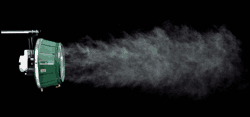
A lesser-known fact about the Pulitzer Prize-winning Sandburg is that he knew at least as much about heat as he did fog. The one-time fireman would probably not have been surprised by today's use of industrial fogging systems to prevent heat stress, but had he seen the systems in action, witnessing the high-powered injection of atomized water particles into the atmosphere of a hot work environment, he might well have modified his famous metaphor, for the fog propelled from these machines at up to 50 miles per hour conjures more the muted roar of a lion than the little feet of a cat.
If you've visited an amusement park or outdoor fair in recent years, you've likely encountered with relief the misting stations that are something like the distant cousins of these fogging systems. Heat is by far the number one source of illness and injury at theme parks, largely because visitors often aren't acclimated to the extreme temperatures or aware until it's too late how vulnerable their bodies are to the conditions. Strategically placed misting stations combat such conditions by offering walk-through cool-down opportunities.
Hit and Mist
Like fogging systems, the misting stations rely on evaporative cooling to work, spraying fine mist into the atmosphere where it flash evaporates, removing heat. Every gram of water that evaporates absorbs about 540 calories of heat from the air, making for cooler temperatures in the immediate area of the stations; if the mist contacts an individual's skin, that same amount of heat is removed directly from the body.
This is, of course, a welcome effect on high-heat days at the park, but it typically does not offer the kind of conditions under which you could or would want to work. The difference between mist and fog is all in the size of the water droplet. Mist droplets are large enough to settle out in a few seconds and will wet the surfaces on which they land. Fog droplets are almost invisibly small (10 microns or smaller) and will remain suspended for several minutes, causing no wetness when properly applied. Aside from their respective droplet outputs, the difference between misting stations and fogging systems has primarily to do with pressure.
"It's different kinds of pressure, different kinds of atomization, different sizes of nozzles," said Mark Finewood, vice president of sales and marketing for Blythewood, S.C.-based Patterson Fan Inc. Although some fogging systems operate without nozzles, dispersing water via centrifugal force right out of a fan's blades, most systems function through use of nozzles situated in rings on the face of a fan. Whereas misting nozzles generally operate at standard domestic water pressures of 45 to 65 pounds per square inch (psi), fogging systems incorporate high-pressure pumps and impeller-driven nozzles that reach up to 1,000 psi and blast the fog out at up to 22,000 cubic feet per minute. Higher-end systems employ concentric rings of the nozzles that serve to stage the fog, allowing an increase or decrease in fog output as humidity levels change.
"When a fan's velocity grabs a droplet that's already atomized and then smacks it with that much air, it just kind of shatters it, and it evaporates," Finewood said. "People try to make it more complicated than it is. It's not rocket science, but it is an effective way to remove heat out of the air. The key is air exchange. If a building has sufficient air exchange, proper ventilation, then fog fans will cool the environment, guaranteed."
Fog on the Field
Ventilation is not the issue outdoors, but, often, having an airstream that is cooled and blowing over the body is very much an issue. This is why the National Football League has become one of fog fans' more visible proponents, with fog systems set up near sideline benches almost as ubiquitously as barrels of thirst quenchers. Jim Anderson, head athletic trainer for the St. Louis Rams, said heat stress prevention is a primary consideration for the league as a whole and its use of fog fans, along with education about effective hydration, is part and parcel of players' on-the-job safety.
"We're just trying to create a cooler environment for our players however we can," Anderson said. "Once our schedule comes out in May, I look down it and see where games with potential heat problems are, and I'll usually order [fog fans] just to have them available, because you never know what kind of temperatures you're going to get. You know, when you go to Arizona or down to Houston, Tampa, Miami, or some of those other outdoor stadiums in the South, it's nice to have equipment like that."
Four years ago this August, 27-year-old Minnesota Vikings offensive tackle Korey Stringer died from heat stroke after collapsing during the team's second day of training camp. Anderson said that afterward the NFL "put a full-on blitz" of heat stress awareness. "We didn't change anything as far as what we were doing, but it did make everybody more alert to watching for and avoiding any heat problems," he said. Anderson noted that while professional football might seem like a uniquely extreme example, any work environment involving high temperatures is a source of potential problems.
Federal statistics agree. Even though the dangers of heat stress are well known, every year injuries, illnesses, and fatalities among workers are caused by excessive heat exposure. According to the Bureau of Labor Statistics, an average of more than 2,500 heat-related lost workdays have happened annually since 2001, and between two and three dozen heat-related worker deaths per year have occurred in the same time period. In the general U.S. population (including infants and the elderly, the most vulnerable groups), an average of 200 people die annually from heat.
Fanning Out
OSHA does not have a specific regulation covering heat stress hazards, but it does make recommendations for avoiding them, chief among which are hydrating properly; allowing acclimatization, in which lighter workloads and longer rest periods are assigned for the first five to seven days of intense heat; wearing lightweight clothing or cooling garments; alternating work and rest periods, with rest periods in a cooler area; and using general ventilation and spot cooling at points of high heat production, which allows airflow to increase evaporation and cooling of the skin.
The CDC, NIOSH, and other federal agencies offer similar recommendations. On its Web site, CDC says, "Air-conditioning is the number one protective factor against heat-related illness and death," and on its site, NIOSH notes, "One of the best ways to reduce heat stress is to minimize heat in the workplace," adding that it recognizes there are some work environments where heat production is difficult to control.
A case in point is the Portland Truck Manufacturing Plant in Portland, Ore., a 500,000-square-foot facility where Class-8, heavy-duty trucks are built from the frame up. According to plant safety manager Ken Coppler, using refrigerated air conditioning is not a viable option for most of the plant's operations, which include 130- to 150-degree paint-cure ovens, mezzanined build-up areas, and other zones in which extremely hot metal parts increase ambient temperatures. He said that after years of trying various methods of cooling the plant, he ultimately decided to follow the NFL's lead.
"I noticed [fog fans] being used on the sidelines of an NFL game--that's where I got the idea--and went to an online search engine," he said. After contacting a manufacturer who agreed to install a fogging system for a trial run, the Portland plant decided to buy the system. Now, three years later, it uses 30 fans throughout the facility.
"We have 1,800 employees on the floor," Coppler said. "In the past, especially up in the mezzanine areas, we've had people have to come down and visit our occupational health nurse. We've never had anyone suffer heat stroke or anything life-threatening like that, but we have had people suffer nausea, fatigue, and cramping, and when that happened we would let them rest and give them electrolytes, and they would cool down. But now that we have the fog fans, we haven't had any of that. We still do heat stress training every year, which is required in these heated areas, but we don't have the heat-induced illnesses that we used to get."
Similarly, Matt Miller, general manager of Rotonics Manufacturing Inc., a manufacturer of rotational moldings, said the process in his 30,000-square-foot Las Vegas plant involves large, 600-degree ovens opening and closing every 18 minutes, and it is not amenable to standard air conditioning. "Just the logistics of being able to cool a factory like this with air conditioning would be astronomical," he said. "They would have to put in a power plant across the street from here just to support it."
He described the work environment within the plant as essentially that of a foundry. "The ovens have circulating fans that keep some of the heat inside them," he said, "but heat does escape, that's for sure, and the place gets very, very hot. Being in Las Vegas, during the summer it can easily be 110 outside, making it around 120 inside, in the work area."
He said Rotonics has used a fogging system for three years and has experienced temperature reductions with it of up to 30 degrees. "It works well enough to where when our guys are working out here hard, they won't stand in the aspiration because it's too cold. If you stand in front of it, even if it's 120 degrees on the floor, you'll get goosebumps. But productivity has definitely increased because they're not getting overheated. It's made a world of difference."
Foggy, Not Soggy
When he was introduced to the idea of using fog fans, Miller said he was initially wary, having had previous experience only with misting systems. "I thought they would soak everything," he said. "For our molding process, we can't have moisture getting in the plastic--if it does, we have all kinds of problems--but because of the way these fans work, with the high-pressure compressors and air-aspirated nozzles, we haven't had any kind of a problem. We do have to make sure to keep the nozzles clean and cleared of deposits, because Vegas water is very, very hard. But, outside of that, just doing standard maintenance--changing the oil and filters regularly--keeps them working the way they're supposed to."
Like the Rotonics plant, Temple Inland Forest Products Corp., a Dequincy, La.-based manufacturer of dimension lumber, uses forklifts in its operation and must keep its floors dry. Safety manager Scott Stubblefield said the fog fans Temple installed about four years ago keep the floors both dry and clear. "We like these fans because we can run multiple satellite units off of one pump, and we can have the whole system up out of the way," he said. "They're convenient, they fit into our process without disturbing our traffic flow, and they provide heat relief for our employees. You know, down here in southern Louisiana, 90-degree weather is not uncommon during summers, and the humidity is certainly a factor. We've run tests on the fans and are seeing temperature reductions anywhere from 6 to 10 degrees, which is significant."

By introducing moisture into the air, fog fans are creating humidity, which has led some to the mistaken idea that fog fans are not effective in humid environments. Temple's 6- to 10-degree cooling using fog may seem drastically less, for example, than the 30-degree cooling Rotonics reported in its arid climate using the same system. In fact, as Cool Zone USA President Bill Falkenstein explained, although the dynamics are different, fogging systems do cool in both climate extremes. "You get a cooling effect merely by circulating hot, humid air precisely because of the moisture it contains," he said. "Some evaporation will take place just in the air's movement. But you can't cool people by blowing 120-degree/5-percent-relative-humidity air around. That's why it's critical to stage the fog: As it gets hotter and dryer, you can add more water to the airstream, and as it gets cooler and more humid, you can adjust the amount of water in the airstream back to the point that maybe you're just using the fan to circulate the air. The key is to move a lot of air and then to make that air cool down by evaporating water. . . . Relative humidity is easily controlled with ordinary air circulation systems. You can work with it and will still get cooling without wetting."
Special Fog Effects
Simple humidistats, whether tied electronically to the fogging system or operated manually, often are used to maintain ideal relative humidity levels, which for indoor work environments are normally from 35 to 40 percent. Many industries--paper, wood, leather, and textile mills, for example--employ fogging systems as much for their humidification as for their cooling. Some companies reported using the systems primarily for dust abatement and static electricity control, seeing their functions as heat stress preventatives as almost secondary.
Shawn Catterlin, operations manager at Gibson Guitar's Montana division in Bozeman, said controlling the humidity in his plant is crucial and something he achieves by maintaining air movement and using a hybrid system of fog fans and swamp coolers. "We manufacture acoustic guitars here, so I have to keep the plant at about 40 percent relative humidity to keep the guitars from cracking," he said. "We can live at 35 [RH] real easily, but if it drops down to about 29, some of the guitar tops start sinking and the ribs start cracking, which is obviously not something you ever want to happen." In addition to their cooling and humidification, the fog fans notably neutralize odors from the plant's processes, he said.
Fogging technology advancements in recent years have given rise to a proliferation of portable, wheeled units that are designed specifically for spot cooling people and machinery. "Say the worst-case scenario happens," Falkenstein said, "and you have somebody already suffering from heat stress. Bringing that person near the fog, letting it blow on him, will cool him down and help resuscitate him faster than any other way I know."
Darren Figart, president of Jaybird Manufacturing Inc., said to think of it this way: "Mother Nature can cool down a whole entire state in a matter of 10 to 15 minutes, and the storm front or cold front that is bringing that temperature down is usually a combination of moisture and evaporative cooling coming in. Fog systems, in effect, create a microclimate of that. They're used for conditioning an air space anywhere heat needs to be removed from the environment."
This article appeared in the May 2005 issue of Occupational Health & Safety.
This article originally appeared in the May 2005 issue of Occupational Health & Safety.